A federal judge in Rhode Island on Friday praised President Donald Trump’s “quick and definitive response” to a ruling concerning Supplemental Nutrition Assistance Program (SNAP) benefits, saying the president’s action was “greatly appreciated.”
In a footnote, the court specifically noted Trump’s role, commending his efforts to ensure the timely distribution of the program’s funding.
“The court greatly appreciates the president’s quick and definitive response to this court’s order and his desire to provide the necessary SNAP funding,” U.S. District Court Judge John J. McConnell Jr. wrote in a court order on Saturday.
Roughly 42 million Americans—about one in eight—depend on food stamps each month, using electronic benefit cards to buy groceries. Advocates warned that any delay or reduction in payments could have severe consequences for families who rely on the program to meet basic needs.
Advertisement
McConnell, an Obama appointee, ordered the USDA to guarantee that full SNAP benefits for November are delivered to recipients by the end of Monday, November 3, or that partial payments be issued no later than Wednesday, November 5.
“There is no question that the congressionally approved contingency funds must be used now because of the shutdown,” the judge claimed, though Agriculture Secretary Brooke Rollins said the law is clear – contintency funds can only be used when the program is fully funded and only in natural disasters.
“In fact, the president during his first term issued guidance indicating that these contingency funds are available if SNAP funds lapse due to a government shutdown,” McConnell added.
Funding ran out Nov. 1 thanks to the Democrat-led government shutdown. It’s not clear whether the administration will appeal or seek clarification from the U.S. Supreme Court.
Meanwhile, in Boston, U.S. District Judge Indira Talwani, an Obama appointee, ruled that the USDA must continue issuing SNAP payments, calling the suspension of the program “unlawful.”
Pollster Matt Towery, meanwhile, said Friday on Fox News that Democrats’ attempt to spark outrage over interruptions to the Supplemental Nutrition Assistance Program (SNAP) is beginning to backfire.
As the government shutdown continues, Democrats are still blocking a temporary funding measure — a move that’s now threatening food aid for more than 40 million Americans.
Appearing on “The Ingraham Angle,” Towery argued that Democrats badly misjudged public reaction by trying to weaponize the program’s funding lapse for political gain.
“I think the public is just now beginning to hear the information about how many people who are receiving food stamps, who simply are not from this country and came into the country illegally. And I think as more of this information comes out, you’ll see more resentment for that aspect,” Towery told host Laura Ingraham.
“Now there’s always been a sympathy among voters for the social safety net. And I just want to add one thing about what the Democrats were doing.”
Towery said Democrats’ plan to use the food stamp disruption to fuel public anger may have the opposite effect of what was intended.
“I don’t know that these decisions by these judges are helping them because the Democrats really wanted people to not get this assistance and be up in arms and very upset, and cause more turmoil over the next week,” Towery added.
“And these judges have stepped in and said, ‘Oh well, we think we’re going to feed you. How we’re going to do it. I don’t quite know.’ I do think that we’re seeing a change in public opinion towards all of these benefits,” he added.
Towery noted that a subtle political realignment is taking place. He added that younger Americans entering the workforce are beginning to rethink their views on government assistance programs.
“There’s a slow shift. You won’t see it from the legacy pollsters, and you won’t hear from the legacy media. But the country is beginning to shift. And I think it starts with the youngest of voters, the ones who are having to get out there and make money and find jobs,” Towery said.
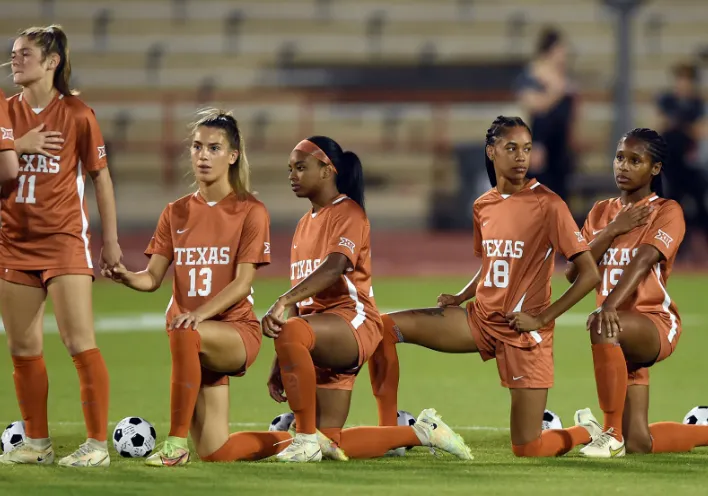
A student at the University of Texas was allegedly expelled on the spot after choosing to kneel during the national anthem at a major school event, sparking an immediate firestorm of controversy, debate, and national outrage.
The incident reportedly occurred during the opening ceremony of a UT Longhorns football game this past weekend. According to eyewitnesses, the student — a sophomore majoring in sociology — quietly took a knee as the “Star-Spangled Banner” played, in what appeared to be a peaceful protest. Moments later, security escorted the student out of the stadium.
But what happened next stunned both students and faculty: by Monday morning, the university administration had allegedly issued an official expulsion notice, citing “actions unbecoming of a representative of the university” and “disruption of school values.”
Social media exploded overnight. Hashtags like #UTExpelsForKneeling, #FreedomToProtest, and #FirstAmendmentFail trended nationwide. Celebrities, activists, and politicians weighed in, with some calling the university’s decision “outrageous” and “deeply un-American.”
“This is not about disrespecting the flag — it’s about demanding justice,” tweeted one user. “Expelling a student for expressing their beliefs peacefully? This is fascism disguised as discipline.”
Civil rights organizations, including the ACLU and NAACP, have already announced plans to investigate the incident and offer legal support to the student.
However, the university’s official response added more fuel to the fire. In a now-deleted statement, a UT spokesperson claimed the expulsion was “in line with campus conduct standards” and aimed at preserving “unity and institutional integrity.”
Still, critics aren’t buying it.
“This is a disgrace to higher education,” said Dr. Elaine Brooks, a professor of political science at the university. “Colleges are supposed to be the breeding ground of free thought. Expelling someone for peaceful protest sets a terrifying precedent.”
As of Thursday, student protests have erupted across the UT campus, with hundreds marching, chanting, and demanding the student’s immediate reinstatement. “We kneel with them,” read banners across the main square. Classes in several departments were canceled as students organized sit-ins.
Meanwhile, some conservative commentators have praised the university’s bold stance, arguing that “discipline and patriotism must come before activism.” But the backlash appears to be far greater than the support.
Legal experts say the university could face a massive lawsuit on constitutional grounds, especially if the expulsion is verified as retaliation against a First Amendment-protected act.
So far, the expelled student has not spoken publicly but is reportedly consulting with legal counsel.
As tensions continue to mount, the University of Texas finds itself at the center of a fierce national debate: where do we draw the line between protest and punishment — and who gets to decide?
A Bolt from the Blue: Gurgaon’s Park Turns Into a Scene of Horror
What started as a calm afternoon in a Gurgaon park spiraled into a terrifying display of nature’s raw power. The sky darkened, winds howled, and in a split second, a searing bolt of lightning split the heavens. Witnesses describe the moment as surreal—an explosion of light and sound that seemed to zero in on four unsuspecting men huddled beneath a solitary tree.
A gaping sinkhole measuring 30 by 30 meters and more than 15 meters deep suddenly opened up in front of Vajira Hospital in Bangkok’s Sam Sen district at 7:00 a.m. on September 24, sending shockwaves through the capital as dramatic video footage captured the moment the road collapsed.
Though no one was injured in the incident, the spectacular collapse has reignited safety concerns about the city’s ambitious infrastructure projects. The timing is particularly sensitive, coming just months after a devastating March 28 earthquake that brought down a State Audit Office building under construction, killing at least 92 people.
Advertisement
Bangkok Governor Chadchart Sittipunt quickly identified the culprit behind the dramatic road failure. The collapse stemmed from soil flowing into the Purple Line subway tunnel construction running beneath the area. This massive underground project stretches from Parliament through Sam Sen, tunnels under the Chao Phraya River, and continues toward Suksawat.
The disaster struck at one of the most complex points along the route—the future Vajira Hospital station. Here, engineers are building an intricate network of tunnels and underground spaces, with two opposing tunnels at different depths: one reaching 15 meters down, the other plunging 30 meters below ground. The station itself sits 30 meters underground, connected by a web of tunnels.
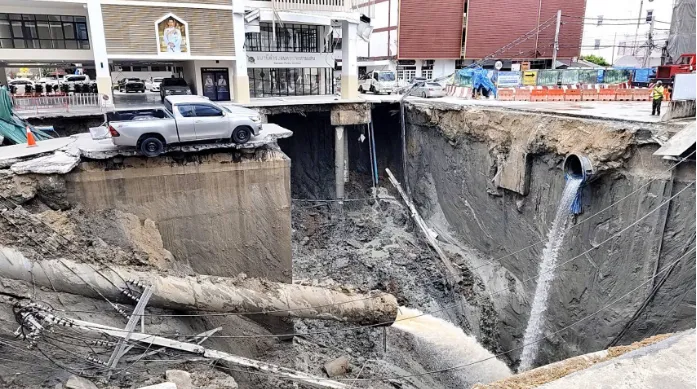
The massive sinkhole in front of Vajira Hospital in Bangkok on September 24, 2025, caused by soil flowing into the Purple Line subway tunnel construction beneath the road surface.
According to Governor Chadchart, the trouble began when the shallower tunnel developed cracks at a critical joint.
“Soil above began flowing into the tunnel and the underground construction spaces,” he explained. “This caused the road surface to collapse, dragging down electrical poles and rupturing water pipes. The broken pipes then washed even more soil into the tunnel, making the situation worse.”
The collapse immediately transformed the busy intersection into a danger zone. Traffic authorities shut down the Vajira Hospital intersection through Sang Hi intersection and sealed off surrounding areas as the damaged road surface threatened nearby infrastructure and posed serious risks to anyone passing by….
Railway officials moved swiftly to contain the crisis. The State Railway of Thailand ordered an immediate halt to all Purple Line construction in the affected area while investigators work to determine exactly what went wrong.
Construction barriers went up around the site, and authorities began evacuating residents from nearby buildings as a precaution.
Close-up view inside the massive Bangkok sinkhole exposes the Purple Line subway tunnel construction with concrete walls and a broken water main flooding the excavation site with sediment-laden water, illustrating the infrastructure damage that led to the road collapse at Vajira Hospita on September 24, 2025.
“The current situation of concern involves the Sam Sen Police Station and shophouses that remain in the danger zone. We must control access and keep people out of a 100-meter radius from the landslide point,” Chadchart warned. “The next concern is rain, because if it falls, it will cause soil erosion and increase landslides. The Drainage Department will expedite drainage work while MRTA rushes to seal the tunnel.”
The governor emphasized that weather conditions could significantly worsen the situation, making rapid response efforts critical as teams work around the clock to stabilize the area and prevent further collapses.
The massive sinkhole in front of Vajira Hospital in Bangkok on September 24, 2025, caused by soil flowing into the Purple Line subway tunnel construction beneath the road surface. (KHAOSOD Photo/Yingyos Akmanachai)
The incident forced Vajira Hospital to make difficult operational decisions. The medical facility, part of Navamindradhiraj University’s Faculty of Medicine, announced it would suspend all outpatient services for at least two days. This includes primary care clinics and specialty services, though the hospital continues treating patients already admitted for inpatient care.
The sinkhole has become a stark reminder of the challenges Bangkok faces as it races to modernize its transportation network while managing the risks that come with major underground construction in an densely built urban environment…. อ่านข่าวต้นฉบับได้ที่ : https://www.khaosodenglish.com/news/2025/09/24/bangkok-governor-reveals-massive-sinkhole-caused-by-subway-construction/
For months, former Vice President Mike Pence had been wrestling with a truth that he had long tried to suppress—a truth that, despite his hopes, refused to be silenced. It was a burden he carried privately, cloaked behind a calm demeanor and unwavering professionalism. But now, standing beneath the harsh lights of the press room, facing a sea of cameras and expectant eyes, he could no longer delay the inevitable.

His expression was somber, marked by the fatigue of sleepless nights and the silent weight of introspection. As he approached the podium, a hush fell over the room. Gone was the familiar confidence in his posture; in its place stood a man visibly shaken, bearing the heaviness of what he was about to say. His voice, usually measured and steady, quivered with restrained emotion. Tears welled in his eyes, a reflection of the personal toll the moment demanded. He paused, drawing a deep, trembling breath before speaking—each word carefully chosen, each syllable laced with sorrow.