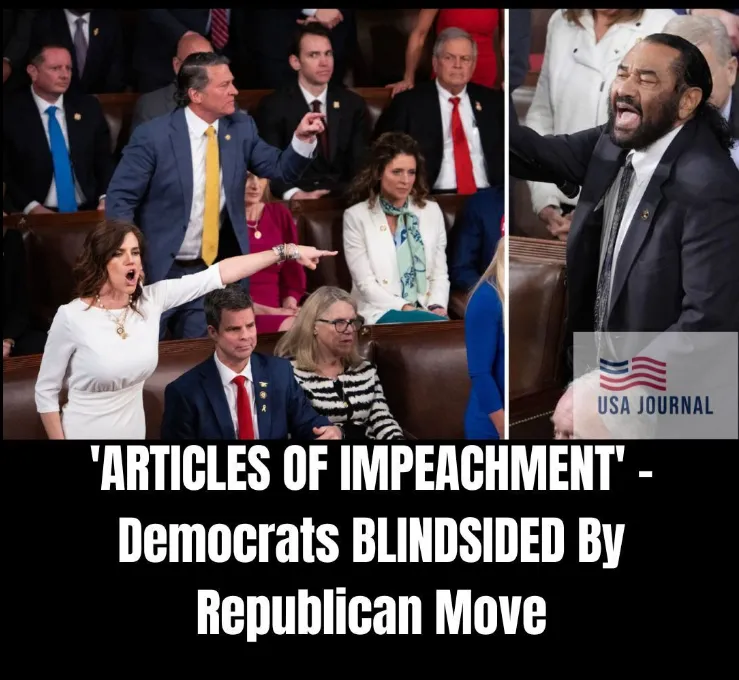
Republican Congressman Brandon Gill of Texas has officially dropped the hammer — filing articles of impeachment against U.S. District Judge James Boasberg for his central role in the Biden administration’s surveillance scandal, Operation Arctic Frost.
Boasberg was the judge who rubber-stamped the subpoenas that gave Special Counsel Jack Smith the green light to spy on Republican lawmakers — a breathtaking abuse of power that reads like something out of an Orwell novel. This wasn’t oversight. It was overreach:
“Chief Judge Boasberg has compromised the impartiality of the judiciary and created a constitutional crisis. He is shamelessly weaponizing his power against his political opponents, including Republican members of Congress who are faithfully serving the American people within their jurisdiction,” Rep. Gill told
Fox News Digital.
“Judge Boasberg was an accomplice in the egregious Arctic Frost scandal where he equipped the Biden DOJ to spy on Republican senators. His lack of integrity makes him clearly unfit for the gavel. I am proud to once again introduce articles of impeachment against Judge Boasberg to hold him accountable for his high crimes and misdemeanors,” he added.
The articles of impeachment charge Boasberg with one count of abuse of power, according to text obtained by Fox News.
“Ignoring his responsibility to wield the power of his office in a constitutional manner, Chief Judge Boasberg granted Special Counsel John L. Smith authorization to issue frivolous nondisclosure orders in furtherance of the Federal Bureau of Investigation project codenamed ARCTIC FROST,” the text read.“These nondisclosure orders covered Members of Congress who were acting in accord with their legislative duties and privileges guaranteed by Article 1, Section 6, Clause 1 of the U.S. Constitution.”
Article I, Section 6, Clause 1 of the Constitution couldn’t be clearer — members of Congress have the absolute right to speak, debate, and legislate without interference or intimidation from outside forces. It’s one of the bedrock protections against tyranny — and exactly what Operation Arctic Frost trampled over.
The trove of Arctic Frost documents released last month by Senator Chuck Grassley (R-IA) exposed just how far the Biden DOJ and Judge James Boasberg were willing to go. They revealed subpoenas for the phone records of 10 U.S. senators and one House lawmaker — along with gag orders to Verizon and AT&T instructing them not to alert the targets. Verizon quietly complied; AT&T refused.
What’s still unclear is what, if any, documentation Boasberg reviewed before greenlighting this outrageous violation of constitutional privilege.
In a stunning turn of events that captivated the nation, Vice President JD Vance intervened in a controversy sparked by Hollywood icon Tom Hanks. The situation escalated after Hanks made a seemingly mocking remark about conservative commentator Charlie Kirk just days after his tragic death. What began as a careless comment quickly transformed into a national debate over decency, grief, and the responsibilities of public figures, with Vance stepping in to defend Kirk’s legacy and challenge Hanks’s insensitivity.
Days after Kirk’s unexpected passing, Hanks took to social media, posting a message that many interpreted as a cruel jab at Kirk. Without mentioning him directly, Hanks suggested that America would heal faster without “loud voices silenced by their own hatred.” The comment ignited a firestorm of backlash, with many feeling that Hanks had taken advantage of Kirk’s death to score political points. For those mourning Kirk, the remark felt like a personal affront, an insult hurled at a man who could no longer defend himself.
The reaction was swift and intense. Hanks’s longtime fans expressed disbelief, while others defended him, claiming his words had been misinterpreted. However, the broader sentiment was clear: what should have been a moment of collective mourning had been turned into a platform for political commentary.
As the outrage grew, commentators began to highlight a perceived double standard in Hollywood. If a conservative actor had made a similar remark about a liberal figure, the backlash would have been relentless, they argued. Major networks would have condemned the remark, and sponsors would have pulled their support. Yet, in this case, the silence from the entertainment industry was deafening.
Among those watching closely was Vice President JD Vance. Known for his unflinching defense of conservative values, Vance recognized Hanks’s comments not merely as an insult to Kirk but as a reflection of the deepening divisions within the country. Kirk was more than just a commentator; he represented a new generation of conservative voices willing to challenge mainstream narratives. Hanks’s words felt like salt in the wound for many who admired Kirk.
Vance waited for the right moment to respond, observing how the public reacted to Hanks’s comments. As hashtags calling for boycotts of Hanks’s films began trending, the pressure mounted on NBC, which had planned for Hanks to host an upcoming episode of Saturday Night Live. Executives debated whether to proceed with the show amid the backlash.
When Vance finally addressed the controversy, he did so with a measured yet powerful message. He articulated not only his defense of Kirk but also a broader call for decency in public discourse. Standing before the press, Vance began by reflecting on loss and the importance of honoring the dead with respect. He emphasized that Hanks’s comments were not just a political misstep but a stain on the fabric of American unity.
“This is not about politics,” Vance stated firmly. “This is about decency.” His words resonated deeply, framing the issue as one of humanity rather than partisanship. Vance’s calm demeanor contrasted sharply with the heated exchanges that had characterized the debate thus far.
Vance’s remarks quickly became a rallying cry for conservatives, who saw him as a voice of reason in a time of division. His assertion that “cruelty disguised as humor is still cruelty” struck a chord, emphasizing the need for compassion, especially in moments of grief. The media caught fire with clips of his speech, and social media buzzed with reactions, many praising Vance for his principled stance.
Meanwhile, Hanks found himself under increasing scrutiny. As the backlash mounted, he faced pressure from fans, colleagues, and sponsors. His representatives fielded calls from journalists seeking clarification, while friends urged him to apologize or at least provide context for his comments. Hanks, however, remained resolute, believing that his words had been misinterpreted and that he would weather the storm.
As the weekend approached, the tension continued to build. The controversy had transcended Hollywood and entered the national consciousness, with discussions taking place in homes, churches, and college campuses across the country. Vance’s words had reframed the conversation, shifting it away from mere political posturing to a fundamental discussion about respect and the responsibilities of public figures.
In an unexpected twist, Hanks agreed to participate in a live-streamed panel discussion that would include Vice President Vance. The announcement sent shockwaves through media circles, as many anticipated a direct confrontation between the two men. The stage was set for a high-stakes exchange that would draw millions of viewers.
As the panel began, the host wasted no time in addressing the controversy. “Mr. Hanks, what did you mean by your remark?” he asked, setting the tone for a candid discussion. Hanks responded carefully, insisting that his comments were not aimed at mocking Kirk but rather intended to highlight the anger and division in the country. However, Vance quickly pushed back, reminding Hanks of the timing of his words and the grief that Kirk’s family and supporters were experiencing.
The tension in the room was palpable as Hanks attempted to defend his position, but Vance’s calm yet firm demeanor cut through the noise. “When you frame a man’s death as a political lesson, you turn grief into a spectacle,” Vance asserted, making it clear that he would not allow Hanks to escape accountability.
As the discussion progressed, Hanks found himself increasingly on the defensive. Vance’s questions were incisive, challenging Hanks to consider the impact of his words on those mourning Kirk. In a pivotal moment, Vance leaned forward and asked, “If it were your loved one who had been taken, would you accept that explanation? Would you?”
The studio fell silent. Hanks opened his mouth to respond but fell short, momentarily speechless under the weight of the question. This moment marked a turning point in the discussion, with viewers recognizing the gravity of the situation. Hanks, usually quick with words, struggled to articulate a defense, and the nation took notice.
In the days that followed, the pressure on Hanks intensified. As public opinion shifted against him, he faced mounting calls for an apology. Finally, after a week of silence, Hanks released a written statement expressing regret for his remarks. “To the family of Charlie Kirk, I want to say clearly and without condition, I am sorry,” he wrote. “My comment was wrong in its timing, wrong in its impact, and wrong in how it was received.”
The apology was significant, marking a departure from his earlier stance. It spread rapidly across news outlets and social media, with many interpreting it as a long-overdue acknowledgment of the harm his words had caused. Vance, for his part, responded positively, stating, “It takes courage to admit fault. I hope this moment can remind all of us that compassion should always come before division.”
The national mood shifted almost immediately. For Kirk’s supporters, Hanks’s apology felt like a validation of their grief and a recognition of the pain caused by Hanks’s earlier comments. For Hanks’s fans, it represented a return to the decency they had long associated with the beloved actor.
The fallout from the controversy served as a reminder of the power of words and the responsibilities that come with public platforms. Hanks’s initial remark, intended as a critique of division, had spiraled into a national debate over respect and compassion. Vance’s calm persistence in calling for accountability resonated with many, reinforcing the idea that public figures must navigate the delicate balance between free speech and the impact of their words.
As the dust settled, the story of Hanks and Vance became more than just a clash between Hollywood and Washington. It evolved into a broader discussion about decency in public discourse, the importance of humility, and the need for compassion, especially in times of grief. The lessons learned from this confrontation will likely echo in future discussions about the role of public figures in shaping national conversations.
In conclusion, the showdown between JD Vance and Tom Hanks was not just a momentary spectacle but a significant event that highlighted the complexities of modern discourse. It reminded Americans that while freedom of speech is a cherished right, the responsibility to use that freedom wisely is equally important. As the nation reflects on this incident, the hope is that it will lead to a more respectful and compassionate public dialogue moving forward.
Conservative commentator Stephen Crowder is once again putting Rep. Ilhan Omar (D-MN) back in the spotlight, repeating claims that the congresswoman married her brother to help him immigrate to the United States.
“Here’s a fun fact. You married your brother!” Crowder said in a recent video, citing documents he claims to have reviewed. His remark reignited the long-running controversy that Omar has consistently dismissed as a smear campaign.
Crowder, who has made a career out of challenging the left, argued that the evidence surrounding Omar’s 2009 marriage to Ahmed Nur Said Elmi, a British citizen, raises serious red flags. “Marital records don’t lie,” he said.
Omar has repeatedly denied the allegations, saying in 2019: “These baseless rumors are absolutely false and offensive.” She has maintained that her marriage history is being weaponized by political opponents.
Still, conservative voices like Crowder remain unconvinced. “If it wasn’t her brother, why has she gone to such lengths to hide records?” Crowder asked his audience, pointing to gaps in Omar’s public disclosures.
Omar’s 2009 marriage ended in 2017 when she and Elmi officially divorced. The timeline has fueled speculation among critics who argue that the marriage was never legitimate in the first place.
“The evidence keeps piling up,” Crowder said. “And every time, the mainstream press looks the other way.” His frustration echoes the views of many on the right who believe the media has protected Omar from real scrutiny.
Omar herself has described the rumors as part of a larger racist and Islamophobic campaign against her. “It’s disgusting to lie about immigrants in this way,” she told the Star Tribune in 2019.
Yet critics note that Omar has avoided answering direct questions about her marriage history. “She’s dodged every attempt to get to the bottom of this,” Crowder said.
Conservative lawmakers have also pressed for clarity. In 2019, Rep. Steve King (R-IA) said: “If she didn’t do this, why not just provide the proof? If she did, the American people deserve to know.”
Omar’s defenders argue that the allegations are nothing more than conspiracy theories designed to delegitimize one of the first Muslim women in Congress. “This is a smear,” Omar said, insisting that the right is targeting her because of who she is.
Crowder isn’t buying it. “This isn’t about race. This isn’t about religion. This is about immigration fraud,” he said, accusing Omar of using identity politics as a shield.
The documents at the center of the controversy come from marriage certificates and school records tied to Omar and Elmi. Conservative outlets have long claimed these records suggest a familial relationship.
“When the paperwork doesn’t match up, when the timelines don’t make sense, the burden of proof falls on her,” Crowder said.
Omar’s spokesman told the Minneapolis Star Tribune in 2019: “There’s no truth at all to this story. This has been debunked multiple times.”
But as Crowder pointed out: “If it’s been debunked, where’s the evidence? Show us the DNA test. Show us the documents.”
Conservative frustration has only grown as media watchdogs refuse to pursue the issue. “They call everything a conspiracy theory,” Crowder said, “until it turns out to be true.”
The controversy gained traction in 2016 when blogger Scott Johnson of Power Line first raised questions about Omar’s marriage records. Since then, critics have pointed to inconsistencies that remain unresolved.
Crowder cited Johnson’s reporting in his video, saying: “These aren’t wild accusations. This is based on actual reporting, on records. Why won’t Omar face the facts?”
Omar’s defenders say the allegations rely on misunderstandings of Somali naming conventions and family structures. But critics argue that this explanation is evasive.
“If the explanation is that complicated, it usually means someone’s hiding something,” Crowder said.
Some Minnesota voters have expressed concern. “If she lied on immigration forms, that’s serious,” one voter told
Fox News in 2019.
Crowder insists that this is not a personal vendetta but a matter of integrity. “If a sitting congresswoman committed immigration fraud, the public deserves accountability,” he said.
Omar continues to reject the allegations, but the pressure from Crowder and other conservative voices shows no sign of slowing. “We’re not going to drop this,” Crowder declared.
The flight attendant, wearing a forced smile that barely masked her disdain, approached with a tray of drinks. The passengers around her barely noticed; they were too engrossed in their own comfort. When the woman in 3A requested water, the attendant rolled her eyes, an almost imperceptible gesture, but the tension in the air suddenly sharpened.
What followed was an act that would go down in aviation infamy. With a flick of her wrist, the attendant “accidentally” tipped a cup of orange juice, sending its contents cascading into the lap of the woman in 3A. Gasps of disbelief echoed through the cabin. The chill of the juice was nothing compared to the cold calculation behind the act. It was deliberate, and everyone knew it.
The woman in 3A didn’t flinch. Instead, she slowly rose from her seat, juice dripping from her designer suit. Her demeanor remained composed, but her eyes were alight with a fire that promised retribution. She calmly addressed the attendant, her voice steady yet filled with a quiet authority that demanded respect and attention.
“That was no accident,” she stated, her voice cutting through the cabin noise like a knife. “And I assure you, this will not go unanswered.”
Passengers watched in stunned silence as she reached for her binder. The documents inside were not mere reading material; they were a testament to her influence—detailed plans and financial charts of the very airline they were aboard. This was no ordinary passenger; she was an influential consultant hired to audit the airline’s operations, and she had the power to ground them with a single call.
She took out her phone, her fingers deftly navigating the screen, and began to type. The attendant’s smugness melted into panic as she realized the gravity of her actions. The passengers watched, spellbound, as the woman in 3A made contact with key stakeholders of the airline. Within minutes, the airline’s executives were aware of the incident, and damage control plans were being hastily activated.
The flight continued, but the atmosphere had shifted. Conversations buzzed with speculation, and the attendant, visibly shaken, made herself scarce. Passengers speculated on the potential fallout, aware that they were witnessing a pivotal moment that mingled justice with corporate accountability.
Upon landing, the woman in 3A was met by a team of executives, eager to apologize and offer compensation. But she was not interested in their money. Her demand was simple and sweeping: “Reevaluate your training programs and address the systemic biases that allow such conduct.”
Her words sent ripples through the industry. The incident became a catalyst for change, sparking widespread discussions about equality and respect in the skies. Other airlines scrambled to review their policies, and a global conversation about prejudice and accountability took flight.
The woman in the charcoal suit returned to her normal life, her identity forever unknown to most, but her impact undeniable. She had not only grounded a $300M jet but had also lifted the veil on discrimination in an industry that prided itself on hospitality. Her actions reminded everyone that true power lies in standing against injustice and demanding change, no matter where you are or who tries to keep you down.