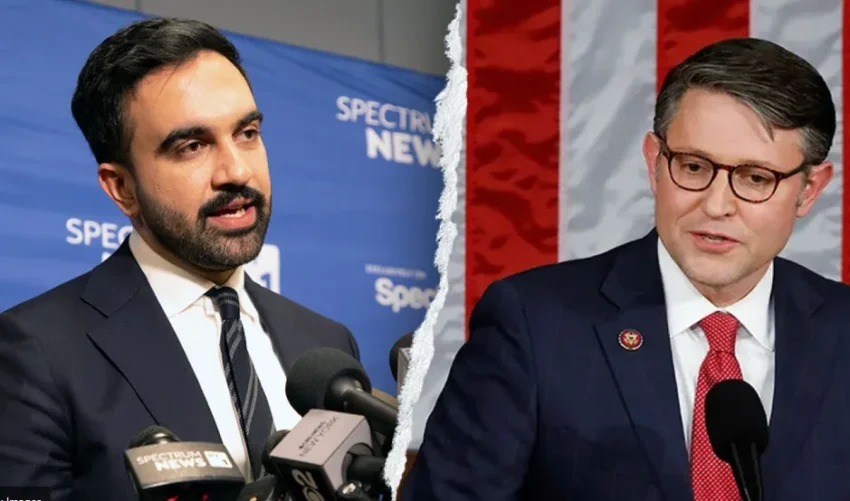
After Zohran Mamdani’s victory in the New York City mayoral election—making him the city’s first Muslim and first South Asian mayor-elect—Republican leaders in Washington, D.C., signaled plans to try to block him from taking office.
President Donald Trump has accused the 34-year-old Ugandan-born politician of being a communist, after previously warning that he would withhold federal funding from New York City if Mamdani won. Mamdani secured his win last week with a decisive margin, defeating former Governor Andrew Cuomo by nearly 10 percentage points, though Mamdani barely won a majority of votes overall.
But some Republican lawmakers have vowed to block him from taking office. Some Republican lawmakers have demanded investigations into Mamdani’s naturalisation process, calling for him to be stripped of his US citizenship and deported. They have accused him of involvement in communist and “terrorist” activities and figures linked to terrorism.
“If Mamdani lied on his naturalisation documents, he doesn’t get to be a citizen, and he certainly doesn’t get to run for mayor of New York City. A great American city is on the precipice of being run by a communist who has publicly embraced a terroristic ideology,” Rep. Andy Ogles (R-Tenn.) said in an October 29 news release, after asking US Attorney General Pam Bondi to investigate the mayor-elect,
the Economic Times reported.“The American naturalization system REQUIRES any alignments with communism or terrorist activities to be disclosed. I’m doubtful he disclosed them. If the information is confirmed, put him on the first flight back to Uganda,” Ogles added.
Meanwhile, a campaign finance watchdog has filed two criminal referrals against Mamdani, accusing the leftist socialist of taking illicit donations from overseas contributors.
The Coolidge Reagan Foundation sent the recommendations to the Department of Justice’s Criminal Division and Manhattan District Attorney Alvin Bragg’s office last week. They say that Mamdani may have broken the Federal Election Campaign Act and the New York Election Code.
The recommendations were made after the New York Post reported earlier this month that Mamdani’s campaign got about $13,000 in donations from at least 170 people who live outside the US, including one from his mother-in-law in Dubai.
“These are not isolated incidents or clerical errors,” Dan Backer, a national campaign finance expert and president of the Coolidge Reagan Foundation, said in a statement.
“This was a sustained pattern of foreign money flowing into a New York City mayoral race which is a clear violation of both federal law and New York City campaign finance rules,” Backer added. “Mamdani’s campaign was on notice for months that it was accepting illegal foreign contributions, and yet it did nothing meaningful to stop it.”
The Coolidge Reagan Foundation has previously filed complaints against Rep. Alexandria Ocasio-Cortez (D-NY), Hillary Clinton’s presidential campaign, and the Democratic National Committee.
The watchdog told Bragg and the DOJ to look into and arrest Mamdani for the campaign cash that may have come from Australia, Turkey, France, Canada, Germany, and other countries.
The group said that Mamdani’s campaign had shown a “systematic failure to comply” with the rules about campaign money.
The Federal Election Campaign Act says that it is against the law to “accept or receive” donations from people who are not US citizens in any federal, state, or local election.
People who knowingly accept donations from other countries could face big fines and jail time.
“The law is crystal clear that foreign nationals may not participate in American elections, and that includes making contributions,” Backer continued. “Yet Mamdani’s campaign repeatedly accepted donations from individuals abroad, some even tied to regions and individuals openly sympathetic to hostile actors.”
“Whether through negligence or intent, this conduct undermines the integrity of the democratic process.”
Mamdani’s campaign for mayor of New York City sent back about $9,000 in donations from people outside the U.S., the Post reported.
New emails have surfaced suggesting that Dr. Anthony Fauci, the longtime head of the National Institute of Allergy and Infectious Diseases (NIAID), encouraged federal employees to destroy government records related to the origins of COVID-19.
The revelations come from a series of emails obtained by congressional investigators and highlighted by Senator Rand Paul, who has long pressed for transparency regarding Fauci’s handling of the pandemic.
“We now have clear evidence that Dr. Fauci instructed federal employees to delete official records,” Senator Paul told the New York Post. “This is a violation of federal law and contradicts his sworn testimony.”
One email from February 2020 was particularly damning. It came shortly after a high-level call with virologists about the origins of COVID-19. According to congressional memos, the email included instructions to “delete” messages that discussed the possibility of a lab leak.
The House Select Subcommittee on the Coronavirus Pandemic released a memo describing “serious misconduct and potentially illegal actions” by Fauci’s senior adviser, Dr. David Morens.
“Dr. Morens unlawfully deleted federal COVID-19 records, used a personal email to avoid FOIA, and repeatedly acted unbecoming of a federal employee,” the subcommittee memo stated.
Emails from Morens also appear to implicate Fauci directly. In one exchange, Morens wrote that Fauci “is too smart to have things in writing,” adding that he would help keep certain discussions “off the record.”
Lawmakers say this proves Fauci was aware of efforts to destroy records. “These revelations demonstrate that Dr. Fauci was not only complicit but may have personally directed the destruction of federal records,” Rep. Brad Wenstrup, chair of the subcommittee, said in a press release.
The alleged cover-up centers around the controversial February 2020 paper, The Proximal Origin of SARS-CoV-2, which dismissed the lab leak theory as a conspiracy. Critics argue Fauci’s behind-the-scenes influence shaped that narrative while publicly denying any involvement.
“What we’re seeing now is evidence of deliberate deception,” Paul said. “Fauci told the American people one thing while working behind the scenes to suppress alternative theories.”
The emails also reveal an ongoing effort within the NIH to avoid Freedom of Information Act (FOIA) requests. Morens admitted in one exchange that he would “delete anything” that might be requested by watchdogs.
“I always try to communicate via Gmail because my NIH email is FOIA’d constantly,” Morens wrote in an email subpoenaed by Congress.
Senator Paul blasted this as a clear violation of federal transparency laws. “The law is very clear—federal employees cannot use private emails to conduct official business and then destroy records to avoid oversight,” he said.
In response, Paul sent a letter to the Department of Justice demanding a full investigation into Fauci and Morens. “The DOJ must investigate whether Dr. Fauci and his associates engaged in the unlawful destruction of records,” Paul wrote.
The New York Post reported that Fauci has been called back to Congress for further questioning. Lawmakers want him to explain the newly released emails that appear to contradict his past testimony.
“Fauci testified under oath that he never instructed anyone to delete records,” Wenstrup said. “These emails suggest otherwise, and that raises serious questions about perjury.”
The controversy is not new. In 2022, the National Archives and Records Administration (NARA) warned the NIH about potential violations of federal recordkeeping requirements.
In a letter obtained by archives.gov, NARA said NIH staff had allegedly been ordered to “shred notes and other documents” referencing its work with the Wuhan Institute of Virology.
“If proven true, these are unauthorized dispositions of federal records,” the letter from NARA stated.
Conservative lawmakers say the implications are massive. “If Fauci ordered records destroyed, that is criminal,” Rep. Jim Jordan said in a Fox News interview. “We’re talking about one of the most consequential cover-ups in U.S. history.”
Paul went further, accusing Fauci of intentionally misleading Congress. “This is about accountability,” he said. “No federal employee, no matter how powerful, is above the law.”
Fauci, however, has denied wrongdoing. In past interviews, he insisted he has always complied with federal transparency rules. “I have nothing to hide,” Fauci said in July when asked about earlier reports of email deletions.
Still, lawmakers say his denials don’t match the evidence. “He told us under oath that he never destroyed records,” Wenstrup said. “Now we see emails where his top adviser brags about deleting them on his behalf.”
Colombia Reels as Powerful Quake Topples High-Rise and Shakes Bogotá to Its Core
It began like any other ordinary morning. Commuters poured into the streets of Bogotá, coffee carts steamed on the corners, and families prepared for another typical day in the heart of Colombia’s capital.
Then the earth convulsed.
At 10:47 AM, without warning, sidewalks buckled, windows shattered, and skyscrapers groaned like wounded giants. A 6.3-magnitude earthquake, its epicenter just outside Villavicencio—roughly 80 kilometers southeast—sent violent tremors rolling beneath central Colombia.
Within seconds, Bogotá transformed into a city of chaos.
A Tower on the Edge
The most chilling scene unfolded downtown: a towering apartment block, once a symbol of urban security, now leans unnaturally against a neighboring building, warped like a falling domino. From above, the structure appears to have folded inward, with exposed wiring and twisted rebar clawing through fractured brick.
Balconies hang like broken teeth. Debris carpets the streets below. And from the building’s crushed lower levels, the muffled cries of survivors continue to emerge—faint but persistent.
Search-and-rescue teams are now in a race against time.
Region-Wide Impact
Tremors from the quake rippled across multiple cities, rattling Medellín, Cali, and smaller towns in between. In Bogotá, power flickered, phone service dropped, and terrified residents flooded out into parks and open plazas.
Colombian authorities have confirmed multiple fatalities and dozens of injuries. The number of people still unaccounted for remains unknown, but with collapsed structures in several neighborhoods, fears are growing that the toll could rise sharply.
Heavy equipment and canine units have been deployed, while emergency responders dig through the rubble with shovels, hands, and hope.
Dust, Sirens, and Resilience
Social media has filled with haunting videos: streets enveloped in dust clouds, screams echoing through the cracks of concrete, and stunned citizens watching as once-solid buildings sway like reeds in the wind.
“Everything moved… like the ground was trying to shake us off,” said one Bogotá resident, still trembling hours later.
⚠️ What Comes Next
Authorities have warned of potential aftershocks and are urging residents to avoid damaged buildings. Shelters are being established across the capital, and medical personnel are treating injuries in makeshift triage zones set up in parking lots and public squares.
Final Word
This earthquake has left more than shattered buildings in its wake—it has fractured Colombia’s sense of normalcy. In a single minute, Bogotá’s skyline—and the lives beneath it—were altered forever.
But in the face of destruction, Colombia’s spirit endures.
With every cleared brick and every hand pulled from the wreckage, a story of survival is unfolding. And though the earth has stilled for now, the aftershocks—emotional and physical—will ripple for days to come.
The rescue continues. The world watches. And Colombia stands, shaken but unbroken.