Funding package heads to House after 8 Senate Dems abandon demand for Obamacare subsidies deal
The shutdown stalemate that has dragged on in the Senate officially ended late Monday night, and it places Congress on a path to reopen the government later this week.
Senators advanced a bipartisan funding package to end the government shutdown after a group of Senate Democrats broke from their colleagues and joined Republicans in their bid to reopen the government.
Those same eight Senate Democratic caucus members stuck with Republicans and provided the crucial votes needed to send the package to the House.
MIKE JOHNSON EYES WEDNESDAY VOTE WITH END OF GOVERNMENT SHUTDOWN IN SIGHT
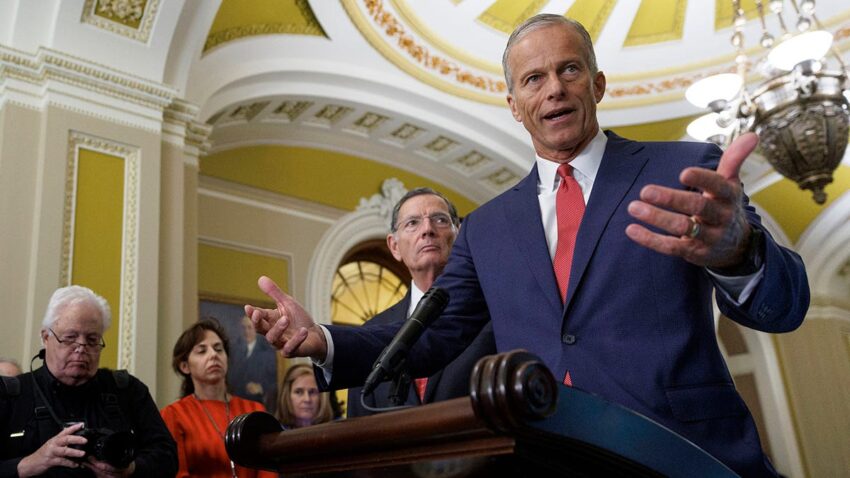
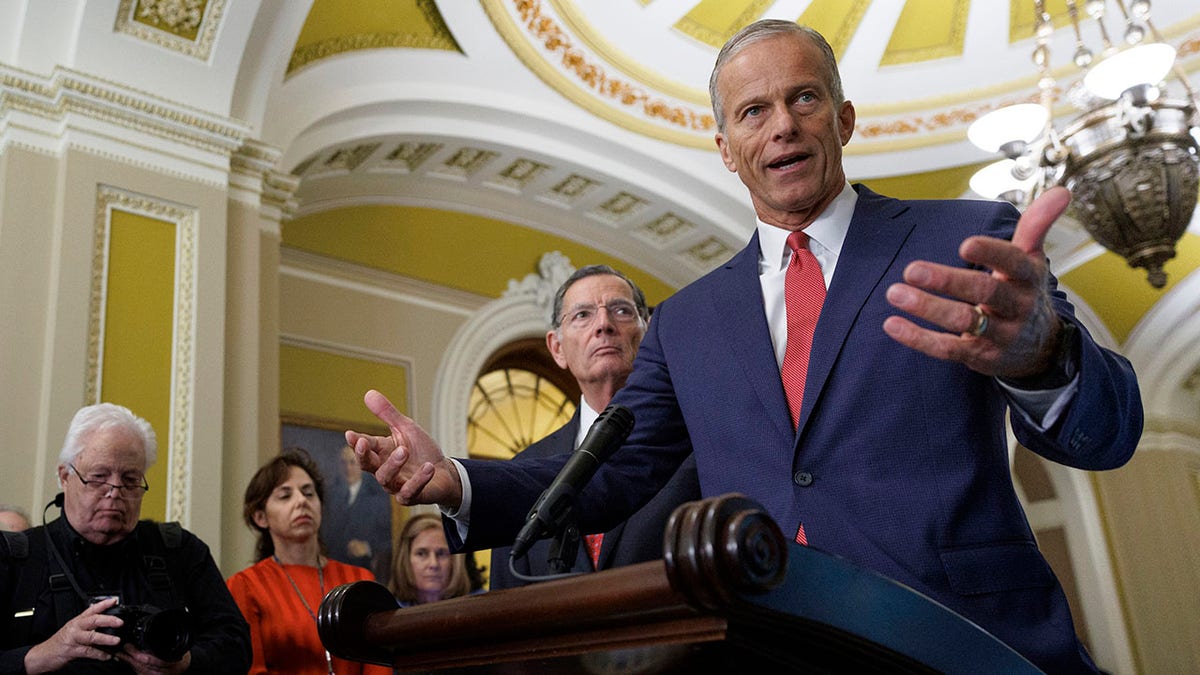
The Senate smashed through procedural hurdles and advanced its package to reopen the government, with the onus of ending the shutdown now falling on the House. (Tom Brenner/Getty Images)
The votes went deep into Monday night on the shutdown’s 41st day and resulted in an updated continuing resolution (CR) being combined with a trio of spending bills in a minibus package that is now headed to the House.
Whether the Senate would get to this point was in the air for much of last week and even earlier in the day. On Monday, lawmakers were riding high after smashing through the package’s first procedural test, but concerns of objections and other procedural maneuvers threatened to derail the process.
“I think everybody\’s pretty united [behind] this bill,” Sen. Bernie Moreno, R-Ohio, said. “We want to reopen the government.”
Senate Minority Leader Chuck Schumer, D-N.Y., and his caucus demanded throughout the entirety of the shutdown that they would only vote to reopen the government if they received an ironclad deal on expiring Obamacare subsidies.
But that deal, or at least the one that Democrats wanted, never materialized. Instead, eight Senate Democrats took the offer that Senate Majority Leader John Thune, R-S.D., has made since the beginning: A guarantee to vote on legislation that would deal with the subsidies.
SENATE HOPES TO BLOW THROUGH PROCEDURAL HURDLES IN BID TO REOPEN GOVERNMENT
A group of Senate Democrats crossed the aisle to join Republicans in their bid to reopen the government and provided enough votes to get the wheels turning as the shutdown enters its 41st day. (Tom Williams/CQ-Roll Call, Inc via Getty Images)
Thune reiterated his promise and noted that a vote would come, “No later than the second week of December.” The subsidies are set to expire by the end of the year.
“We have senators, both Democrat and Republican, who are eager to get to work to address that crisis in a bipartisan way,” he said. “These senators are not interested in political games, they’re interested in finding real ways to address healthcare costs for American families. We also have a president who is willing to sit down and get to work on this issue.”
Senate Democrats did not leave completely empty-handed, however.
Included in the revamped CR, which would reopen the government until Jan. 30, was a reversal of the Trump administration’s firing of furloughed federal workers, a deal to ensure that furloughed workers would get back pay and future protections for federal workers during shutdowns.
“This was the only deal on the table,” Sen. Jeanne Shaheen, D-N.H., one of the eight that crossed the aisle to support the package, said. “It was our best chance to reopen the government and immediately begin negotiations to extend the [Obamacare] tax credits that tens of millions of Americans rely on to keep costs down.”
Sen. Tim Kaine, D-Va., another of the eight Senate Democrats to break with Schumer, said that it was clear that Republicans weren\’t going to budge on their position that healthcare would be dealt with after the government reopened.
But it wasn\’t the guarantee of a vote on the expiring subsidies that got him to splinter, it was promises that there would be protections for federal employees.
SENATE DEMOCRATS CAVE, OPEN PATH TO REOPENING GOVERNMENT
House Speaker Mike Johnson, R-La., briefs the media on the timeline to possibly end the government shutdown in the Capitol Visitor Center in Washington, Nov. 10, 2025. (Tom Williams/CQ-Roll Call, Inc via Getty Images)
“If you wait another week, they\’re going to get hurt more, another month or even more,” Kaine said. “So what got me over the line was the pledge that they were able to give the federal employees.”
On the House side, it appears GOP leaders are eager to move quickly on ending the prolonged shutdown.
Speaker Mike Johnson, R-La., earlier Monday told Fox News Digital that he would bring the House back into session “immediately” upon Senate passage of the legislation.
He later told House Republicans on a lawmaker-only call that he anticipated a vote in their chamber midweek at the earliest, Fox News Digital was told.
CLICK HERE TO DOWNLOAD THE FOX NEWS APP
“We\’re going to plan on voting, on being here, at least by Wednesday,” Johnson said. “It is possible that things could shift a little bit later in the week, but right now we think we\’re on track for a vote on Wednesday. So we need you here.”
Johnson signaled the House would not move to fast-track the legislation via suspension of the rules however, which would bypass procedural hurdles in exchange for raising the passage threshold to two-thirds of the chamber.
It\’s not a surprising move given House Democratic leaders\’ opposition to the bill.
He said, however, that the House Rules Committee should be ready to move by Tuesday at the earliest.
Senate Minority Leader Chuck Schumer delivered a fiery critique on Wednesday of the Republican-backed “One Big Beautiful Bill” (BBB), accusing the GOP of disguising the legislation’s true costs to the American public.
Schumer claimed the bill, championed by former President Donald Trump and Republican lawmakers, would jeopardize health care for millions and slash vital assistance programs, while rewarding the wealthiest Americans with major tax breaks.
During his remarks, Schumer argued that the legislation should be renamed the “We’re All Going To Die Act.” He said the measure could:
Strip health insurance from roughly
Cut food assistance for 11 million people
Fund tax reductions that disproportionately benefit billionaires
“This isn’t a bill for working families,” Schumer said. “It’s a bill that takes from those who need help the most and gives to those who already have more than enough.”
Republicans and conservative commentators quickly dismissed Schumer’s remarks as exaggerated fearmongering.
Some noted that Democrats have often warned of catastrophic outcomes from GOP-backed legislation, from the repeal of net neutrality to tax reforms and border security measures — predictions that critics say never came true.
On social media, reactions were sharp:
“I think I’ve already ‘died’ a dozen times, according to these warnings,” one user joked.
Others pointed out that constant claims of disaster may weaken Democrats’ credibility, saying the rhetoric has “lost its emotional impact.”
The clash over the “Big Beautiful Bill” highlights the deep divide between Republicans, who frame the legislation as a pro-growth, pro-business package, and Democrats, who argue it comes at the expense of vulnerable Americans.
As the debate unfolds, both parties appear ready to lean into their respective narratives — Republicans emphasizing economic opportunity, and Democrats warning of dire human costs.
The tragic assassination of conservative activist Charlie Kirk has not only shaken the nation but has ignited one of the fiercest political firestorms in recent memory.What began as a moment of shared grief in the U.S. House of Representatives quickly unraveled into bitter partisan conflict, as Republicans accused Democrats of fueling an environment of hatred that ultimately contributed to the killing.At the center of the storm is former President Barack Obama, whose response to Kirk’s death has drawn condemnation from conservatives who argue his words reflect years of damaging rhetoric.On Wednesday, Obama issued a brief statement on X, formerly Twitter, responding to the assassination. “We don’t yet know what motivated the person who shot and killed Charlie Kirk, but this kind of despicable violence has no place in our democracy,” he wrote.The statement was intended as a general condemnation of violence, but for many on the right, it rang hollow. Critics pounced, arguing that Obama himself had helped foster the hostile climate that encouraged extremists to target conservative figures.Outkick founder and conservative commentator Clay Travis was among the loudest voices. Appearing on Fox News, Travis accused Obama of emboldening violence by framing Donald Trump and his supporters in fascist terms over the past decade.“You can’t call the president of the United States Adolf Hitler for 10 years, and you can’t say that he’s a fascist dictator,” Travis fumed. “You cannot say that anyone who voted for Trump or advocated for him like you, me, Riley, and Charlie Kirk are Nazis, and then when someone tries to kill us, suddenly say, ‘Oh, we condemn this violence.’ You caused it!” His anger reflected a broader sentiment spreading among conservatives: that the rhetoric of Obama, Hillary Clinton, and other Democratic leaders had laid the groundwork for extremist acts of violence against Trump supporters.The accusations gained traction when critics resurfaced reports from 2016. According to NBC News, during that election cycle Obama privately described Trump as a “fascist” during a phone call with then–vice presidential nominee Tim Kaine.Hillary Clinton, appearing with Kaine, later echoed that sentiment by insisting they had to do everything possible to “keep a fascist out of the White House.”For conservatives, these remarks represented more than just heated campaign language. They argued that once political figures equate opponents with Adolf Hitler or fascism, they effectively give a green light to unstable individuals to commit violence in the name of protecting democracy.Clay Travis made that case emphatically: “Look at me right now! You caused this! When you tell people that someone is Hitler, you are telling crazy people: Go kill them. And I am sick of pretending that is anything other than what they are doing.”The debate was further fueled by recent events. Ryan Wesley Routh, a 58-year-old man who attempted to assassinate Donald Trump in West Palm Beach, reportedly told authorities that he viewed Trump as another Hitler. For conservatives, this connection was proof that repeated Nazi comparisons had deadly consequences.“This is what they do,” Travis added. “This left-wing violence, it’s out of control, and Charlie Kirk bore the brunt of that left-wing violence.”His remarks resonated with a segment of the American public already distrustful of mainstream narratives. Many conservatives took to social media to express outrage, asserting that Obama’s statement was disingenuous, a hollow condemnation that ignored his own role in demonizing Trump-aligned figures.Democrats, however, rejected the accusation that their rhetoric bore any responsibility for Kirk’s death. Senator Elizabeth Warren was visibly exasperated when asked if Democratic language could have incited the killing. “Oh, please,” she snapped outside the Capitol. “Why don’t you start with the President of the United States?”For Warren and her colleagues, the charge that Obama or others had indirectly caused Kirk’s assassination was both offensive and politically opportunistic.They countered that violent rhetoric and conspiracy theories had long been cultivated by the right, and that responsibility for the crime lay solely with the individual who pulled the trigger.This clash of narratives underscored the broader polarization in American politics, where tragedies are immediately refracted through partisan lenses. What might have been an opportunity for unity and collective mourning instead became a new front in the battle between left and right.The divisions played out dramatically on the House floor. Republicans demanded a formal condemnation of political rhetoric that dehumanizes conservatives, while Democrats accused their opponents of exploiting a tragedy for political gain. Heated exchanges erupted, with lawmakers shouting over one another as the debate devolved into recriminations.For many Americans watching from the outside, the spectacle was disheartening. Instead of unity in the face of a national tragedy, the country was once again reminded of the depth of its partisan divides.The controversy raises deeper questions about the power of political rhetoric in shaping public perceptions and behavior. When leaders compare opponents to history’s most reviled figures, what effect does it have on the political culture? Does it heighten vigilance against authoritarianism, or does it encourage acts of violence by unstable individuals who interpret such comparisons literally?Political historians note that hyperbolic language has been a staple of American politics for centuries. But the digital age has amplified its reach and intensity. What once might have been a campaign trail quip now reverberates endlessly on social media, repeated, distorted, and consumed by audiences across the ideological spectrum.In this environment, the line between metaphor and incitement becomes increasingly blurred.For Republicans, the backlash against Obama’s remarks represents both a moral conviction and a political strategy. By highlighting Democratic rhetoric, they aim to turn the tables in a debate where they are often accused of fueling violence through incendiary speech.House Republicans have already begun drafting resolutions condemning political rhetoric that “dehumanizes” Americans based on ideology. Conservative media outlets are amplifying the message, portraying Obama’s words as emblematic of a larger culture of liberal disdain for Trump supporters.The hope, for many on the right, is that public sympathy for Kirk’s family will translate into political momentum. By framing the assassination as a byproduct of Democratic demonization, they seek to rally voters around the narrative that conservatives are under siege.Democrats, meanwhile, are determined to prevent this narrative from taking hold. They argue that it is dangerous to blame political leaders’ words for the actions of individuals, particularly when those individuals act independently and without direct instruction.Their message is that responsibility lies with extremists themselves, not with politicians who warn about the dangers of authoritarianism. They also point to the violent rhetoric that has emerged from the right, including threats against Democratic officials and institutions.To Democrats, Republicans are engaging in projection—accusing others of the very behavior for which they are often criticized.Media coverage has further complicated the picture. Conservative outlets have seized on Obama’s past remarks and Clay Travis’s fiery denunciations, while liberal networks have highlighted the dangers of conspiracy theories and gun violence. The result is a fragmented information environment where Americans encounter radically different narratives depending on their preferred sources.Social media has amplified these divides, with hashtags trending in both directions—some demanding accountability for Democrats’ rhetoric, others condemning conservatives for politicizing tragedy.Polling in the coming weeks may reveal how the public is processing the controversy. Early indications suggest that Americans remain deeply divided, with partisans sticking to their respective narratives. For many conservatives, Obama’s words epitomize hypocrisy; for many liberals, the outrage amounts to deflection.What is clear, however, is that the assassination of Charlie Kirk has become more than a tragedy—it has become a symbol in the broader culture war over truth, rhetoric, and political responsibility.The furor surrounding Obama’s remarks is unlikely to subside quickly. Both sides see the stakes as too high. Yet the deeper question lingers: can America find a way to mourn its dead without turning grief into another battlefield?The answer may depend on whether political leaders can recognize the gravity of their words, not only in moments of tragedy but in the ordinary rhythms of governance and campaigning. Language has power, and in an age of polarization, that power can shape perceptions in ways that extend far beyond the intentions of the speaker.The assassination of Charlie Kirk has opened yet another chapter in America’s ongoing struggle with division and violence. Barack Obama’s response, intended as a condemnation of bloodshed, has instead become a lightning rod for fury, exposing the raw nerves of a country unable to agree on who bears responsibility for its tragedies.For conservatives, the message is clear: years of demonizing rhetoric from Democratic leaders helped pave the way for Kirk’s death. For liberals, the charge is outrageous, a distortion of reality aimed at scoring political points.Caught between these narratives are ordinary Americans, many of whom simply mourn the loss of life and worry about the path their country is on. The question that remains is whether this moment will serve as a wake-up call for more careful rhetoric—or whether it will deepen the divisions that continue to tear at the fabric of American democracy.