BREAKING: Zohran Mamdani Has Been Stopped
This article may contain commentary
which reflects the author’s opinion.
The wheels are coming off the socialist bus.
New York Gov. Kathy Hochul is tapping the brakes on Mayor-elect Zohran Mamdani’s $700 million plan for free city buses, casting early doubt on one of the far-left lawmaker’s biggest campaign promises, The New York Post reported.
Speaking at the SOMOS political retreat in Puerto Rico on Saturday, Hochul said she’s already spent heavily to support the city’s struggling MTA and questioned how much further the state could go.
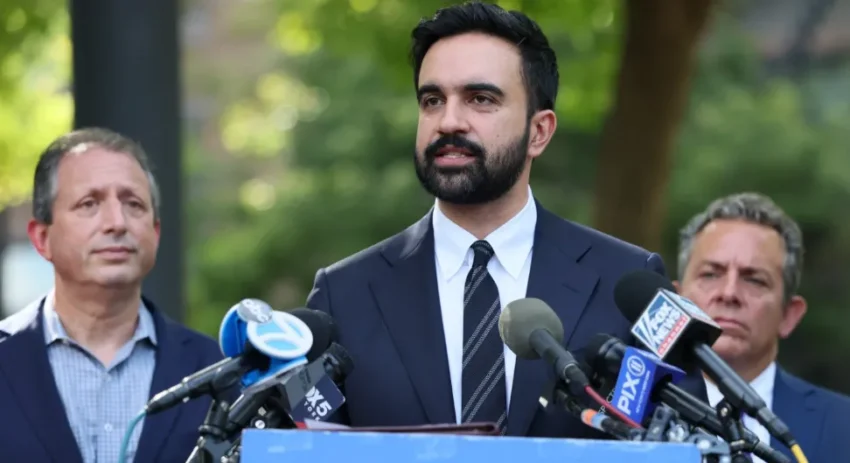
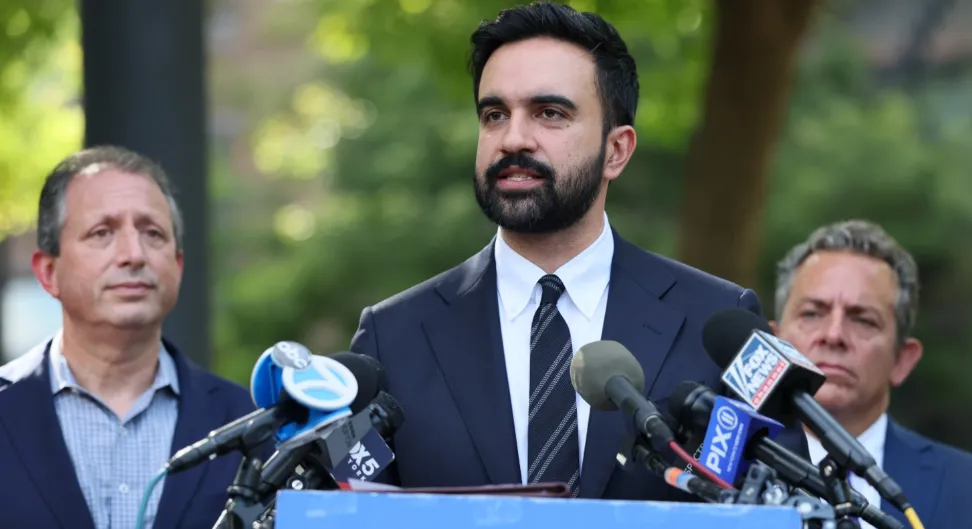
“I continue to be excited at the work of making the slowest buses in America fast and free,” Mamdani said Monday during an unrelated press conference. “And I appreciate the governor’s continued partnership in delivering on that agenda of affordability.”
But Hochul’s comments in San Juan marked the latest break between the moderate Democratic governor and Mamdani, the Democratic socialist she endorsed just two months ago.
Hochul happily rode Mamdani’s coattails during the campaign as he energized progressives with promises of affordability and social programs, but she has shown far less enthusiasm for actually paying for them.
The governor has rejected several of Mamdani’s cornerstone ideas, including proposals to raise taxes on wealthy New Yorkers to fund $10 billion in new benefits like free child care and fareless transit.
Her caution could create a serious roadblock for the incoming mayor, whose ambitious plans rely on support from Albany to move forward.
The top two Democratic leaders in the state Legislature — Assembly Speaker Carl Heastie and Senate Majority Leader Andrea Stewart-Cousins — have signaled more willingness to help Mamdani pursue his agenda.
That divide leaves Hochul increasingly isolated from the party’s energized left flank, which has been openly pressuring her to embrace higher taxes on the rich.
During recent public appearances, activists have twice interrupted the governor with chants of “Tax the rich,” drawing a sharp rebuke.
“The more you push me, the more I’m not going to do what you want,” Hochul told the SOMOS crowd in response.
Still, Hochul did not fully reject Mamdani’s wish list.
She said she’s open to working with him on expanding free child care, though she made clear it would be an expensive and long-term goal.
“We’ll be on a path to get there, because I’m committed to this as ‘mom governor’ — I get it,” Hochul said.
“But also to do it statewide, right now, it’s about $15 billion — the entire amount of my reserves.”
The cautious tone was a reality check for Mamdani, who has portrayed himself as the champion of “everyday New Yorkers” and promised to make the city more affordable through massive new public spending.
Hochul’s remarks also came as she continues her own political maneuvering ahead of a likely 2026 re-election bid.
After the SOMOS conference, she flew to the Dominican Republic to attend a breakfast celebrating cross-cultural exchange — an event seen as an appeal to one of New York’s largest and most influential immigrant voting blocs.
Hundreds of thousands of New Yorkers trace family roots to the Dominican Republic, making the outreach a politically savvy move for a governor seeking to rebuild her base while keeping the party’s left wing at arm’s length.
Whether Hochul and Mamdani can maintain their uneasy alliance may determine not only the future of free buses and child care, but also the balance of power within the New York Democratic Party.
In the kaleidoscopic world of 1960s cinema, where horror films bled into pop culture and starlets seemed to shimmer and fade overnight, one name briefly burned with an almost mythic glow: Susan Denberg. In 1967, she appeared in a Hammer Horror production that still lives vividly in the memories of fans, only to vanish from the screen soon after. For decades, whispers of scandal, silence, and personal struggles trailed her legacy. Who was this enigmatic blonde who seemed to embody the very spirit of swinging-sixties glamour and gothic dread, only to disappear just as quickly as she arrived?
Born Dietlinde Zechner in 1944 in Bad Polzin, Germany (then part of Prussia, now Poland), she emigrated to Austria as a child. Like many young women of her generation, she found early work in modeling, where her statuesque figure, platinum hair, and striking blue eyes made her an instant standout. By the mid-1960s, she had reinvented herself as Susan Denberg, pursuing opportunities far from her European beginnings.
Her first burst of fame came not from acting but from the pages of glossy magazines. In August 1966, she was featured as Playboy’s Playmate of the Month. The spread introduced her to American audiences, painting her as the quintessential blonde bombshell of the era — alluring, slightly exotic, and brimming with possibility. From there, Hollywood beckoned.
Denberg’s most notable screen appearance came swiftly. In 1967, Hammer Films, then at the height of its horror success, cast her in Frankenstein Created Woman. Directed by Terence Fisher, the film paired gothic horror with themes of love, revenge, and metaphysical mystery. Denberg played Christina, the disfigured daughter of an innkeeper who, after her tragic death, is resurrected by Peter Cushing’s Baron Frankenstein in a new, flawless body. As Christina, Denberg balanced pathos with eerie allure, embodying Hammer’s blend of beauty and menace.
The role was both bold and tragic. Denberg was not just another damsel in distress; her Christina carried the weight of longing, despair, and vengeance. In one of Hammer’s more philosophically inclined scripts, her performance elevated the film beyond camp. For many horror fans, her image in that role — golden-haired, pale-skinned, both victim and avenger — remains iconic.
Yet just as Denberg’s career seemed poised to take off, she disappeared from mainstream cinema. There were rumors of small television appearances, including an episode of Star Trek (“Mudd’s Women,” 1966), but after
What happened next became the stuff of tabloid speculation. Some reports suggested that she had fallen into personal difficulties in Los Angeles, including struggles with substance abuse and mental health. Others claimed she returned quietly to Europe, retreating from fame after its brief, searing burn. For years, conflicting accounts circulated, some insisting she had died young, others that she lived reclusively in Austria. The mystery only deepened her legend.
Part of Denberg’s allure lies in this absence. Unlike her contemporaries who built long résumés of films and television roles, she left behind only fragments — a handful of performances, photographs, and rumors. That scarcity has turned her into a cult figure, her name invoked with the same fascination reserved for stars who vanish at their peak.
What we do know is that Denberg’s life after Hollywood was turbulent. By the 1970s, she had largely retreated from the spotlight, but traces of her surfaced in European gossip columns. Tales of heartbreak, scandal, and personal reinvention circulated but were rarely confirmed. In some ways, the absence of certainty has made her story even more compelling — a real-life mystery that mirrors the gothic fantasies she once inhabited on screen.
For fans of Hammer Horror, Susan Denberg remains frozen in time, forever the tragic Christina. That image — a young woman reborn by mad science, her beauty both a gift and a curse — resonates beyond its pulp origins. In the role, Denberg projected an emotional vulnerability that made Christina unforgettable, a performance that outshone her limited dialogue. It was the kind of part that might have launched a longer career, had circumstances been different.
Today, Denberg’s brief moment in the spotlight is celebrated not only by horror aficionados but also by cultural historians who see in her story the complexities of 1960s celebrity. She was part of a generation of women whose careers were both made and constrained by their beauty, caught in an industry that valued them as icons more than as artists. Her vanishing act — whether by choice or by circumstance — only underscores how fragile fame could be.
Who was Susan Denberg? A model, a Playboy pin-up, a Hammer starlet, a rumored cautionary tale — but also a reminder that some stories resist neat conclusions. Her life, like the films she graced, is tinged with mystery and melancholy. She may not have built the filmography of a Monroe or a Bardot, but for those who glimpse her in
Frankenstein Created Woman, she is unforgettable: a ghostly vision of beauty, loss, and cinematic immortality.
Her story is stranger than fiction because it lingers unfinished, a question mark wrapped in velvet shadows. Denberg’s name still prompts curiosity, still conjures the image of a blonde beauty whose star blazed briefly and vanished. And perhaps that is why, more than fifty years later, we still ask the same question: what really became of Susan Denberg?
In the winter chill of 1967 London, beneath the foggy skies and among the opulent sets of Mayerling, Catherine Deneuve was immersed in a role that dramatized love, betrayal, and tragedy. Yet off-camera, a different story was unfolding—one that would remain largely unknown to the public for decades. At the heart of it was her discreet, deeply personal relationship with fellow actor Marcello Mastroianni, a liaison that defied expectations, quietly weathered complexity, and ultimately gave birth to one of the most intriguing chapters of Deneuve’s storied life.
By the time Deneuve began filming Mayerling alongside Omar Sharif, she had already become a celebrated figure in French cinema. Known for her ethereal beauty and aloof elegance, she was often cast as enigmatic women whose silence spoke volumes. That same winter, Deneuve’s life off-screen took a profound turn when she began a relationship with Mastroianni—already a legend in his own right, and at the time, a married man. Unlike the splashy romances that modern fame so often invites, theirs unfolded with restraint, dignity, and a sense of privacy rarely seen in public life. It was a connection forged not just in passion, but in mutual artistic respect and shared values.
Their relationship lasted years, away from the noise of tabloids and paparazzi, and in 1972, it quietly led to the birth of their daughter, Chiara Mastroianni—who would grow up to follow in her parents’ footsteps. For Deneuve and Mastroianni, this bond defied conventional labels; it was not bound by marriage, but rooted in enduring affection and personal freedom. While the world was watching their films, the couple was building a life that remained, by choice, off-screen.
But to view Deneuve solely through the lens of her personal life is to miss the broader picture of her singular impact on global cinema. From her breakout role in The Umbrellas of Cherbourg (1964) to her transformation into a complex, provocative muse for visionary directors, she steadily built a legacy grounded in bold choices and fierce autonomy.
What distinguished Deneuve throughout the 1960s and ’70s was her steadfast refusal to conform. Hollywood beckoned—repeatedly—and she declined. Rather than become another imported glamour icon, Deneuve favored the psychological depth and artistic experimentation of European auteurs. She collaborated with Roman Polanski (Repulsion), Luis Buñuel (Belle de Jour, Tristana), and François Truffaut (Mississippi Mermaid), offering performances that challenged not only audience expectations but the very archetype of femininity on screen.
In Belle de Jour, arguably her most defining role, she portrayed Séverine, a Parisian housewife who leads a double life as a sex worker during the afternoons. It was a role that could have been scandalous or reductive in lesser hands—but Deneuve brought a cool detachment and quiet rebellion to the character, inviting viewers to confront the complexity of desire, repression, and identity. Her performance was not meant to titillate—it was meant to provoke thought, and it did. In doing so, she redefined what it meant to play a female lead in European cinema.
Her defiance of easy categorization carried over into her life off-screen. In the 1980s, long after her status as an icon was firmly cemented, Deneuve showed that her convictions ran deeper than fashion editorials and film festival appearances. When French farmers mobilized in protest against genetically modified crops, Deneuve—by then synonymous with refined Parisian style—arrived quietly to stand with them. No entourage, no press spectacle. Just boots, denim, and a quiet resolve.
This environmental advocacy surprised many, but it shouldn’t have. Deneuve had always held her beliefs close and voiced them with action, not declarations. Her later career has mirrored that integrity. Whether supporting AIDS awareness campaigns or defending artistic freedom, she has chosen her causes as carefully as her scripts—favoring authenticity over applause.
Still active in film into her seventies, Deneuve refuses to be defined by age, beauty standards, or nostalgia. Her recent performances—gritty, raw, and deeply human—continue to earn acclaim, not because they echo past roles, but because they chart new emotional territory. She remains, to this day, a figure of mystery and mastery—at once familiar and unreachable, iconic and deeply individual.
The winter of 1967 may have cast her in a tragic romance on screen, but behind the camera, Catherine Deneuve was writing her own narrative—one of agency, quiet rebellion, and unshakable grace. Her relationship with Marcello Mastroianni was only one thread in a life lived deliberately, outside the confines of celebrity mythology.
In a world that often demands simplicity, Catherine Deneuve has always chosen complexity. And in doing so, she has become not just a symbol of French cinema—but a quiet revolution all her own.