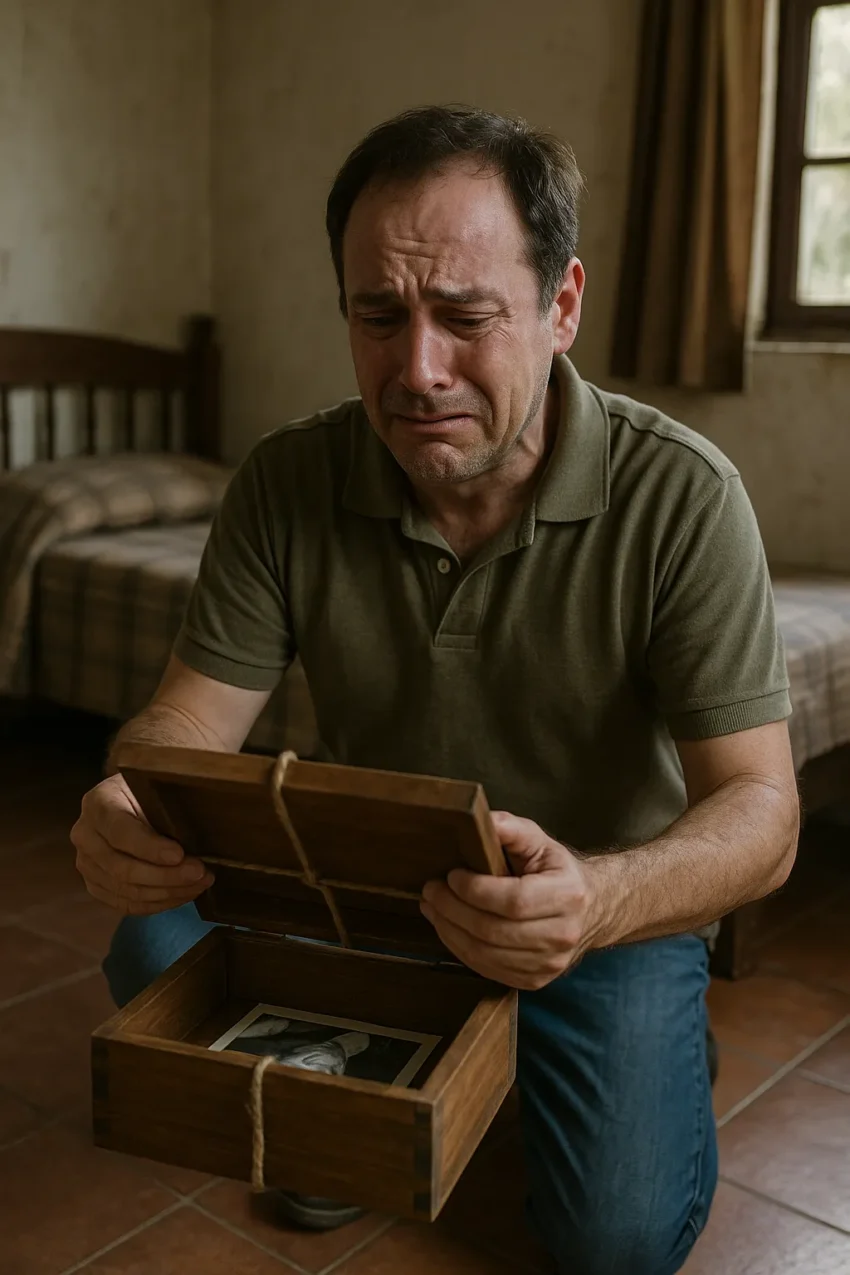
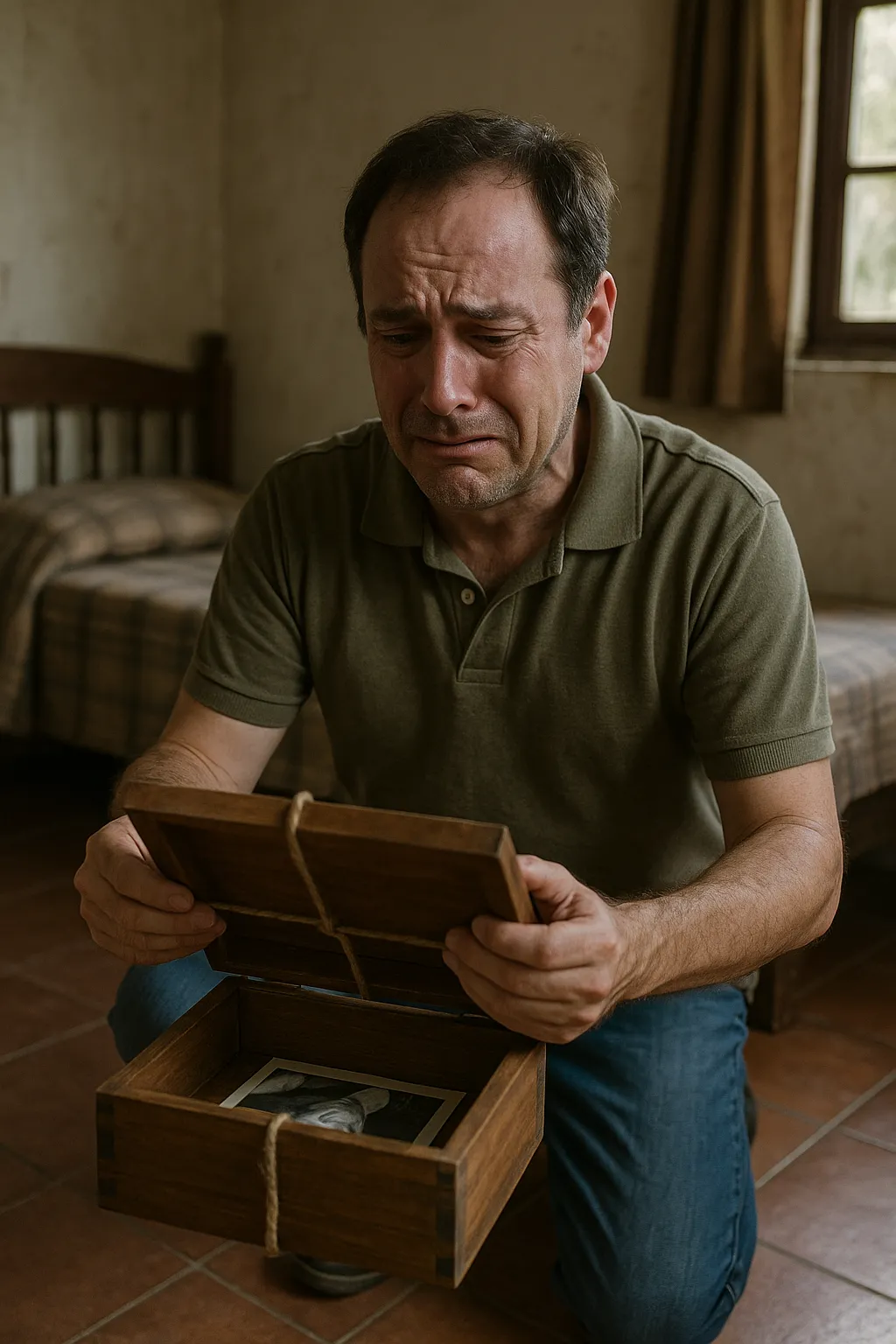
Ramón’s hands trembled as he untied the faded ribbon. The wooden box creaked softly when he opened it, as if the past itself was exhaling after years of silence. Inside lay a few simple things — a folded handkerchief, an old rosary, a small notebook bound in cloth, and a bundle of envelopes tied together with a piece of twine.
For a long time, Ramón couldn’t move. The sight of his mother’s neat handwriting on those envelopes froze him. Each one had his name written carefully, lovingly: “Para mi hijo Ramón.”
He picked up the first envelope. The paper smelled faintly of lavender — the scent of his mother’s soap. His vision blurred as he unfolded it.
My son,
If you are reading this, I am already with your father. I don’t know how much time God will give me, but I want you to remember what truly matters. Don’t let this house divide your heart. It was built by our love, not by money. Please, don’t let anyone make you ashamed of where you came from.
The words struck him like a hammer. Ramón’s chest tightened. He closed his eyes, remembering her voice — gentle, patient, always forgiving.
He reached for another letter.
Do you remember, my boy, when you were eight, and we planted the first orange tree behind the house? You cried because it had no fruit that year. I told you that patience was the secret of life. You didn’t believe me until you saw the first blossom two years later. That’s what love is, hijo — planting even when you don’t see the fruit yet.
Tears ran down his face. He pressed the letter to his forehead.
For a moment, the proud, distant man he had become disappeared, and the little boy who used to chase chickens around the yard came back — barefoot, laughing, safe in his mother’s arms.
Clarisa found him like that — kneeling on the floor, surrounded by old papers, his face buried in his hands.
“What’s all this?” she asked, frowning at the mess.
Ramón looked up at her with red eyes. “They’re… letters. From my mother.”
Clarisa crossed her arms. “You shouldn’t upset yourself. She’s gone. It’s better to move on.”
Her coldness sliced through him like ice. For years, he had ignored those same small cruelties — the way she’d wrinkle her nose when his mother entered the room, the tone she used when saying “Doña Teresa,” like it was a stain she couldn’t scrub off.
But now, hearing her dismiss his mother’s memory, something inside him snapped.
“Get out,” he said quietly.
Clarisa blinked. “What did you say?”
“I said get out. Of this room. Of her space.”
She opened her mouth to retort, but one look at him — the way he was trembling, his fists clenched — made her hesitate. She turned and left, muttering under her breath.
Ramón closed the door behind her and sat back on the floor. He picked up the small notebook next. It was worn, its pages filled with tiny handwriting.
The first entry was dated twenty-five years ago.
Today Ramón brought home his first paycheck. He bought me a shawl. I told him he didn’t have to, but he said, “You deserve everything, mamá.” I thank God for him every day.
The next page read:
Clarisa visited today. She’s very polite, though she doesn’t like the chickens. Ramón looks happy. I’ll learn to like her. That’s what mothers do — they learn to love what their children love.
As he kept reading, the entries grew more fragile — the words written shakier, thinner.
Ramón works a lot. I hardly see him. But when he passes by the garden, he still smiles. I think that’s enough.
Clarisa asked if I could move to the small house in the back. She says it’s better for me. I said yes, of course. I don’t want to be a burden. God, give me strength not to cry in front of them.
Ramón felt his heart crumble. Every line was a quiet sacrifice, every word a mother’s silent pain written in ink.
The last entry was dated just three days before she died.
Today I dreamt of Andrés. He was sitting under the orange tree, smiling. He said our boy will come back to himself one day. I hope he’s right. I’m tired, but my heart is calm. When I go, I want them to find peace — even if they never said sorry.
Ramón sat in the dark for hours. Outside, the garden whispered in the wind. Somewhere in the distance, he could hear the faint clucking of the chickens his mother had loved so much.
He stood slowly, his body heavy with guilt. He walked out into the garden. The small house looked lonely, its window cracked, its paint faded. But under the moonlight, the orange tree stood tall and full of fruit.
He remembered planting it as a boy — the way his mother had knelt beside him, her hands covered in dirt, her smile proud.
Now, standing beneath it, he whispered, “I’m sorry, mamá.”
The branches rustled softly, as if answering.
The next morning, Ramón told Clarisa he wanted to renovate the little house — properly this time.
She raised an eyebrow. “Why waste money on that old shack? We could use the space for a guest area or maybe a pool.”
“It’s not a shack,” he said sharply. “It’s where my mother lived. It’s where I’ll live now.”
She laughed, thinking it was a joke. But Ramón’s face didn’t change.
“You’re not serious.”
“I am. You can stay here if you want. But the main house is yours. The small one is mine.”
That was the beginning of the end. Within weeks, Clarisa packed her things and left. She said she couldn’t live “with a ghost.”
Ramón didn’t stop her. He only watched from the porch as she drove away. He felt no anger, no sadness — only a strange, quiet clarity.
Over the next months, he poured his heart into restoring the small house. He fixed the windows, repainted the walls, planted new flowers in the garden. He rebuilt it not as a monument of guilt, but as a promise — to honor what he had forgotten.
Inside, he kept his mother’s wooden box on a shelf beside her old rosary. Every evening, he lit a candle and sat by the window, listening to the wind through the trees.
He began volunteering in town — repairing roofs, teaching young boys how to build. People were surprised; the proud engineer from the big house now walked through the market with humble eyes.
When someone asked why he was doing all that, he simply said, “Because my mother taught me that love is a foundation, not a wall.”
One afternoon, as he was repairing the fence, a little boy approached. He looked about ten, his clothes dusty, a basket of oranges in his hands.
“Señor,” the boy said shyly, “my mom says thank you for fixing our roof.”
Ramón smiled. “You’re welcome, hijo. How’s your house now?”
The boy grinned. “It doesn’t leak anymore. And… she told me to give you these.”
He handed over two oranges — bright, round, fragrant.
Ramón’s throat tightened. He turned toward the old orange tree behind him. Its branches were heavy with fruit, just as his mother had promised all those years ago.
He looked at the boy and said softly, “Tell your mom I said thank you. These mean more to me than she’ll ever know.”
Years passed. The garden flourished again. The old house, once forgotten, became a small community refuge. Children came to read, neighbors gathered to share food, and travelers found shelter there when the rains came.
People started calling it La Casita de Teresa.
Ramón never sought recognition. He just kept the doors open and the kettle warm. Sometimes, late at night, he would sit beneath the orange tree, looking up at the stars, and whisper, “We did it, mamá. The house still breathes.”
One autumn morning, a letter arrived — from Clarisa. It had been years since she left.
Ramón,
I saw an article in the newspaper about what you’ve built. I came to say thank you. I didn’t understand before. I was so busy pretending to be someone that I forgot what home really means. I hope you can forgive me.
He folded the letter carefully and placed it in the wooden box beside his mother’s.
Forgiveness, he realized, was not something to be given in words. It was something that lived quietly — in the spaces we rebuild, in the peace we choose.
When Ramón grew old, he wrote his own note and slipped it into the box.
To whoever finds this: This house was built twice. The first time with sweat and dreams, the second with repentance and love. If you live here, take care of the orange tree. It still listens.
When he passed away, the townspeople gathered under that same tree. The children of La Casita de Teresa placed flowers at the roots. And as the sun set, the wind carried the faint scent of oranges — sweet, pure, and forgiving.
And for those who passed by that day, it seemed as though the leaves themselves were whispering her name.
On December 3rd, the world will once again hold its breath — because Princess Kate will step back into the royal spotlight.
Alongside Prince William, she will personally welcome the royal couple from Qatar, attending the official ceremony hosted by King Charles III, before returning in the royal carriage to Buckingham Palace.
For most royals, this would be just another diplomatic engagement.
But for Kate — still recovering from illness after months of treatment — it is an act of devotion that redefines duty, grace, and strength.
Sources close to the palace say that Princess Kate insisted on joining the welcome, despite her doctors’ cautious advice. After her major abdominal surgery earlier this year and subsequent cancer diagnosis, her public appearances have been few and far between.
Yet those who know her say she couldn’t bear to miss this one.
“She feels it’s her duty,” one insider shared softly. “She doesn’t want her illness to overshadow the King’s diplomacy. That’s who she is — steadfast, selfless, and impossibly graceful.”
Even now, her calendar remains carefully measured. She won’t attend the state banquet later that evening — a necessary concession to her health — but her brief presence at the ceremony itself will carry immense symbolic power.
Because when Kate steps out of that carriage, the cameras won’t just see a princess — they’ll see courage wrapped in elegance.
This isn’t the first time Kate has enchanted the world with her effortless diplomacy.
At last year’s South Korea state visit, she appeared in a striking scarlet gown, her presence commanding yet gentle, her smile warm but poised.
The image went viral almost instantly. Royal watchers across the globe described her as “the embodiment of modern royalty.”
What struck people most wasn’t the jewels or the gown — it was her confidence. She carried herself with the kind of unspoken assurance that only true queens possess.
Her makeup was minimal, her hair swept back simply, and yet she glowed — that unmistakable radiance of someone who knows her purpose.
Even without words, her message was clear: power doesn’t need to shout when it shines.
This upcoming visit from the Qatari Amir and his wife marks a significant diplomatic occasion for the United Kingdom. It will be the first major state event since Kate began her gradual return to public duties — and her participation, even in a limited capacity, signals something more profound than protocol.
It’s a moment of rebirth — a quiet declaration that she’s finding her strength again.
Observers expect her to appear in a muted but elegant gown, likely favoring soft tones that highlight her natural complexion. Royal stylists suggest she may wear her hair down, with minimal jewelry — allowing her timeless poise to speak for itself.
Even without the tiaras and grandeur of a banquet, Kate will undoubtedly steal the moment, just as she always has.
There’s something magnetic about Kate’s beauty — not the superficial kind, but the serenity that comes from within.
Her eyes carry calmness; her gestures radiate empathy. That’s why the public sees her not merely as a princess but as their queen in waiting.
Last year’s image in red remains etched in memory — Queen Kate in her prime, glowing beneath the chandeliers, representing Britain with dignity and quiet fire.
Now, as she returns this December, that same image feels like a promise renewed — the light after a long night.
She may be fragile, yes. But she is unbroken.
Royal fans have long called her “The Eternal Pearl.” It’s not just because of her beauty — it’s because of her purity of spirit.
Like a pearl, she was formed through pressure — adversity, illness, scrutiny — and yet she emerged stronger, smoother, shining with resilience.
Even when absent, her presence lingers — in photographs, in gestures, in the way the nation waits for her with affection rather than curiosity.
To many, Kate represents the best of the British monarchy: elegance without arrogance, compassion without performance.
When Kate greets the guests from Qatar on December 3rd, the scene will be brief — perhaps just a few moments of smiles and handshakes. But for millions watching, it will mean everything.
It will remind the world why Kate Middleton has become more than a royal — she’s a living symbol of grace under trial, beauty without vanity, and strength in silence.
And as the carriage returns to Buckingham Palace, sunlight glinting off its gold trim, all of Britain will be united in one quiet wish — that their Eternal Pearl keeps shining, no matter the storm.