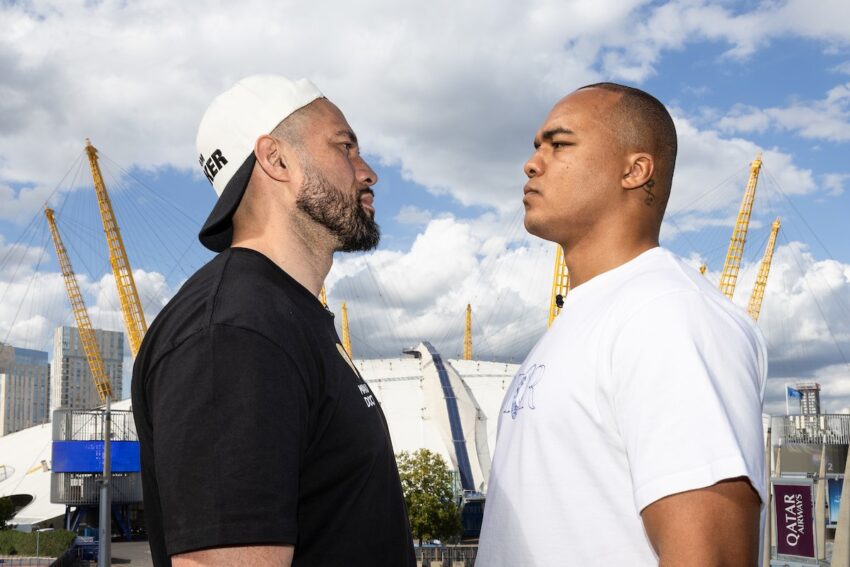
The boxing world is divided once again. After a night of drama, emotion, and controversy, Joseph Parker has broken his silence following his stoppage defeat to Fabio Wardley — a fight that ended in confusion and outrage, with fans questioning whether justice was truly served inside the ring.
The fight had all the makings of a modern classic. Parker, the calm and seasoned tactician, faced Wardley, the hungry powerhouse eager to make a statement. For ten rounds, it was chess with leather — Wardley’s aggression clashing with Parker’s precision.
By the 11th, the tide seemed to shift. Wardley landed a flurry of heavy shots, forcing referee Howard Foster to step in and call the fight. The crowd roared — not in celebration, but in disbelief.
Parker wasn’t on the canvas. He wasn’t defenseless. He looked dazed, yes, but far from finished.
And that’s exactly what has fueled the controversy.
“I was fine,” Parker said afterward, visibly frustrated. “I wanted to continue. I could’ve kept fighting. It’s boxing — we all take punches, but I wasn’t done.”
For many in the fight game, especially in the heavyweight division, the unwritten rule is simple: if you can still stand, you should be allowed to fight
. Parker echoed that sentiment with quiet defiance.
“I respect the referee. He’s doing his job. But I wanted to finish that fight,” he told reporters backstage. “I’ve been hit harder and come back. I wasn’t hurt — I was just caught off balance.”
The scorecards support his frustration. Before the stoppage, Parker was ahead on points across two of the three judges’ cards, meaning he was just minutes away from what could have been a career-defining win.
Instead, the victory — and the spotlight — went to Wardley.
The reaction online was immediate and explosive. British and Kiwi fans flooded social media, accusing referee Howard Foster of “robbing” Parker of a fair ending.
“Let the man fight,” one fan wrote on X. “He was winning. It’s not ballet — it’s boxing.”
Another echoed the sentiment: “Parker showed heart, skill, and composure. He deserved the chance to finish on his terms.”
Even some boxing insiders agreed. One commentator noted that Foster has a history of “early stoppages,” adding that Parker “earned the right to go out swinging.”
But amid the noise, Parker refused to lash out. Instead, he remained composed — disappointed, but gracious.
“Fabio fought well,” he said. “He landed clean shots. But I’ll be back. I’m not done yet.”
While the loss officially goes on his record, the manner of it may actually boost Parker’s stock. His performance — calculated, disciplined, and brave — reminded the world that he remains one of boxing’s true professionals.
Promoters are already hinting at a rematch later this year, and Parker himself seems ready to accept. “There’s unfinished business,” he said. “The fans deserve a clear ending — no doubts next time.”
In a sport built on grit and glory, Parker’s response has resonated deeply. He didn’t blame. He didn’t complain. He simply asked for another chance to fight the way champions do — to the very last second.
And if that rematch happens, one thing’s for sure: the world will be watching.
It reads like a screenplay. Meghan Markle, radiant at 30,000 feet, smiles like a star in an airline commercial, scribbles a note to the crew, and captivates onlookers. Cameras flash, passengers gush, and the moment feels polished, harmless. Yet in the underbelly of the narrative you shared, this cheerful act is painted not as charm, but as cover. A smokescreen. A sleight of hand.
This is the anatomy of modern gossip: dazzling surfaces, sinister shadows. And as a cultural critic, it is my role not to endorse such tales, but to judge how they are told—and why they matter.
The text you provided moves like a thriller script. It pivots quickly from an image of glamour to whispers of emotional detachment, to anonymous attendants, to a woman identified only as “DL” who claims to be the hidden surrogate. Each beat is designed not for clarity, but for escalation.
Notice how carefully it builds: first, a subtle doubt (“she didn’t bond with the baby”), then a resurfaced viral clip (“a folding belly”), then sharper accusations about missing records and blurred baby photos. The narrative thrives on accumulation. One oddity alone can be dismissed. But stacked together, they create the illusion of inevitability:
This is not journalism. This is architecture—architecture of doubt.
The United States, perhaps more than anywhere else, is primed for this kind of spectacle. American audiences have long consumed celebrity stories not as reporting, but as serialized drama. From the O.J. Simpson trial to Britney Spears’ conservatorship, the line between fact and entertainment is porous.
Harry and Meghan, already symbols of rebellion against the crown, become the perfect protagonists for such a saga. To their fans, they are victims of an outdated monarchy and a hostile press. To their detractors, they are manipulators of public sympathy. Either way, the conspiracy you outlined offers emotional payoff: outrage, vindication, or schadenfreude.
And so readers lean in—not because they trust it, but because it feels like part of the ongoing show.
The character of DL is written with striking precision. She is anonymous, yet intimate. Silenced, yet courageous. Erased, yet now reclaiming her story. Her alleged evidence—videos, scans, whispered dates in a locked compound—carries the rhythm of a confession, not a deposition.
This is how gossip cloaks itself in credibility. It offers sensory detail—metadata, ultrasound images, crying in a dim room. But none of it is verifiable to the reader. And that gap, that suspended space between belief and disbelief, is where gossip thrives. It lets the audience play judge and jury, piecing together a verdict based not on evidence, but on emotion.
So what should we conclude? Not whether Meghan used a surrogate, not whether footage exists, not whether succession laws tremble. Those questions belong to courts, not columns.
What we can conclude is this: the text is a masterclass in how modern rumor weaponizes storytelling. It mimics investigative reporting, but feeds entirely on suspicion. It appeals to our desire for hidden truths, for the drama behind the curtain, for the feeling that we, the audience, are smarter than the stage-managed photos.
As a critic, my judgment is blunt: it is effective theater, but dangerous theater. It confuses entertainment with evidence. It risks reducing human beings to characters, children to plot devices, and institutions to soap opera settings. And in doing so, it does not just distort reality—it erodes our trust in reality itself.
The reason such stories spread so fast today is not mystery. We live in an era where distrust is currency. Political polarization, fractured media, and the algorithmic hunger for outrage create perfect conditions for narratives like this. A polished royal smile is no match for a viral TikTok thread claiming a baby doesn’t “look right.”
And yet, we click. We read. We analyze. Because gossip is not just about the celebrity—it’s about us. It reflects our insecurities, our skepticism, our craving for control in a world that often feels manipulated.
So here is my verdict: the Sussex conspiracy story you shared is not truth, nor is it harmless fun. It is a mirror. It shows us how easily we slip from admiration to suspicion, how quickly love stories become courtroom dramas in the court of public opinion.
Harry and Meghan may never respond to such claims. The palace may stay silent. But the real turbulence is not in the skies, nor even in Buckingham’s halls. It is in us—the audience—who keep demanding ever wilder scripts.
Because in the end, gossip is theater. And we, the public, are both spectators and co-authors.