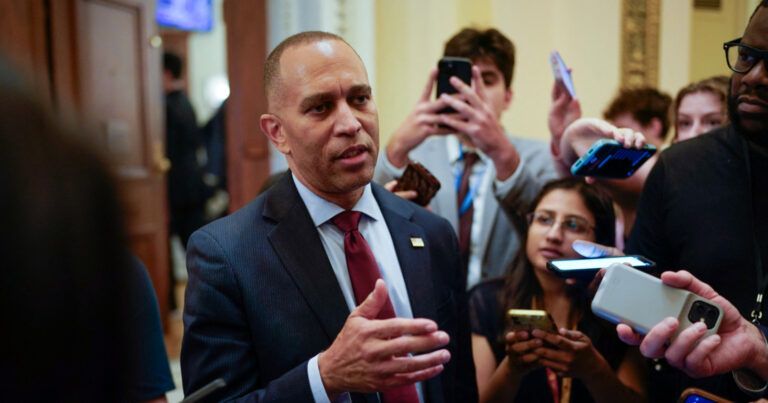
Jeffries Losing Support, Dozens of Dems Won’t Commit To Backing Him
Dozens of Democratic candidates running for U.S. House seats nationwide told Axios they either would not support House Minority Leader Hakeem Jeffries (D-N.Y.) for party leader or were not prepared to commit to voting for him.
The responses suggest growing unease within some parts of the Democratic Party about its current leadership as the 2026 election cycle approaches, the outlet reported this week.
Since assuming the role of Democratic leader in 2022, Hakeem Jeffries has maintained unanimous support within his caucus. That unity, however, may be tested in the next Congress amid rising frustration from grassroots activists, particularly on the party’s left flank.
While Senate Minority Leader Chuck Schumer (D-N.Y.) has drawn much of the criticism from progressive circles this year, Jeffries is increasingly becoming a focal point of dissatisfaction as well, Axios noted.
Axios contacted nearly every Democrat running for a U.S. House seat considered potentially winnable for the party in 2026, receiving responses from 113 candidates through phone interviews or written statements.
Of those surveyed, 20 said they would not vote for Hakeem Jeffries as speaker or minority leader, while another five indicated they were likely to oppose him. Fifty-seven candidates declined to commit to supporting Jeffries, describing it as too early to decide or citing concerns over ideology, strategy, messaging, or leadership style.
Only 24 respondents said they would definitely back Jeffries, and seven more said they were likely to do so, the outlet said.
However, his office pushed back on the narrative that he’s lost support.
“Leader Jeffries is focused on battling Donald Trump, ending the Republican shutdown of the federal government and addressing the crushing GOP health care crisis,” Jeffries spokesperson Justin Chermol told Axios.
Many of the Democrats expressing skepticism toward Hakeem Jeffries are political outsiders or long-shot candidates, while several front-runners in key battleground races declined to respond to Axios’ inquiries. Still, a number of Jeffries’ critics and noncommittal candidates have credible paths to winning seats in Congress.
Among them are Daniel Biss and Kat Abughazaleh, two leading contenders in the Democratic primary to replace retiring Rep. Jan Schakowsky (D-Ill.), both of whom stopped short of pledging to support Jeffries.
Other prominent challengers — including Luke Bronin, Donavan McKinney, Mai Vang, Saikat Chakrabarti, and Patrick Roath — have also withheld their support. Each is running well-funded campaigns aimed at unseating long-serving Democratic incumbents.
Heath Howard, a New Hampshire state representative running for an open U.S. House seat, told Axios regarding the Democratic leader: “I think we need to have a new type of leadership that’s … going to fight back significantly harder against the Trump administration.”
Abughazaleh, meanwhile, told Axios she will support a leader who is “taking actual action against this administration” and that the left should use “our leverage to demand progressive change.”
“We’ve got to see improvement, without question,” Amanda Edwards, who was a member of the Houston city council and is now running in a Texas special election, told the outlet.
Harry Jarin, a firefighter mounting a primary challenge to former House Majority Leader Steny Hoyer (D-Md.), told Axios: “The anger of the base right now is not being matched by Democratic leadership … and that is going to have to change one way or another.”
A recurring theme among candidates who declined to back Jeffries was his refusal to endorse socialist New York City mayoral candidate Zohran Mamdani — a decision that has also become a source of frustration among left-wing members of Congress.
“His refusal to endorse Zohran makes me nervous that, if I were to become the nominee in my race, he and the party would not support me,” noted Jacob Lawrence, who is set to challenged Rep. Chuck Edwards (R-N.C.).
Chakrabarti, when asked whether he would support for Jeffries, quipped: “What is it that Hakeem said about endorsing Zohran? ‘I’ll have conversations with him and see where it goes.’”
Washington, D.C. — In a scene more gripping than any political thriller, the House Judiciary Committee erupted into chaos yesterday as Kash Patel, former chief investigator, unveiled a mountain of evidence implicating Congressman Jaime Raskin in a web of corruption, cover-ups, and ethical violations. The hearing, broadcast live across every major network, left Raskin—once hailed as a constitutional scholar and defender of democracy—utterly speechless and facing the prospect of federal prison.
It began innocuously enough: Patel entered the committee room, six boxes of documents stacked behind him, the culmination of five months of relentless investigation. The air was tense, the room packed with reporters, lawmakers, and spectators eager for drama but unprepared for the spectacle that would unfold.
At the center of it all sat Jaime Raskin, the Maryland congressman, his signature bow tie and wire-rimmed glasses reflecting the camera lights. Surrounded by high-priced lawyers and communications advisors, Raskin wore the confidence of a man who believed himself untouchable.
But that confidence was shattered in minutes.
Before the chairman could call the hearing to order, Raskin demanded the floor. “This committee is being used for political persecution,” he declared, voice booming with the practiced authority of a law professor. “Another Trump lackey, another witch hunt, another attack on those of us who dared to defend democracy.”
His supporters erupted in applause. Raskin, feeding off the energy, recounted his decades teaching constitutional law and his role in defending the Capitol on January 6th. “Truth doesn’t bend to power,” he insisted. “Justice doesn’t bow to tyrants. And I will not be silenced.”
It was a masterful performance—but Patel was unmoved.
Patel quietly opened his briefcase, the click of its latches echoing in the sudden hush. From it, he produced a single folder and began his methodical dismantling of Raskin’s legacy.
“Congressman Raskin,” Patel said, voice low but clear, “I appreciate your opening statement. Very passionate, very theatrical, very rehearsed. But I’m not here to debate constitutional theory. I’m here because you committed crimes—multiple felonies—while hiding behind the Constitution you claim to revere.”
Raskin scoffed, but Patel pressed on, revealing a confidential FBI memo from January 15, 2021—nine days after the Capitol riot. The memo, signed by Raskin himself, stated unequivocally: No evidence of coordinated insurrection. Spontaneous riot. Not planned coup attempt.
Yet, as Patel showed, Raskin spent the following weeks on national television, claiming the opposite: that the attack was coordinated, planned, and orchestrated by President Trump. The contradiction was damning.
As Patel laid out the timeline—FBI briefing, Raskin’s signature, subsequent media appearances—the committee room grew tense. Raskin’s face drained of color. Murmurs rippled through the gallery, and even loyal supporters began to look unsettled.
Patel continued, producing emails and internal memos showing how Raskin buried contradictory testimony, suppressed video evidence, and manipulated the narrative for political gain. Notably, Patel revealed that Raskin’s own staff had flagged Capitol Police Sergeant Torres’ testimony as “problematic” because it contradicted the coordinated attack narrative. Raskin’s response? “Archive it. Focus on testimony that supports the narrative.”
The drama escalated when Sergeant Torres, a 23-year veteran of the Capitol Police, stood up in the gallery. His voice trembling, Torres described how he had been reassigned to parking lot duty after refusing to alter his testimony at Raskin’s urging. Patel then played a recording—legally obtained in Maryland—of Raskin pressuring Torres to “emphasize different aspects” and warning him about the consequences for his career.
The committee room exploded. Reporters shouted, advisers wept, and Raskin’s wife, Sarah Bloom Raskin, walked out, her face pale and resolute.
Patel’s investigation didn’t stop at cover-ups. He revealed a detailed financial timeline showing the Raskin family’s income spiking to $5.4 million over four years—coinciding with impeachment proceedings and the January 6th investigation.
Sarah Bloom Raskin’s legal fees from progressive advocacy groups tripled. Raskin’s children launched consulting firms, netting nearly half a million dollars from organizations tied to anti-Trump activities. Raskin himself earned over $2 million in book advances and $3 million for paid speeches, some fetching as much as $50,000 apiece.
“Duty didn’t call, Congressman,” Patel declared. “Money did. $5.4 million—that’s what duty paid.”
As Patel presented text messages showing Raskin coordinating with media outlets to push the “insurrection” narrative, the committee fractured. Representative Jared Golden of Maine stood up, voice shaking, and accused Raskin of lying to Congress and the American people. “I cast one of the most important votes of my career based on your lies. I’m calling for your expulsion from Congress.”
Three other Democrats followed him out. The dam was breaking.
Patel listed eight felony charges against Raskin: obstruction of justice, perjury, conspiracy to deprive civil rights, witness tampering, and unauthorized disclosure of classified information. The potential sentence: 85 years in federal prison.
Patel produced Raskin’s own textbook on constitutional law and read aloud passages condemning prosecutorial misconduct and suppression of exculpatory evidence. “You became the tyranny,” Patel said softly. “You became everything you taught your students to fight against.”
Former students entered the room, announcing that American University was removing Raskin’s name from its law program and recalling his textbooks.
The hearing ended with FBI agents serving subpoenas to Raskin and his family. Outside, hundreds of protesters—Raskin’s own constituents—demanded accountability. Social media exploded. #RaskinLied trended worldwide.
Raskin’s wife announced her cooperation with authorities and filed for separation. His children returned consulting fees and sought immunity. His staffers packed boxes, some looting supplies. His senior aide admitted to years of cover-ups, now regretted.
Raskin was left alone, his legacy dismantled piece by piece. In the coming days, he would be expelled from Congress, indicted on eight federal felonies, disbarred, and stripped of his honors. His books were pulled from shelves, his name erased from buildings, his family gone.
As the sun set over Washington, Raskin sat in darkness, awaiting the consequences of his choices. The constitutional scholar had become the constitutional criminal.
In the months that followed, the Justice Department reopened over 200 January 6th cases, providing exculpatory evidence to defense attorneys. Seventy-three convictions were overturned or sentences reduced. Congress passed new ethics rules—the “Raskin Rule”—to prevent future abuses.
A year later, Kash Patel reflected, “This didn’t need to happen. Raskin had opportunities to tell the truth, to do the right thing. He chose corruption over integrity, money over justice. Justice was served. It always is, eventually.”
Jaime Raskin now serves his sentence at FCI Cumberland in Maryland. He will be eligible for release in 2071, at age 106. His Wikipedia page is a cautionary tale: “James Raskin is a former US representative convicted of eight federal felonies related to suppressing evidence and corrupting congressional investigations.”
America watched as justice unfolded, a reminder that no one—not even the most celebrated defenders of democracy—is above the law.
Just as the royal family seemed to settle into its familiar rhythm of public appearances and private tensions, an unforeseen crisis shattered the fragile peace.
News of a serious accident involving Prince Harry sent shockwaves from California all the way to London, prompting an urgent and discreet journey by King Charles.
Behind closed doors, a deeply personal drama unfolded—one that official statements barely touched. Old grievances resurfaced, and the delicate bonds holding the family together were tested like never before.
Prince Harry’s accident triggered a heartfelt and urgent reunion with King Charles, who flew to the United States to be at his son’s side.
The meeting carried profound weight, especially as King Charles is currently undergoing treatment for cancer—a fact Buckingham Palace confirmed earlier this year.
In response to the gravity of his father’s condition, Harry left Meghan and their children behind in California to make a solo trip to London. Their reunion was brief—less than an hour—but charged with emotion and honesty.
A royal insider shared, “This wasn’t a routine royal engagement. It was a son visiting his ailing father. They embraced, exchanged candid words, and despite years of strain, the love between them was undeniable.”
Yet, the visit also highlighted the widening gulf within the family. Harry departed the UK quietly, avoiding public events and royal residences. Those close to him describe a man “deeply troubled,” burdened by the painful awareness that illness and time may limit chances for reconciliation.
“He came hoping for healing, a meaningful conversation,” an insider explained. “But the moment was too fleeting. Now, back in California, he carries a heavy emotional toll.”
Public reaction has been mixed. Some commend Harry’s dedication and empathy, while others remain skeptical about whether true healing can occur after years of public conflict.
Still, many hold onto hope that this tender reunion could be the first step toward mending not only the father-son bond but also fractured ties with Prince William. Facing mounting pressures, how the family moves forward now may well shape their future.
Prince Harry has not spoken publicly about the meeting, but those closest to him affirm the pain is real—and that, despite distance and discord, his love for his father endures.
Conclusion
From the freeing of a captive lion, to a sudden garden emergency, a heroic dog rescuing lost children, or a poignant royal reunion amid turmoil, these stories remind us that life’s fragility is matched only by the resilience of love and compassion. Crisis strips away pretenses, revealing raw emotion and true character, often inspiring hope in the darkest moments. Ultimately, it’s connection—between people, and between humans and animals—that sustains us through uncertainty and pain.
It is a shocking turnover of events that seems almost too incredible to be true – an attack on one of the most famous zoos zoos zoos and a human intruder.
What could have led a 32-year-old woman to be put in such a dangerous situation? When the world watched in disbelief, the story of Manda and her fateful decision to jump into the polar bear cover in the Berlin Zoo.
This incredible act of despair not only led to a terrible encounter with massive predators but also raised questions about extreme measures that some individuals could take when they felt hopeless.
An unusual and scary event appeared in the Berlin Zoo when a 3232-year-oldoman identified as Mandy K was attacked by a polar bear. The incident occurred on Friday during the time of feeding bears when the woman managed to break the closure, despite the obvious danger.
Mandy took a courageous and risky approach, first climbing over the fence, maneuvering over the line of hedges, and then scaling the wall to enter the polar bear. She timed her jump during the Bears ranging session, which led to serious consequences. After getting into close contact with animals, she suffered arms, legs, and back injuries.
Despite the rapid response of the six Zookaepers, they had difficulty dispersing four polar bears, and one of the bears managed to bite Mandy several times on the limbs. However, Zookeepers finally managed to scare the aggressive bear and were able to save it from closure.
After the dramatic rescue, Mandy was immediately taken to the hospital, where she underwent an injury surgery. He is currently recovering.
Later, it was revealed that Mandy was a teacher who was struggling with unemployment, which could contribute to her needs.
This worrying event is certainly one that is discussed with friends, whether through coffee or on social media, especially for those who plan to visit the zoo soon.