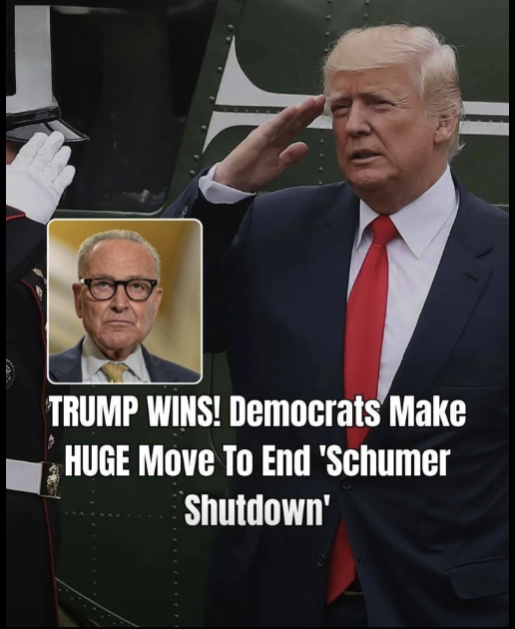
As the federal government shutdown approaches its fourth week, pressure is mounting inside the Democratic Party to find a way out of the impasse that has left hundreds of thousands of federal employees unpaid and key social programs at risk of disruption.
The shutdown — now widely referred to by critics as the “Schumer Shutdown” — began after negotiations between congressional Democrats and Republicans collapsed over spending levels and border policy. What initially appeared to be a short-term standoff has turned into a prolonged test of endurance that is beginning to take a toll on both the economy and public opinion.
Mounting Pressure on Senate Democrats
According to a report from The Hill, Senate Democrats have quietly begun exploring off-ramps to end the stalemate without appearing to capitulate to Republican demands. Lawmakers and aides say the Democratic caucus is feeling the squeeze from multiple directions — federal workers, unions, and vulnerable constituents who are beginning to feel the economic strain.
One of the ideas under discussion involves supporting a Republican proposal to ensure federal employees — both essential and furloughed — receive paychecks while the government remains closed. While Democrats initially resisted piecemeal funding bills, the worsening political optics are forcing them to reconsider.
At the same time, Democratic leaders are drafting legislation to extend funding for critical social safety net programs, including the Supplemental Nutrition Assistance Program (SNAP) and the Special Supplemental Nutrition Program for Women, Infants, and Children (WIC). Without renewed funding, millions of low-income families could face interruptions in benefits within weeks.
A Senate Democratic aide told The Hill,
“We’re trying to make sure that the most vulnerable Americans don’t bear the brunt of Washington’s dysfunction. But we also need to protect the integrity of the broader funding negotiations.”
The Political Tide Turns
What makes this shutdown different from past ones is the shifting political perception among voters. In previous standoffs, Democrats often managed to frame the narrative around Republican obstruction. This time, however, polling data suggests the public is holding Democrats responsible for the gridlock.
A recent Rasmussen survey found that 54% of likely voters blame Senate Democrats for the ongoing shutdown, compared to 39% who fault Republicans. Independent voters, a key political bloc, also appear to be breaking against the majority party in the Senate.
Political analyst Caroline Bixby noted,
“In 2018 and 2019, Democrats successfully branded the shutdown as a result of President Trump’s immigration policies. This time, they control the Senate, and the public expects them to lead. It’s harder to point fingers when you’re the one steering the chamber.”
Republicans, meanwhile, have seized the opportunity to portray the standoff as a failure of leadership by Senate Majority Leader Chuck Schumer (D-NY). House Speaker Mike Johnson (R-LA) accused Democrats of “playing politics with paychecks,” saying his party had already passed multiple funding bills that Democrats refused to consider.
“We’ve done our job,” Johnson told reporters on Monday. “We’ve passed targeted funding measures for veterans, border security, and federal workers. The Senate could end this shutdown today if they chose to.”
Growing Frustration Among Federal Workers
Beyond Washington’s political posturing, the human cost of the shutdown is becoming increasingly visible. Tens of thousands of federal employees across the country are now entering their fourth week without pay, forcing some to turn to food banks, community organizations, and short-term loans.
The American Federation of Government Employees (AFGE), the largest federal workers’ union in the U.S., has been urging both parties to reach a compromise but has recently directed its frustration squarely at Senate Democrats.
AFGE National President Everett Kelley said in a statement,
“Federal workers are not bargaining chips. Our members deserve to be paid for the work they do, and this shutdown must end now. We are calling on Senate leadership to pass a clean continuing resolution.”
According to union data, nearly 800,000 workers have been affected by the shutdown, including employees at the Transportation Security Administration (TSA), Environmental Protection Agency (EPA), and Department of Agriculture (USDA). With back pay uncertain, morale is plummeting across agencies.
Programs for Families and Children at Risk
The economic ripple effects extend beyond federal employees. Programs like SNAP and WIC, which provide essential nutrition assistance to millions of Americans, are now on the verge of running out of funds.
A USDA official told reporters that benefit payments could be disrupted within two weeks if Congress fails to act. That could affect more than 7 million low-income women, infants, and children who rely on monthly food vouchers.
Senate Democrats are reportedly drafting legislation to extend funding for those programs, along with emergency provisions to keep school lunch programs operational. However, Republicans have argued that such targeted bills only prolong the broader stalemate.
“Democrats want to patch up their political problem with temporary fixes,” said Sen. John Thune (R-SD). “The responsible approach is to reopen the government completely and negotiate a full-year budget that controls spending.”
Schumer’s Balancing Act
For Majority Leader Schumer, the political calculus is complex. He faces competing pressures — from progressives urging him to hold firm on social spending and border policy, and from moderates anxious about the growing political fallout.
Behind closed doors, Senate aides describe a divided Democratic caucus. Some senators representing swing states, such as Jon Tester (D-MT) and Sherrod Brown (D-OH), have privately expressed concern that the shutdown could damage their reelection prospects if it continues into November.
One Democratic strategist, speaking anonymously, admitted:
“The polling is bad, and the narrative is slipping away. The longer this goes on, the harder it will be to recover politically. Schumer needs a win — or at least an exit ramp that doesn’t look like surrender.”
Republicans Sensing Momentum
Republicans, sensing political momentum, are showing little appetite to compromise. They have framed the shutdown as part of a broader debate over government spending and fiscal discipline, emphasizing the need to reduce the deficit and secure the border.
Senate Minority Leader Mitch McConnell (R-KY) said,
“Democrats created this crisis by refusing to accept even modest spending reforms. They’re trying to spend their way out of every problem, and the American people are tired of it.”
House Republicans, meanwhile, have continued to pass smaller funding packages that would reopen parts of the government, effectively forcing Democrats to vote against measures to pay federal employees, veterans, and active-duty military personnel — votes that have been used to paint Democrats as obstructionist.
Economic Costs Rising
Economists warn that if the shutdown extends into next month, it could begin to slow GDP growth and undermine investor confidence. A report by Moody’s Analytics estimated that each week of the shutdown could shave 0.1% off quarterly economic output.
With holiday travel approaching, disruptions in air traffic control, passport processing, and national park operations are likely to intensify. Small businesses dependent on federal contracts or tourism have already reported financial losses.
“Every day this continues, the pain spreads,” said economist Diane Swonk. “Shutdowns don’t just affect Washington — they ripple across local economies and household budgets.”
Looking Ahead
As the shutdown nears the one-month mark, Washington’s political theater shows no sign of resolution. Democrats are increasingly eager to change the narrative, but doing so without appearing to fold remains a delicate balancing act.
Insiders say behind-the-scenes discussions are ongoing, with both parties testing possible compromise frameworks — including short-term continuing resolutions or agreements on specific budget caps.
Still, without a breakthrough, Americans may be facing a second missed paycheck for federal employees and an increasingly frustrated electorate heading into the holiday season.
Political veteran Larry Sabato summed up the situation bluntly:
“Shutdowns are a political gamble. This one has gone on long enough that everyone’s losing — but some are losing faster than others.”
Inferno in Zhytomyr: Deadly Gas Station Explosion Sparks Grief—and Suspicion
Something felt wrong in Zhytomyr Oblast yesterday afternoon. The air was too still. The hum of everyday life—cars refueling, conversations drifting between pumps—was shattered in an instant.
A deafening explosion ripped through a local gas station, sending a towering fireball into the sky and plunging the region into panic.
What should have been a routine stop turned into a scene of devastation—and questions are now rising about whether this was truly an accident, or a symptom of deeper, systemic failure.
A Normal Day, Until It Wasn’t
It was just after 4:00 p.m. when the blast struck—peak refueling hours, when the station was at its busiest.
Witnesses described the earth shuddering beneath their feet, followed by screams, shouts, and flames leaping into the air like a volcanic eruption.
“It felt like the world was ending,” said one resident, still trembling hours after the incident.
Others ran from nearby shops and homes to see black smoke billowing above the treetops—a cloud of chaos that could be seen for miles.
Casualties and Chaos
The explosion claimed at least two lives and injured 15 more, several of whom remain in critical condition. Emergency responders were on the scene within minutes, facing a chaotic and dangerous situation:
Flames engulfing nearby vehicles
Gas lines threatening further explosions
Injured civilians sprawled on the ground, screaming for help
Paramedics raced to evacuate the wounded, while firefighters battled the inferno into the night.
Hospitals across the oblast launched urgent blood donation appeals, describing an overwhelming influx of patients with burns, trauma, and smoke inhalation.
What Went Wrong?
The exact cause remains under investigation.
Ukraine’s State Emergency Service has not ruled out a technical malfunction, but early speculation also points to the possibility of human error, faulty equipment, or neglected safety protocols.
Experts warn that many fuel stations across the region—especially those outside major cities—operate with outdated infrastructure and insufficient regulatory oversight.
This incident, they say, is not an outlier.
It’s a warning.
A Community in Mourning
As the flames died down, grief set in.
Residents gathered at the site late into the night—lighting candles, laying flowers, and whispering prayers for the victims. Social media flooded with images of soot-streaked skies and heartfelt messages of support from across Ukraine.
“We are with Zhytomyr,” read one post, shared thousands of times.
A Nation Reckons With Its Infrastructure
In the wake of the explosion, calls for reform are intensifying.
Activists, safety advocates, and even local officials are demanding:
Stricter fuel station inspections
Mandatory infrastructure upgrades
Criminal accountability for safety violations
“We can’t keep calling these accidents,” said one civil safety expert. “They’re preventable failures.”
Conclusion: A Tragedy That Demands More Than Mourning
As smoke still lingers over Zhytomyr Oblast, recovery efforts are far from over. Families are grieving. Survivors are fighting for their lives. And an entire community is left to ask:
Could this have been stopped?
This was more than a tragic fire. It was a flashpoint—an alarm sounding across Ukraine’s aging infrastructure, warning that unless action is taken, it won’t be the last.
The time for reform is now—before another ordinary day becomes a headline soaked in ash and sorrow.
The news came suddenly, with little warning and no advance hints. Matthew Dowd, a seasoned political strategist and television commentator, was abruptly removed from MSNBC, leaving viewers, colleagues, and critics stunned.The announcement carried the unmistakable weight of urgency: Dowd was fired, and the network had already begun to move on without him.For years, Dowd had been a prominent presence in the political media landscape. His career began in campaign strategy, where he became known for sharp insights, data-driven messaging, and his ability to interpret the shifting winds of public opinion.Later, he transitioned into television commentary, bringing with him both an insider’s knowledge of politics and a knack for boiling complex issues into concise, provocative statements.His addition to MSNBC was initially viewed as a strategic move. The network, constantly working to balance its progressive audience with demands for nuanced coverage, had hired Dowd to provide political context rooted in both Democratic and Republican circles.His experience—ranging from work with Democratic figures to serving as chief strategist for George W. Bush’s 2004 reelection campaign—gave him a unique credibility.But credibility is fragile in the high-stakes world of modern cable news. When reports emerged that Dowd had been terminated, the immediate reaction was one of disbelief. Many journalists covering the media industry described the move as “stunning,” not because controversies are rare in the field, but because of how abruptly MSNBC severed ties.Cable news is built on a delicate balance of ratings, trust, and brand identity. Commentators who align with a network’s values typically receive protection during turbulent times.Yet Dowd, despite his established reputation, was cut loose without the sort of extended negotiations or suspensions that sometimes precede dismissals.The firing underscored the volatility of television news in an age of heightened polarization. Audiences are more vocal than ever, advertisers are sensitive to backlash, and executives often prioritize brand safety over individual loyalty.In Dowd’s case, whatever line he crossed was serious enough for MSNBC to act decisively.Dowd has never been a commentator content to play it safe. His on-air presence was marked by sharp phrasing, bold assessments, and at times a willingness to push beyond conventional boundaries. Viewers who followed his career grew accustomed to a style that mixed analysis with conviction.That same approach, however, sometimes attracted controversy. Critics accused him of speaking in sweeping generalities or allowing his own experiences to overshadow broader analysis.Supporters countered that his frankness was refreshing in a media environment too often sanitized by talking points.In television, bold commentary is both an asset and a risk. Audiences tune in for insights that go beyond headlines, but the wrong phrase at the wrong moment can spark waves of outrage. Dowd walked that line for years. This time, it appears, the balance collapsed.MSNBC has not provided a detailed public explanation. Instead, the network released a statement acknowledging the termination but avoiding elaboration.Behind the scenes, sources described heated discussions among executives about the potential damage of keeping Dowd on air versus the consequences of letting him go.Cable news executives operate in an environment where every decision is scrutinized across multiple platforms. A comment made on live television can be clipped, shared, and debated on social media within minutes.If those comments spark outrage, networks face pressure not only from viewers but also from advertisers and advocacy groups.For MSNBC, which positions itself as a progressive outlet, maintaining credibility with its audience is paramount. Allowing a commentator to remain after crossing a perceived line risked undermining that credibility.Reactions from within MSNBC have been mixed. Some colleagues expressed quiet sympathy, noting Dowd’s long experience and valuable contributions. Others were less forgiving, pointing out that on live television, discipline and judgment are essential, and lapses can carry steep costs.Privately, several staff members admitted that while they were surprised by the timing, they were not shocked that tensions existed. Dowd’s outspoken style had occasionally put him at odds with the more carefully measured tone favored by certain anchors and producers.In the competitive atmosphere of cable news, where personalities drive ratings but must also serve the network’s mission, internal conflicts are inevitable. Dowd’s departure highlights how fragile even high-profile positions can be.On social media, the news ignited heated debate. Supporters of Dowd praised him as an independent thinker who refused to bow to pressure. They described MSNBC’s decision as an overreaction, a sign that networks are too quick to silence dissenting voices.Critics, however, argued that Dowd had long been careless with his words and that his dismissal was overdue. Some accused him of using his platform to inflame rather than enlighten.The divided response reflected a broader tension in American media: the struggle to reconcile freedom of commentary with accountability. Audiences want passion and conviction, but they also demand responsibility. When those values collide, controversy follows.Dowd’s firing comes during a period of intense competition in cable news. Networks battle not only each other but also streaming platforms, podcasts, and independent online outlets that command growing audiences. In such an environment, networks must safeguard their brand identities carefully.MSNBC has carved out a niche as a progressive counterweight to conservative outlets. Its viewers expect commentary aligned with values such as inclusion, accountability, and responsibility.At the same time, MSNBC must avoid appearing rigid or intolerant of differing perspectives. Striking that balance is difficult, and Dowd’s removal illustrates the delicate calculations involved.The media industry is also grappling with declining trust. Surveys consistently show that Americans hold deep skepticism toward news organizations. Every controversy—whether involving a misstep by a commentator or a decision by executives—becomes part of that larger narrative. In this sense, Dowd’s firing is more than a personnel matter; it is a reflection of the pressures shaping journalism itself.For Dowd, the termination represents a major professional setback. Yet it may also open new opportunities. In recent years, several commentators dismissed from major networks have found success elsewhere.Podcasts, newsletters, and independent platforms provide outlets where personalities can speak freely without the constraints of corporate oversight.Dowd’s long career and established following give him a foundation to pivot if he chooses. Whether he seeks another television role, embraces independent media, or returns to political strategy, his voice is unlikely to disappear.Still, the abrupt end at MSNBC will remain a defining chapter. The dismissal highlights the risks faced by commentators who thrive on candor but must navigate a world where missteps can have immediate consequences.The firing of Matthew Dowd underscores lessons relevant to all media figures. First, visibility is power but also vulnerability. A statement that might once have been forgotten now lives indefinitely online, available to be replayed, dissected, and criticized.Second, networks are less willing than ever to shield personalities from fallout. Even established commentators can find themselves expendable if their words create enough backlash.Finally, the incident shows how blurred the line has become between analysis and activism. Commentators are often expected to provide both insight and moral clarity, but when those roles collide, controversy is inevitable.For MSNBC, the challenge is managing the aftermath. The network must reassure its audience that it acted responsibly without appearing heavy-handed. It must also fill the gap left by Dowd, either by promoting existing contributors or by bringing in new voices.In the short term, MSNBC is likely to emphasize stability. The network’s anchors and remaining commentators will continue to cover the political landscape, while executives quietly search for replacements.Long term, however, the firing raises questions about how the network defines its boundaries for commentary and what risks it is willing to tolerate.Lost in much of the debate is the human toll of such an abrupt dismissal. Dowd, like any professional, built relationships with producers, reporters, and viewers. His removal not only disrupts his career but also impacts those around him.Behind every public controversy lies private upheaval. Families, colleagues, and friends must adjust to sudden changes. In Dowd’s case, the rapid unraveling of a high-profile role is both a personal and professional crisis.The dismissal of Matthew Dowd from MSNBC is more than a headline. It is a case study in the challenges facing modern media: the clash between bold commentary and corporate caution, the pressures of audience expectations, and the ever-present threat of backlash in a hyperconnected world.For Dowd, it marks the end of one chapter and the uncertain beginning of another. For MSNBC, it represents a decisive, if controversial, act of brand preservation.And for viewers, it is a reminder that in the turbulent world of television news, nothing is permanent—not even the familiar faces that seem to define the daily discourse.