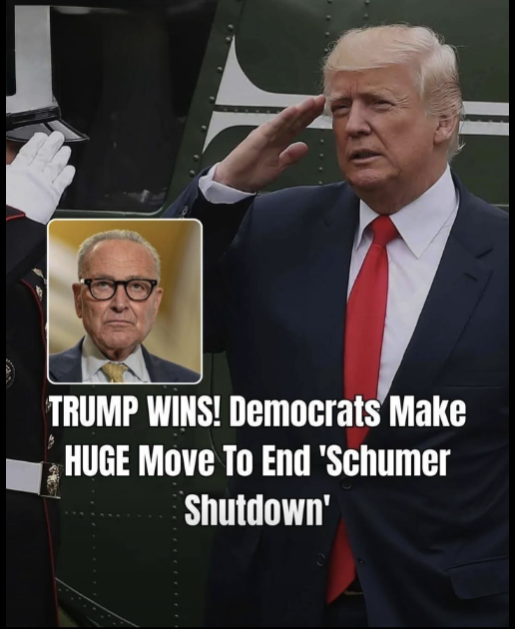
As the federal government shutdown approaches its fourth week, pressure is mounting inside the Democratic Party to find a way out of the impasse that has left hundreds of thousands of federal employees unpaid and key social programs at risk of disruption.
The shutdown — now widely referred to by critics as the “Schumer Shutdown” — began after negotiations between congressional Democrats and Republicans collapsed over spending levels and border policy. What initially appeared to be a short-term standoff has turned into a prolonged test of endurance that is beginning to take a toll on both the economy and public opinion.
Mounting Pressure on Senate Democrats
According to a report from The Hill, Senate Democrats have quietly begun exploring off-ramps to end the stalemate without appearing to capitulate to Republican demands. Lawmakers and aides say the Democratic caucus is feeling the squeeze from multiple directions — federal workers, unions, and vulnerable constituents who are beginning to feel the economic strain.
One of the ideas under discussion involves supporting a Republican proposal to ensure federal employees — both essential and furloughed — receive paychecks while the government remains closed. While Democrats initially resisted piecemeal funding bills, the worsening political optics are forcing them to reconsider.
At the same time, Democratic leaders are drafting legislation to extend funding for critical social safety net programs, including the Supplemental Nutrition Assistance Program (SNAP) and the Special Supplemental Nutrition Program for Women, Infants, and Children (WIC). Without renewed funding, millions of low-income families could face interruptions in benefits within weeks.
A Senate Democratic aide told The Hill,
“We’re trying to make sure that the most vulnerable Americans don’t bear the brunt of Washington’s dysfunction. But we also need to protect the integrity of the broader funding negotiations.”
The Political Tide Turns
What makes this shutdown different from past ones is the shifting political perception among voters. In previous standoffs, Democrats often managed to frame the narrative around Republican obstruction. This time, however, polling data suggests the public is holding Democrats responsible for the gridlock.
A recent Rasmussen survey found that 54% of likely voters blame Senate Democrats for the ongoing shutdown, compared to 39% who fault Republicans. Independent voters, a key political bloc, also appear to be breaking against the majority party in the Senate.
Political analyst Caroline Bixby noted,
“In 2018 and 2019, Democrats successfully branded the shutdown as a result of President Trump’s immigration policies. This time, they control the Senate, and the public expects them to lead. It’s harder to point fingers when you’re the one steering the chamber.”
Republicans, meanwhile, have seized the opportunity to portray the standoff as a failure of leadership by Senate Majority Leader Chuck Schumer (D-NY). House Speaker Mike Johnson (R-LA) accused Democrats of “playing politics with paychecks,” saying his party had already passed multiple funding bills that Democrats refused to consider.
“We’ve done our job,” Johnson told reporters on Monday. “We’ve passed targeted funding measures for veterans, border security, and federal workers. The Senate could end this shutdown today if they chose to.”
Growing Frustration Among Federal Workers
Beyond Washington’s political posturing, the human cost of the shutdown is becoming increasingly visible. Tens of thousands of federal employees across the country are now entering their fourth week without pay, forcing some to turn to food banks, community organizations, and short-term loans.
The American Federation of Government Employees (AFGE), the largest federal workers’ union in the U.S., has been urging both parties to reach a compromise but has recently directed its frustration squarely at Senate Democrats.
AFGE National President Everett Kelley said in a statement,
“Federal workers are not bargaining chips. Our members deserve to be paid for the work they do, and this shutdown must end now. We are calling on Senate leadership to pass a clean continuing resolution.”
According to union data, nearly 800,000 workers have been affected by the shutdown, including employees at the Transportation Security Administration (TSA), Environmental Protection Agency (EPA), and Department of Agriculture (USDA). With back pay uncertain, morale is plummeting across agencies.
Programs for Families and Children at Risk
The economic ripple effects extend beyond federal employees. Programs like SNAP and WIC, which provide essential nutrition assistance to millions of Americans, are now on the verge of running out of funds.
A USDA official told reporters that benefit payments could be disrupted within two weeks if Congress fails to act. That could affect more than 7 million low-income women, infants, and children who rely on monthly food vouchers.
Senate Democrats are reportedly drafting legislation to extend funding for those programs, along with emergency provisions to keep school lunch programs operational. However, Republicans have argued that such targeted bills only prolong the broader stalemate.
“Democrats want to patch up their political problem with temporary fixes,” said Sen. John Thune (R-SD). “The responsible approach is to reopen the government completely and negotiate a full-year budget that controls spending.”
Schumer’s Balancing Act
For Majority Leader Schumer, the political calculus is complex. He faces competing pressures — from progressives urging him to hold firm on social spending and border policy, and from moderates anxious about the growing political fallout.
Behind closed doors, Senate aides describe a divided Democratic caucus. Some senators representing swing states, such as Jon Tester (D-MT) and Sherrod Brown (D-OH), have privately expressed concern that the shutdown could damage their reelection prospects if it continues into November.
One Democratic strategist, speaking anonymously, admitted:
“The polling is bad, and the narrative is slipping away. The longer this goes on, the harder it will be to recover politically. Schumer needs a win — or at least an exit ramp that doesn’t look like surrender.”
Republicans Sensing Momentum
Republicans, sensing political momentum, are showing little appetite to compromise. They have framed the shutdown as part of a broader debate over government spending and fiscal discipline, emphasizing the need to reduce the deficit and secure the border.
Senate Minority Leader Mitch McConnell (R-KY) said,
“Democrats created this crisis by refusing to accept even modest spending reforms. They’re trying to spend their way out of every problem, and the American people are tired of it.”
House Republicans, meanwhile, have continued to pass smaller funding packages that would reopen parts of the government, effectively forcing Democrats to vote against measures to pay federal employees, veterans, and active-duty military personnel — votes that have been used to paint Democrats as obstructionist.
Economic Costs Rising
Economists warn that if the shutdown extends into next month, it could begin to slow GDP growth and undermine investor confidence. A report by Moody’s Analytics estimated that each week of the shutdown could shave 0.1% off quarterly economic output.
With holiday travel approaching, disruptions in air traffic control, passport processing, and national park operations are likely to intensify. Small businesses dependent on federal contracts or tourism have already reported financial losses.
“Every day this continues, the pain spreads,” said economist Diane Swonk. “Shutdowns don’t just affect Washington — they ripple across local economies and household budgets.”
Looking Ahead
As the shutdown nears the one-month mark, Washington’s political theater shows no sign of resolution. Democrats are increasingly eager to change the narrative, but doing so without appearing to fold remains a delicate balancing act.
Insiders say behind-the-scenes discussions are ongoing, with both parties testing possible compromise frameworks — including short-term continuing resolutions or agreements on specific budget caps.
Still, without a breakthrough, Americans may be facing a second missed paycheck for federal employees and an increasingly frustrated electorate heading into the holiday season.
Political veteran Larry Sabato summed up the situation bluntly:
“Shutdowns are a political gamble. This one has gone on long enough that everyone’s losing — but some are losing faster than others.”
The Trump administration has begun a sweeping shake-up within the federal immigration court system, quietly dismissing dozens of judges as part of a larger effort to overhaul what officials describe as a “dysfunctional and overly politicized” system.
According to a report from El País, around 50 immigration judges have been removed from their positions since the beginning of August, while another 50 have reportedly been transferred or encouraged to retire. The move follows a White House directive to streamline immigration proceedings and reduce the record 3 million-case backlog that has built up over recent years.
The dismissals were delivered through short, formal notices—typically brief emails informing judges that their service was no longer required. No public announcement was made, but the message was clear: the administration is determined to reshape the immigration judiciary.
A System Under Scrutiny
President Donald Trump has long criticized what he calls “activist judges” who he believes have hindered immigration enforcement through lenient rulings. The latest actions appear to be a direct response to those frustrations, signaling a new phase of the administration’s broader effort to restore control and consistency to the system.
Some of the dismissed judges have gone public, claiming they were targeted for their prior rulings or political leanings. Among them is Jennifer Peyton, appointed during the Obama administration in 2016. She said she received her dismissal notice while on vacation, with no prior warning or disciplinary record.
“I was shocked,” Peyton said, alleging that her removal may have been politically motivated. She suggested that conservative groups had pressured the administration to remove her after she gave a courthouse tour to Democratic Senator Dick Durbin.
Sen. Durbin, who chairs the Senate Judiciary Committee, called Peyton’s removal an “abuse of power,” accusing the administration of attempting to intimidate the judiciary.
However, supporters of the shake-up argue the opposite—saying the move represents an overdue accountability effort within a system that has long operated without sufficient oversight.
Union Pushback and Claims of Discrimination
The National Association of Immigration Judges (NAIJ), which represents immigration judges nationwide, confirmed that roughly 50 judges have been dismissed so far. Its president, Matt Biggs, said the remaining judges are “deeply concerned” about the direction the administration is taking.
“Morale is low, and there’s a sense of fear,” Biggs told reporters. “Judges are uncertain whether their decisions will be second-guessed by political officials.”
Some judges have also claimed that the dismissals were discriminatory. Carla Espinoza, who served as a short-term immigration judge in Chicago, said her contract was not renewed because of her gender and Hispanic background.
Espinoza’s case, however, has drawn scrutiny. She reportedly dismissed charges against a Mexican national who had been flagged by Homeland Security after being falsely accused of threatening the president. Espinoza later described her ruling as “fair and justified,” but critics within DHS say it exemplified the kind of decision-making that has frustrated federal authorities.
Restructuring and the Bigger Picture
Administration officials maintain that the dismissals are not politically motivated, but rather part of a broad restructuring of the immigration courts.
“This isn’t about punishing anyone—it’s about performance, efficiency, and restoring faith in the system,” a senior DHS official said on background. “For too long, certain judges have ignored enforcement priorities and created unnecessary backlogs. That’s changing.”
The Executive Office for Immigration Review (EOIR), which oversees the nation’s immigration courts, has been directed to conduct a full review of judicial caseloads, case outcomes, and performance metrics. Officials say the goal is to identify bottlenecks and improve consistency across regions.
At the same time, the White House has reportedly begun recruiting new judges with backgrounds in law enforcement, national security, and immigration prosecution—part of an effort to align judicial leadership with the administration’s enforcement agenda.
Critics Call It Political Retaliation
Legal analysts and civil rights groups have sharply criticized the move, describing it as an unprecedented attempt to politicize the judiciary.
“This is a dangerous precedent,” said Julia Hernandez, a senior attorney with the American Immigration Council. “Firing judges because their rulings don’t align with political goals undermines judicial independence and erodes the rule of law.”
Democratic lawmakers have echoed that concern, accusing the administration of using dismissals to send a message to remaining judges.
Still, administration allies insist the actions are necessary. “This isn’t a purge—it’s reform,” said one senior aide to the president. “The American people are tired of seeing immigration laws ignored. The system is finally being held accountable.”
A Long Road Ahead
With more than three million pending cases still clogging the system, the immigration courts face a monumental challenge. While the recent dismissals may speed up some proceedings, experts warn that the short-term disruption could create confusion and delays as new judges are appointed and reassigned.
For now, the administration appears undeterred. President Trump has made immigration enforcement a central pillar of his second term, framing the issue as a matter of national security and sovereignty.
“The days of activist judges standing in the way of border enforcement are over,” one White House official said. “We’re restoring fairness, consistency, and respect for the law.”
Whether the shake-up succeeds in achieving that goal—or sparks further controversy—remains to be seen. But one thing is clear: the immigration courts, long viewed as insulated from political upheaval, are now at the center of one of Washington’s most consequential power struggles.