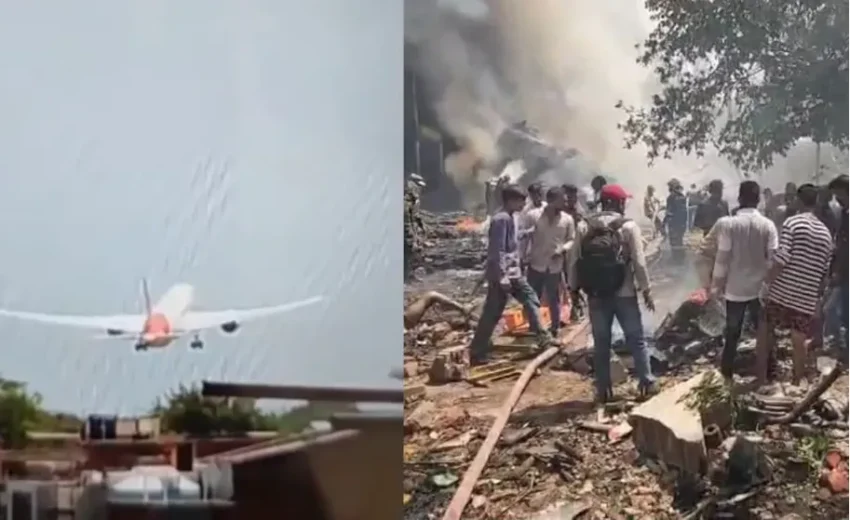
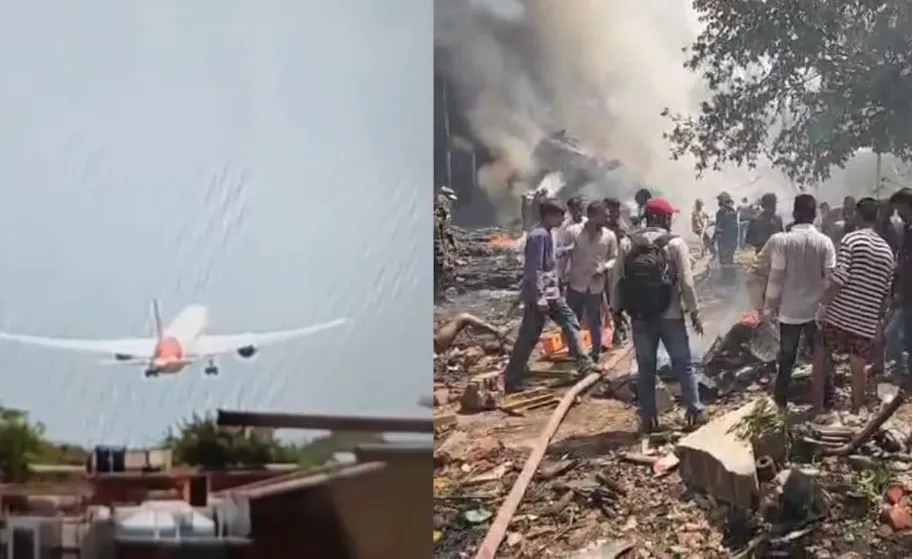
On June 12, 2025, an Air India flight experienced a critical emergency immediately after departure from Ahmedabad. The pilot’s urgent Mayday call was the final communication before tragedy struck. Here’s what the Mayday signal means, when it’s used, and why it’s crucial in aviation emergencies.
The Incident: Air India Flight AI-171 Issues Mayday Before Crash
An Air India Boeing 787 Dreamliner, operating as Flight AI-171 and bound for London Gatwick, made a distress call moments after taking off from Sardar Vallabhbhai Patel International Airport in Ahmedabad on Thursday, June 12. The aircraft was carrying 242 individuals, including crew and passengers.
According to initial reports confirmed by the Directorate General of Civil Aviation (DGCA), Captain Sumeet Sabharwal, who was commanding the flight, issued a Mayday call to Air Traffic Control (ATC) within seconds of takeoff. The signal was the last communication from the aircraft before it lost radar contact and crashed into a residential area in Meghaninagar at approximately 1:39 PM IST.
Plumes of black smoke were seen rising from the site as emergency teams responded swiftly. Despite repeated attempts by ATC to reestablish contact, no further communication was received after the distress call.
What Is a Mayday Call?
Origin and Definition
The term “Mayday” is an international distress signal used in aviation and maritime communications. It is reserved for situations involving immediate, life-threatening emergencies. The signal must be repeated three times consecutively – “Mayday, Mayday, Mayday” – to ensure it is clearly understood and receives top priority.
The word “Mayday” originates from the French phrase “m’aider”, which translates to “help me.” It was introduced in the 1920s by Frederick Stanley Mockford, a senior radio officer at Croydon Airport in London. By 1927, the term was officially adopted as the standard voice call for distress under the International Radiotelegraph Convention. It complements the Morse code signal “SOS” for emergencies.
Mayday vs. Pan-Pan
While Mayday denotes an urgent, life-threatening situation, a Pan-Pan call is used for less severe emergencies where immediate assistance is not necessary. For example, a Pan-Pan might be issued for non-critical technical issues or minor medical problems.
In contrast, a Mayday implies “grave and imminent danger” that demands immediate intervention, such as:
Engine failure
Fire on board
Structural damage
Rapid cabin depressurization
Severe weather conditions
Onboard medical emergency endangering lives
The Standard Procedure for Mayday Calls
When a Mayday call is made, pilots are trained to deliver a structured message containing essential information to help coordinate a response. The following details are typically included:
Aircraft identification and type
Current position and heading
Nature of the emergency
AltitudeFuel on board
Number of persons aboard
Pilot intentions
This protocol allows air traffic controllers and emergency response teams to prioritize the distressed aircraft, prepare for a potential emergency landing, and mobilize relevant services like fire crews, ambulances, and recovery units.
What Happens After a Mayday Is Received?
Once ATC receives a Mayday transmission, all non-essential radio communication is suspended. Controllers immediately:
Assign a dedicated frequency to the distressed aircraft
Alert airport emergency services
Coordinate with nearby airports in case of diversion
Re-route other aircraft to clear the airspace
Provide navigation and weather information as needed
Air traffic control may also notify national aviation safety authorities and, in extreme cases, military air traffic controllers for added support.
In the case of Air India Flight AI-171, the rapid issuance of a Mayday signal meant that rescue operations could be activated immediately, even though communication was lost shortly afterward.
Legal Framework and Misuse of Mayday Calls
Issuing a Mayday call is a serious matter and is governed by strict regulations. Making a false Mayday transmission is a criminal offense in most countries and may result in fines or imprisonment.
The Federal Aviation Administration (FAA) and other aviation authorities require pilots to undergo rigorous training on when and how to declare emergencies. The use of a Mayday call is only permitted in genuine, life-threatening circumstances.
This legal structure ensures the credibility of distress calls and prevents unnecessary disruptions to air traffic systems.
Why the Mayday Call Matters in the Ahmedabad Crash
Timely Action by the Flight Crew
Though the crash resulted in a tragic outcome, the fact that a Mayday call was made promptly shows the flight crew’s professionalism and strict adherence to safety protocol.
Even in a crisis unfolding within moments of takeoff, the crew was able to:
Recognize the emergency
Decide on the severity of the situation
Communicate the distress call effectively
This transmission will prove crucial in investigative efforts as authorities attempt to reconstruct the chain of events and determine the root cause of the crash.
Information for Investigators and Responders
Emergency calls like Mayday help:
Identify the last known position of the aircraft
Clarify the nature of the malfunction or emergency
Support timeline analysis of the incident
Assist in black box data correlation
This initial data can help agencies such as the DGCA and Air Accident Investigation Bureau (AAIB) assess whether the incident was due to technical malfunction, external interference, pilot error, or environmental factors.
Broader Implications for Aviation Safety
Reinforcement of Emergency Protocol Training
Aviation authorities worldwide frequently use real-world incidents to improve pilot training programs. The Ahmedabad crash and the Mayday signal will likely be integrated into safety briefings and simulation scenarios to help future pilots respond effectively in similar crises.
Role of ATC and Airport Emergency Readiness
The situation also puts a spotlight on the readiness of ATC teams and airport emergency units. Effective coordination among these teams is essential for:
Minimizing loss of life
Ensuring efficient evacuation or firefighting response
Preserving evidence for investigation
Sardar Vallabhbhai Patel International Airport temporarily suspended flight operations following the incident, focusing entirely on rescue and recovery efforts.
Enhancing Aircraft Systems and Communications
The accident may prompt a review of:
Aircraft design and reliability of systemsReal-time telemetry and flight data streaming
Redundancy in communication systems
These considerations aim to further improve flight safety standards, especially in densely populated or urban takeoff corridors.
Conclusion
The Mayday call issued by Air India Flight AI-171 seconds after takeoff was a vital part of the emergency response process, even though the aircraft tragically crashed shortly afterward. The transmission signified a clear and immediate threat, initiated swift rescue efforts, and provided critical information for investigators.
Understanding what a Mayday call is, how it’s used, and its legal and operational importance reveals the complex layers of aviation safety protocols that are in place to protect lives in the sky. As investigations unfold, the lessons learned from this incident will contribute to strengthening the aviation industry’s commitment to safety, preparedness, and rapid emergency response.
Sources
Directorate General of Civil Aviation – India
Federal Aviation Administration – Emergency Procedures
International Civil Aviation Organization (ICAO)
Unlikely Senate Duo Crosses The Aisle To Help End Government Shutdown
While it’s true the modern political climate in the United States is heavily divided along party lines, Pennsylvania Senators Dave McCormick (R) and John Fetterman (D) have been bucking the trend by providing an encouraging example of bipartisanship.The two senators recently released a video urging an end to the government shutdown, which is beginning to take a toll on average Americans. The collaboration features Fetterman saying, “Even though we are in a different party, we both want to talk about why we believe it’s so important to reopen this government.”
McCormick shares this sentiment in the video by saying, “23 days, 12 votes, Senator Fetterman and I have both voted to open up the government. We agree on that 100%. It’s really starting to hurt Pennsylvania.”
Some of the folks who are now beginning to feel the pinch from the shutdown include air traffic controllers and border patrol agents who are working to secure the border and keep the country safe. Resources set aside for two million SNAP users are starting to run low, which means those who use the service to support their families during tough economic times could go without the resources they need to get by.
By acknowledging this reality, both senators are demonstrating a commitment that goes beyond party allegiance and addresses their constituents’ concerns and needs.
Both senators have also been deeply involved in efforts to pass bills that would alleviate the suffering caused by the shutdown. They voted in favor of a measure to pay certain federal workers during the deadlock. Unfortunately, these measures did not pass in the Senate.
Many are hoping that the bipartisanship on display between McCormick and Fetterman will rub off on others in the Senate and help heal some of the division that is ripping the country apart and preventing an agreement that will get the government up and running.
Conservatives and even a handful of Democrats are hopeful that seeing these two work together for the betterment of their constituents will lead others to see that collaboration between individuals with different political ideologies is possible when politicians, elected to represent the people, put the needs of others above their own.While there are many different areas of disagreement between Republicans and Democrats concerning the shutdown, providing healthcare for illegal aliens is one of the biggest hurdles to cross. President Donald Trump has made it clear he will not compromise on this issue.
JD VANCE LAUNCHES NATIONWIDE INVESTIGATION INTO VOTER FRAUD
JD VANCE LAUNCHES NATIONWIDE INVESTIGATION INTO VOTER FRAUD — AND POINTS THE FINGER THAT STUNNED AMERICA
The Capitol chamber was silent when it happened. The tension in the room was heavy, the kind that only comes before a political earthquake. Vice President
For weeks, rumors had been circulating about irregularities in ballot counts, missing voter ID checks, and digital inconsistencies. Most dismissed them as noise. But then Vance stepped forward with what he called “irrefutable evidence” — evidence, he claimed, that could “shake the very foundation of public trust.”
“Fairness must always come before politics,” he declared. “If America loses faith in its elections, then we’ve already lost everything else.”
It was a statement that drew both applause and alarm. But no one expected what would happen next.
It all began quietly — a few reports of discrepancies from poll workers in New York City. Several precincts had flagged suspicious patterns: duplicate ballots, misprinted barcodes, and unexplained entries in digital voter logs. At first, local officials brushed them aside as “technical errors.”
But when one whistleblower came forward claiming that certain absentee ballots were being “processed twice” through the scanning system, the situation escalated.
Within 48 hours, the Department of Justice had been alerted. Within a week, Vice President JD Vance personally requested access to the case files. And within a month, he was standing in front of Congress, calling for a
“This isn’t about one election,” Vance said during his address. “It’s about ensuring that every American vote — Republican or Democrat — is counted honestly.”
Vance’s tone that day was calm, but the fire behind his words was unmistakable.
He laid out a series of documents, displaying charts, timestamps, and digital records allegedly showing inconsistencies in vote counts across multiple boroughs. According to him, the data pointed to “a systematic manipulation of ballot entries,” though he stopped short of naming individuals.
“Whether it’s an error, negligence, or deliberate fraud,” he said, “we will find out. No one is above accountability — not politicians, not officials, not anyone.”
The room buzzed with tension. Democrats accused him of fearmongering. Republicans rallied behind him, demanding transparency. But as the minutes passed, Vance’s evidence began to paint a chilling picture.
He claimed that some ballot boxes had been tampered with before collection, and others were linked to private organizations with partisan affiliations. “We have receipts,” he added, “and we’re not afraid to use them.”
Just when it seemed the hearing had reached its peak, Vance paused mid-sentence. He looked across the chamber, his eyes narrowing.
Then, slowly, he raised his hand and pointed — directly at someone sitting in the audience.
Gasps filled the room. Cameras swiveled. Every eye turned to see who it was.
At first, the figure looked calm, even dismissive. But as Vance’s gaze remained fixed, whispers began to ripple through the crowd. The person in question was a high-ranking New York election official
“You told this nation there was nothing to see,” Vance said firmly. “But the evidence says otherwise.”
The official’s face went pale. Reporters scrambled to capture the moment. Within seconds, social media exploded. Clips of Vance’s finger-pointing were trending under the hashtag #VanceExposesTruth.
The hearing devolved into chaos. Security moved in as reporters shouted questions. Members of both parties exchanged accusations across the aisle. And through it all, Vance remained steady, his expression unreadable.
In the days that followed, the documents Vance referenced were released to the public. They included internal emails between election supervisors discussing “ballot batch irregularities,” time-stamped photos of double-processed envelopes, and forensic data showing unusual access patterns in New York’s electronic voter registration system.
Independent analysts confirmed that while not all the data proved deliberate fraud, the sheer number of irregularities was “highly unusual.”
“This is not a small discrepancy,” said one cybersecurity expert. “This is systemic. It points to either gross mismanagement or something far more intentional.”
Vance seized on that conclusion, calling for bipartisan oversight committees in every state. “We need to rebuild trust,” he said. “And trust only comes from transparency.”
Predictably, the fallout was immediate.
Democrats accused Vance of politicizing the issue, claiming his investigation was an attempt to discredit their string of recent victories in mayoral races across the country.
“Every time Democrats win, Republicans cry fraud,” one senator said. “This is just another political stunt.”
But the evidence made that argument harder to sustain. Even neutral observers began demanding answers.
Meanwhile, the Republican base hailed Vance as a hero — a man willing to confront what others ignored. His approval ratings surged, and calls for him to lead a national election reform task force began circulating within hours.
Conservative commentator Jeanine Pirro praised the move as “a defining moment for justice in American democracy,” while others warned that the investigation could spark a constitutional crisis if wrongdoing was proven at higher levels.
In a follow-up press conference, Vance reiterated his stance.
“This investigation isn’t about party lines,” he said. “It’s about one principle — fairness. Every citizen deserves to know that their vote carries equal weight, and I will not rest until that’s guaranteed.”
He emphasized that those found guilty of tampering with ballots or violating election law would face the maximum federal penalty.
“Anyone caught undermining democracy will pay the highest price — prison, public disgrace, and the permanent loss of trust,” he stated. “This isn’t a warning. It’s a promise.”
The firmness of his tone sent chills through the press room.
JD Vance’s rise to political prominence has been anything but conventional. Once a venture capitalist and author, he entered politics with a reputation for candor and an unyielding sense of accountability. His brand — part populist reformer, part traditionalist conservative — has resonated deeply with voters disillusioned by establishment politics.
But this investigation has elevated him to a new level entirely.
Supporters call him “the watchdog America needed.” Critics call him “dangerous.” Either way, his move has reignited a national debate about
As the federal probe expands, more officials are expected to be questioned, and state legislatures across the country are already reviewing their own voting systems.
But the public remains divided. Some see Vance’s crusade as the dawn of accountability. Others fear it will deepen mistrust and polarization.
For now, one thing is certain: the nation is watching. Every word, every document, every new piece of evidence is being scrutinized by a population desperate to know the truth.
And as for the moment when JD Vance pointed across that crowded hearing room — that single gesture has already entered political history. It was more than a dramatic flourish. It was a message.
A message that someone, somewhere, had finally decided to stop looking the other way.
As Vance himself put it in closing:
“Democracy doesn’t collapse when people cheat. It collapses when good people stay silent. I refuse to stay silent.”
Whether history remembers this as the start of a reckoning or another chapter in America’s endless political battles, one thing is undeniable: JD Vance has set something in motion that no one can ignore — and the truth, whatever it is, will have consequences far beyond New York.