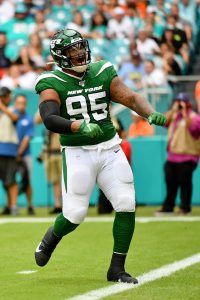
The Jets decided against selling off auxiliary cogs at the trade deadline, opting instead to gut the core of their team by trading Sauce Gardner and Quinnen Williams in barely an hour. While the team collected three first-rounders and more from the Colts and Cowboys in those swaps, the current regime will be tasked with high-profile efforts to replace two All-Pros.
Competing with the Jaguars to land Williams, the Cowboys entered into serious trade talks with the Jets on Monday, ESPN’s Rich Cimini notes. The Jets were not a lock to deal Williams to the Jags had the Cowboys not upped the ante, as Gang Green needed to be “blown away” to give in on Williams’ trade push. The Cowboys giving the Jets the sweetener of having access to the higher of Dallas’ 2027 first-rounders finalized the trade, Cimini adds.
Months before Williams was dealt, he had made it known on multiple occasions he would like to be moved. The seventh-year veteran’s tweet about another rebuilding year being likely — a social media salvo launched after the team’s plans to release Aaron Rodgers became known — did not go over well with some in the organization, Cimini adds.
Williams later admitted a mistake there, but the three-time Pro Bowler made no secret about his frustration with the Jets’ losing ways. The Jets have not made the playoffs since 2010 — far and away the NFL’s longest-running drought — and Williams went 0-for-6 in .500 seasons as a Jet, with the team topping out at seven wins during his tenure. The Jets have won two straight, though they started 0-7 as Justin Fields struggled. The picks obtained in the Gardner and Williams deals figure to be aimed at acquiring a long-term quarterback answer.
The Jets had also used Williams more as a three-technique tackle in Aaron Glenn‘s scheme, after he had played more nose previously. While Williams’ snap percentage in the A-gap did not decline noticeably under Glenn, Cimini said the subtle position shift contributed to his unhappiness. Williams, 27, now joins Kenny Clark, Osa Odighizuwa and Solomon Thomas in a suddenly crowded Cowboys D-tackle corps.
Adding Williams does create a complication for a Cowboys team now carrying three $20MM DT salaries. The team plans on using all three when it uses five on-ball defenders, according to ESPN’s Dan Graziano. Though, only two will play when the team is using four down linemen.
The Cowboys are planning to be creative to get all three on the field at once, per Graziano, though it will be interesting to see the snap percentages when Williams, Clark and Odighizuwa share the field. The Cowboys believe Williams’ presence will also help a struggling sect of edge rushers draw more favorable matchups.
This NFL period has involved far more sub-package sets than base defenses, and teams do not make a habit of including DTs as edge rushers when in nickel. That adds more scrutiny to Dallas’ decision to trade two premium picks for Williams after already paying Odighizuwa (four years, $80MM) in March and then taking on Clark’s three-year, $64MM Packers extension in the Parsons trade.
Odighizuwa’s 2026 money is fully guaranteed, while Clark’s through-2027 contract does not have any guarantees beyond this season. Beyond Kirk Cousins, the Chiefs have the NFL’s most expensive backup (tackle Jaylon Moore, who is at $15MM per year). The Cowboys’ base 4-3 alignment figures to vault either Clark or Odighizuwa past Moore.
It would be odd for the Cowboys to bail on Clark after prioritizing him in the Parsons trade, but Dallas carrying three $20MM-per-year DTs — with Williams having previously pushed the Jets for a contract rework (and not yet receiving it) — to go with a $60MM-AAV quarterback (Dak Prescott) and $34MM-per-year wide receiver (CeeDee Lamb) will be a challenge. A Williams extension would reduce his 2026 cap number, slated to check in at $21.75MM.
The team may need to find another rookie-contract edge rusher, as the Parsons void remains at that position. Keeping its two 2026 first-rounders will help on that end, but for the time being, how Matt Eberflus deploys his three high-priced DTs during this season’s second half will be very interesting and perhaps prove telling about the team’s long-term plans.
“We obviously value Shota a ton. He was amazing for us as a pitcher and a teammate, and I don’t want to close that door completely.”
— Jed Hoyer, Cubs President of Baseball Operations, hints at a possible reunion with Shota Imanaga despite contractual differences.
The Chicago Cubs are making waves in the MLB with a calculated, high-stakes game of contractual chess involving pitcher Shota Imanaga. In a move that left many analysts speculating, the Cubs opted not to exercise their team option on the 32-year-old lefty starter, which would have activated a $57 million three-year extension. Instead, Imanaga was allowed to decline his $15 million player option, making him a free agent. But this wasn’t the end of the story—it was only the beginning of a complex negotiation play by the Cubs.
In a surprising but strategic move, the Cubs extended a qualifying offer of over $22 million for the 2026 season, adding another layer to their intricate chessboard. If Imanaga chooses to sign elsewhere, the Cubs stand to gain draft pick compensation. But even more intriguing is the possibility of bringing Imanaga back at a lower cost, potentially securing him for a team-friendly deal. The Cubs, in essence, appear to be betting that the market for Imanaga will be less than expected due to his shaky 2025 season.
Coming off a rough year where injuries and inconsistency (especially with home runs) hindered his performance, Imanaga struggled to find his footing. Despite a 3.73 ERA in 2024, the 2025 season exposed cracks in his game. His poor September (6.51 ERA) and even worse playoff performance (8.10 ERA in two starts) left many questioning if the league had figured out his pitching style. Yet, the Cubs are clearly not ready to let go of him just yet, with Hoyer commenting on the importance of a potential reunion.
“It’s a complicated structure. Ultimately, we didn’t think that the club option was the right value, and he didn’t think the player option was right for him,” Hoyer said. Despite these differences, the door remains open for talks, and the Cubs seem confident that Imanaga could return on a deal more suited to both sides’ needs.
While Jon Heyman of the New York Post reports that Imanaga is likely to decline the $22 million offer, it doesn’t completely shut the door on a return to the Cubs. With Imanaga’s market value potentially lower than anticipated, the Cubs may offer him a two-year deal with a lower base salary, but with performance-based incentives to increase his potential earnings.
As the clock ticks toward the November 18 deadline for Imanaga to accept or decline the Cubs’ offer, the entire MLB is watching. Will Imanaga take a chance on free agency, or will the Cubs’ gamble on a reunion pay off? With both sides needing each other in a market that’s not guaranteed to be kind to Imanaga, the situation remains fluid. And in this game of high-stakes baseball, anything can happen.