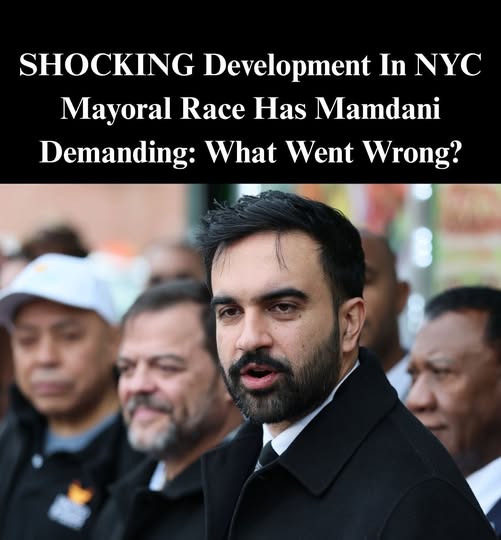
Radical socialist Zohran Mamdani’s lead over former Democratic Gov. Andrew Cuomo in the race to become the next mayor of New York City has narrowed to just 6.6 points — the tightest margin since July — according to a new AtlasIntel poll released Saturday.
The survey shows Mamdani leading with 40.6% of the vote, while Cuomo, running as an independent, has climbed to 34% just days before Tuesday’s election, The New York Post reported
.
“The gap is closing fast — we can feel it on the ground everywhere from the Bronx to Staten Island. At this rate, we win the race. Keep going strong,” Cuomo said.
“Six points in this election is nothing,” he added while campaigning in Brownsville, Brooklyn.
Cuomo credited his late-campaign momentum to what he called a voter awakening about Mamdani’s unrealistic promises, including proposals for free bus service and city-run grocery stores.
“What has happened is, in the primary, Zohran got away with his TikTok band and a smile,” Cuomo said. “He had his slogans — ‘freeze the rent,’ ‘free buses,’ ‘free food’ — and that was enough. But now people have found out what he’s about.”
“There is no free food, there are no free buses, and he can’t raise corporate taxes statewide and dedicate them to New York City. That can’t happen,” Cuomo said.
AtlasIntel CEO Andrei Roman said Cuomo’s comeback underscores deep voter anxiety about Mamdani’s far-left agenda.
“From not being inspirational to being really hated and terrifying people — that’s a major difference,” Roman said. “That’s what’s happening with Mamdani.”
Roman added that Cuomo’s path to victory depends on consolidating moderate Democrats, independents, and disaffected Republican voters.
The new poll also gave Republican candidate Curtis Sliwa his highest mark since summer, showing him at 24.1%, up from 22% in a HarrisX survey in July.
The results sharply contrast with two earlier polls that showed Mamdani holding a comfortable double-digit lead.
A Fox News poll released Thursday had Mamdani at 47%, Cuomo at 31%, and Sliwa at 15%.
An Emerson College poll the same day showed Mamdani at 50%, Cuomo at 25%, and Sliwa at 21%.
RealClearPolitics’ polling average still gives Mamdani a 14.5-point advantage, with 45% support to Cuomo’s 31% and Sliwa’s 17%.
However, the AtlasIntel numbers suggest the race may be shifting rapidly in its closing days.
In a hypothetical two-man race without Sliwa, the poll found Cuomo would lead Mamdani 50% to 42%.
Political analysts say that the result reflects growing frustration with Mamdani’s anti-police positions and statements critical of Israel — views that have alienated moderate Democrats and Jewish voters in key boroughs.
Mamdani appeared at an event in Harlem on Saturday at Rev. Al Sharpton’s National Action Network, where he brushed off suggestions of a tightening race.
“I’m not worried at all,” he told reporters. “I continue to be confident, but I never let that confidence become complacency.”
Cuomo, meanwhile, spent Saturday in Brighton Beach, Brooklyn, where he told supporters there is “no way” Sliwa can win.
“He can only make Zohran Mamdani win,” Cuomo said.
The AtlasIntel poll surveyed registered voters from Oct. 29 to Nov. 1 and has a margin of error of three percentage points.
According to the New York City Board of Elections, nearly half a million residents have already voted early, a significant increase over 2021 turnout levels.
With the election just days away, Mamdani’s once-commanding lead has now narrowed into a fight that could go down to the wire.
It began as a routine House Judiciary Committee hearing, but by the time it ended, the event had become the most-watched political drama in American history. Alexandria Ocasio-Cortez (AOC), one of the nation’s most visible and controversial progressive figures, found herself at the center of a storm that would shake the foundations of Congress, the media, and the very concept of political authenticity.
The tension in the hearing room was palpable from the start. AOC, dressed in her signature red Valentino blazer, stood at the microphone, a stack of documents in hand. Her opening salvo was as sharp as it was theatrical: “Director Patel, you’re a fascist running a Gestapo, and I have the evidence right here.”
Millions watched live as she accused FBI Director Kash Patel of weaponizing federal law enforcement against progressive members of Congress. Her words, chosen for maximum impact, reverberated across social media, instantly trending under hashtags like #AOCvsPatel and #PoliceStateExposed.
Behind AOC, her media-savvy team live-streamed the event, their captions blaring “AOC DESTROYS FASCIST FBI DIRECTOR” and “EXPOSING THE POLICE STATE LIVE.” The stage was set for a battle of wits and reputations.
Patel, in a plain suit and with a calm demeanor, sat motionless at the witness table. He let AOC’s accusations hang in the air, watching her with the detachment of someone who had seen this play before.
When AOC demanded he respond to the “leaked FBI memoranda” she wielded, Patel’s reply was quiet but devastating: “Congresswoman, may I see these documents?” The request was not what her team had anticipated. They had prepared for denial, deflection, or claims of executive privilege. Instead, Patel’s simple demand for transparency shifted the energy in the room.
Upon inspection, Patel revealed a crucial detail: the watermark on the documents was from a 2019 design, but he had only become director in 2025. “Those documents are forgeries,” he stated. The committee room fell silent as viewers at home saw the comment feeds slow, replaced by question marks and stunned emojis.
Patel didn’t stop at exposing the forgery. He opened his own briefcase, revealing folders meticulously labeled: “Met Gala Deception,” “Robert’s Scheme,” “Capital Mythology,” “Green New Deal Grift,” and “The Yorktown Files.” Each folder contained evidence, not just of AOC’s alleged misdeeds, but of a pattern of deception stretching back years.
He began with the infamous “Tax the Rich” Met Gala dress. Patel produced receipts, loan agreements, emails, and legal demands showing that AOC had not returned borrowed designer items, totaling $57,700 for one night’s outfit. The pattern, Patel argued, was not mere oversight but a calculated scheme: borrowing luxury goods, never returning them, and funneling campaign funds to designers under the guise of consulting fees.
Patel’s next folder detailed payments to AOC’s husband, Riley Roberts, through a web of LLCs and consulting contracts. According to campaign finance records, Roberts had received $890,000 for “digital marketing consulting,” yet staff depositions revealed no evidence of actual work produced. Patel traced $3.7 million in payments from progressive organizations to Roberts’s companies, all tied to gaining access to AOC.
Emails and text messages painted a damning picture: Roberts was allegedly selling legislative support. “Your husband was selling your vote,” Patel declared. Texts between AOC and Roberts suggested she was not only aware of the scheme, but actively directing it.
Patel then turned to January 6th, 2021. Security footage, phone records, and staged photographs suggested AOC was never in danger during the Capitol riot, yet she negotiated book deals and speaking engagements in real time. Her “survivor” narrative, Patel alleged, was crafted for profit, resulting in $7.7 million in earnings from appearances, book advances, and a Netflix documentary.
Therapy records showed only two sessions, one focused on maximizing the media narrative. Texts revealed a premeditated strategy: “If anything happens, we need to be ready to own the narrative. This could be our Reichstag fire moment.”
Patel’s fourth folder revealed SEC records showing AOC’s college roommate and other associates made millions trading renewable energy stocks days before major policy announcements. Texts suggested AOC advised these trades, justifying them as “political intelligence.” The pattern expanded to pharmaceutical and defense stocks, with evidence of coordination with corporate executives for mutual profit.
“Trading on the future you’re creating,” Patel said, “is not governance. It’s racketeering.” Estimated profits from insider trading: $47 million.
The final folder exposed alleged fabrications in AOC’s personal biography. Property records, school enrollments, employment and lease agreements, and social media posts suggested her “Bartender from the Bronx” persona was manufactured. Patel presented evidence that she grew up in affluent Westchester County, worked only six shifts as a bartender, and staged photos in a friend’s apartment.
Her voter registration used a Bronx business address to gain city resident discounts. Patel concluded, “You’re not Alexandria from the Bronx. You’re Sandy from Westchester playing a character designed by political consultants.”
As Patel finished, FBI agents entered the room. AOC’s staff had abandoned their posts, her live stream cut to an error message, and her carefully constructed persona unraveled in real time. Her voice, stripped of its practiced Bronx cadence, revealed the tones of Westchester privilege.
Her arrest became the most-watched political event in American history. Memes flooded the internet, pairing her “Tax the Rich” dress with images of her Yorktown Heights mansion. The communities she claimed to represent felt betrayed, and young activists who had looked up to her expressed heartbreak.
Democrats distanced themselves overnight, and the progressive movement was rocked by revelations that other “authentic” candidates had similarly fabricated their biographies. Financial markets crashed as investors realized the extent of insider trading linked to political announcements.
Riley Roberts was arrested at JFK airport, attempting to flee. The Justice Democrats’ leadership was indicted for conspiracy. Seven other representatives were implicated. The “Authenticity Act” was rushed through Congress, requiring extensive background verification for all federal candidates and strengthened financial disclosure laws.
In her trial, AOC was found guilty on all counts: fraud, theft, insider trading, conspiracy, money laundering, and false statements. She was sentenced to 25 years without parole. The progressive policies she championed suffered from association with her corruption, and the authenticity of all politicians was called into question.
In the end, the saga of Alexandria Ocasio-Cortez served as a cautionary tale about the dangers of manufactured authenticity and unchecked ambition. As a Bronx organizer put it, “She didn’t just lie about who she was. She made it harder for those of us who actually are who we claim to be.”
The final image was not of AOC, but of the real bartenders, activists, and struggling workers who continued their fights without cameras or costume changes. They were left to rebuild trust in progressive politics, proving that not every claim of injustice is performance art.
The actress had taken her final bow. In American politics, the show—for once—was over.
Rachel Maddow, the renowned MSNBC host and political commentator, and her longtime partner, artist Susan Mikula, have reached a heartwarming milestone: 20 years of sharing their lives together.
The couple, known for their private yet profoundly inspiring relationship, marked this occasion with a minimalist yet deeply romantic photoshoot that has left fans in awe.
Adding a touch of timeless elegance, Maddow gifted Mikula a simple diamond necklace, symbolizing their enduring love.
This milestone is not just a celebration of time but a testament to the strength, mutual respect, and quiet devotion that define their bond.
The story of Rachel Maddow and Susan Mikula began in 1999 in Western Massachusetts, in a moment Maddow famously described as “love at first sight.” At the time, Maddow, fresh from Stanford University and working on her doctoral dissertation at Oxford, took on odd jobs to make ends meet. One such job led her to Mikula’s doorstep, where she was hired to do yard work.
“It was very Desperate Housewives,” Maddow later joked to People, recalling the serendipitous encounter. The connection was immediate, with Maddow telling The New Yorker in 2017, “Bluebirds and comets and stars. It was absolutely 100 percent clear.” Their first date, a quirky outing to the National Rifle Association’s “Ladies Day on the Range,” set the tone for a relationship that blends the unconventional with deep commitment.
Over the past two decades, Maddow and Mikula have built a life that balances their contrasting worlds. Maddow, a public figure known for her incisive political commentary on The Rachel Maddow Show, thrives in the spotlight, while Mikula, a celebrated photographer, prefers a quieter existence focused on her art.
Mikula’s work, often created using vintage techniques like pinhole and Polaroid cameras, has been showcased in galleries across New York, San Francisco, Miami, and beyond, with pieces in the permanent collection of the U.S. Embassy in Nuevo Laredo, Mexico.
Despite their 15-year age gap, their differences have only strengthened their partnership, with Mikula describing Maddow’s relentless work ethic and Maddow crediting Mikula’s support during personal challenges, including her struggles with depression.
The couple’s 20th anniversary photoshoot, shared subtly through social media, captured their understated elegance. Set against the rustic backdrop of their pre-Civil War farmhouse in Western Massachusetts, the images show Maddow and Mikula in simple, earthy tones, their smiles radiating warmth and intimacy.
Fans were particularly touched by the moment Maddow presented Mikula with a delicate diamond necklace, a gesture described as a symbol of “eternal love.” The minimalist design of the necklace mirrors the couple’s approach to their relationship: profound yet unpretentious, grounded in authenticity rather than extravagance.
Social media buzzed with admiration, with fans calling the photos “a beautiful reflection of a love that endures.”
This milestone joins a series of significant moments in their journey together. One of the most poignant was their shared experience during the COVID-19 pandemic in 2020, when Mikula faced a severe case of the virus.
Maddow, broadcasting from home, shared an emotional update on The Rachel Maddow Show, calling Mikula “the center of my universe” and admitting she “would have moved mountains” to take her place.
The ordeal, which Maddow described as the “scariest thing” she had ever faced, underscored the depth of their bond. Mikula’s recovery, though slow due to lingering symptoms like fatigue and headaches, was a turning point that deepened their appreciation for each other.
Other milestones highlight their shared life. Their first vacation together, a trip that solidified their early connection, allowed them to explore shared passions.
Mikula has been a steadfast presence at Maddow’s career milestones, from Emmy wins to book launches, including Drift: The Unmooring of American Military Power and Blowout.
Likewise, Maddow has supported Mikula’s art exhibitions, often attending openings, such as Mikula’s 2009 show in Provincetown and her 2011 American Bond series in San Francisco.
Their annual anniversary celebrations, often private and reflective, have been moments to honor their journey, with Maddow once calling their relationship her “proudest accomplishment” in a 2008 interview with The Nation.
The couple’s decision to forgo marriage, despite its legalization in Massachusetts in 2004, reflects their belief in the unique creativity of their bond.
Maddow has expressed ambivalence about traditional institutions, noting in 2019 that she values the “alternative ways of recognizing relationships” developed within gay culture.
Instead, they’ve built a life centered on shared spaces—a Manhattan apartment and their Massachusetts farmhouse—where they enjoy simple pleasures like Mikula’s home-cooked meals and the antics of their “enormous dog” who “barks at floppy hats but not skateboarders.”
Maddow and Mikula’s 20-year milestone is more than a personal triumph; it’s a beacon for the LGBTQ+ community, showcasing a love that thrives on mutual respect and individuality.
Their minimalist anniversary photos and the diamond necklace gift encapsulate a relationship that doesn’t need grand gestures to shine.
As Maddow continues to shape political discourse and Mikula creates art that captures the essence of place and identity, their partnership remains a quiet, powerful force.
Fans, moved by their story, continue to celebrate a couple whose love, as Maddow once said, is “the only thing I would kill or die for without hesitation.”
The American people have every right to know who is funding their candidates and what agendas those backers represent. A growing web of financial connections now links a controversial Muslim civil rights network—long scrutinized for its ties to radical organizations—to one of the largest donors backing a Democratic Socialist mayoral candidate.
At the center of this story is the Unity and Justice Fund, a political action committee that pumped $120,000 into the campaign of Zohran Mamdani, a self-proclaimed socialist running for New York City mayor. What raises immediate concern is not just the amount but the deeper affiliations behind that check.
The Unity and Justice Fund shares addresses and leadership personnel with CAIR Action, a political arm operating under the broader umbrella of the Council on American-Islamic Relations. CAIR, which has long positioned itself as a Muslim civil rights organization, has also faced years of scrutiny over its alleged radical ties.
Despite claims that CAIR Action is legally distinct from the non-profit CAIR, the overlapping addresses and shared individuals blur the lines. This looks less like a separation and more like a shell game, designed to mask political operations behind a non-profit veil.
Additional PACs linked to the same network are involved as well. Unity Lab PAC, which donated $23,500 to Mamdani’s PAC, is run by an individual who also operates as a spokesperson for a regional chapter of the parent organization. These interconnections raise red flags about coordination and transparency.
Meanwhile, the Unity and Justice Fund is run by a former chapter leader of the parent group, who also serves as treasurer for its political wing. This is not mere coincidence. It reflects a deliberate strategy to create political influence pipelines using groups that purport to be civil rights advocates.
Radical anti-Israel activist Linda Sarsour openly celebrated the influence of these PACs in Mamdani’s campaign, boasting that a large majority of his financial backing came from Muslim-American donors mobilized by these very organizations.
That statement alone should have set off alarms among ethics watchdogs and campaign-finance authorities. Yet, the only action taken by the involved parties was to add a legal disclaimer—hardly the kind of meaningful transparency the public deserves.
This network of political activity is also housed at the same address as the national office of the civil rights organization, further cementing suspicions that these entities are working hand-in-hand despite the technical distinctions on paper.
This is more than just politics as usual. It’s a sophisticated funding apparatus working to shape U.S. elections using money from groups that have faced serious questions about their allegiances and activities.
The background of these groups is not irrelevant. Leaders of their affiliated networks have previously been convicted of financing foreign terrorist organizations. Several high-profile trials have exposed the extent to which some of these so-called charities were functioning as financial channels for radical Islamist movements.
Yet these same networks are now pouring funds into the campaign of a mayoral candidate with openly radical positions, including praise for individuals convicted of funding terrorism. That should be deeply troubling to every American.
One such case involved a now-defunct charity whose directors were sentenced for funneling money to Hamas. During that trial, the civil rights group connected to the Mamdani campaign was named as an unindicted co-conspirator.
Even more disturbing is Mamdani’s own record. Years ago, he released a song in which he explicitly praised the convicted directors of that radical charity, telling listeners to “look ’em up.” That’s not a slip—it’s a declaration.
The message being sent here is that it’s perfectly acceptable to glamorize convicted criminals, accept funding from groups under investigation, and advance a political platform that aligns with far-left ideologies and radical sympathies.
This entire operation represents a gross manipulation of campaign finance laws, exploiting nonprofit protections to funnel massive political donations into the coffers of socialist candidates.
The American people are being kept in the dark about who is really backing some of the most extreme voices rising in today’s political ranks. And when those backers have controversial, even dangerous, affiliations, the implications become urgent.
This isn’t about smearing one religion or community. This is about national security, campaign integrity, and the need for full transparency in our electoral system.
Every dollar entering a political campaign should be traceable, accountable, and free from the shadow of extremism. When we allow dark-money operations tied to radical networks to go unchecked, we threaten the very foundations of our democracy.
The candidate in question has not refuted the source of the donations, nor has he returned the money. That silence is as telling as any endorsement. It signals complicity or, at the very least, indifference to the origins of his campaign’s financial backing.
Congress must act. Campaign finance rules must be updated to prevent nonprofits from serving as political fronts. Audits must be conducted. PACs with suspicious affiliations must be shut down.
Voters deserve to know who’s trying to buy influence in American cities—and for what purpose. In this case, the answer appears to be power cloaked in radicalism.
BREAKING: Anna Paulina Luna Claims The Biden DOJ DESTROYED…
Representative Anna Paulina Luna has leveled explosive information against the Biden Department of Justice, claiming that critical materials related to the Jeffrey Epstein investigation have been deliberately destroyed.
This assertion, if proven true, would represent one of the most damning instances of governmental obstruction and cover-up in recent history.
Luna, who chairs a congressional task force focused on federal transparency, has stated unequivocally that she possesses evidence implicating high-ranking officials in the DOJ.
According to her, these officials not only failed to disclose materials related to Epstein but actively destroyed them to conceal the extent of powerful individuals’ involvement in Epstein’s criminal network.
She introduced legislation titled the SHRED Act, aimed at imposing severe penalties on government agents who destroy or conceal federal records. The proposed bill calls for 20 years to life in prison for anyone caught eliminating evidence in cases of national significance.
“Even if they are conducting a criminal investigation, you should probably pick up the phone and call us,” Luna told Fox News. “We have been more than patient.”
These developments come amid growing conservative suspicion that the Biden administration has no interest in unmasking Epstein’s full network. The notion that key records could be gone forever only intensifies fears that justice is being buried under a bureaucratic rug.
Luna’s office has reportedly sent multiple requests to the Department of Justice demanding clarity on the handling of Epstein-related materials. So far, those inquiries have been met with either vague responses or complete silence.
The congresswoman did not mince words in her public statements, suggesting that the DOJ’s behavior constitutes a deliberate act of obstruction. If true, such actions could violate federal law and trigger an entirely new legal battle.
“The Biden DOJ has obstructed Congress, ignored subpoenas, and now appears to have destroyed critical evidence,” Luna said. “This is corruption at the highest level.”
Critics argue that this is yet another example of double standards in Washington. “Had this been a Republican-led DOJ accused of destroying documents in a child sex trafficking case, the media would be apoplectic,” one conservative commentator noted.
For years, the Epstein case has symbolized the deep rot within America’s elite circles. The financier’s suspicious death in prison and the subsequent lack of high-profile indictments have fueled accusations of a widespread cover-up.
Now, Luna’s allegations breathe new life into those concerns. If records were indeed destroyed, the implications are profound. It would mean that the DOJ, under Biden, actively shielded criminals from justice.
What’s more troubling is that these destroyed materials could have named prominent individuals—politicians, celebrities, and global financiers—who participated in or enabled Epstein’s crimes.
In this context, Luna’s SHRED Act isn’t just legislative symbolism. It is a clarion call for accountability in an era marked by elite impunity. Her bill seeks to ensure that future officials think twice before erasing truth from the historical record.
Despite Luna’s repeated calls for transparency, there has been no formal response from Attorney General Merrick Garland. The silence speaks volumes to many who believe the DOJ is stonewalling on purpose.
Meanwhile, conservative lawmakers have rallied behind Luna. A growing number of Republicans in the House and Senate are voicing support for investigations into the DOJ’s handling of Epstein evidence.
Some have even floated the idea of appointing a special counsel to probe the matter independently. Given the stakes, such a move may be the only path forward to restore public confidence.
This latest scandal further erodes the credibility of an already battered Department of Justice. From the Hunter Biden laptop fiasco to the political targeting of conservatives, the agency has been repeatedly accused of partisanship.
Now, with Epstein documents allegedly destroyed, the DOJ’s credibility is in tatters. Public trust, once broken, is hard to rebuild.
The American people deserve the truth. And if Luna’s allegations are accurate, they deserve justice, no matter how high the guilty parties sit.