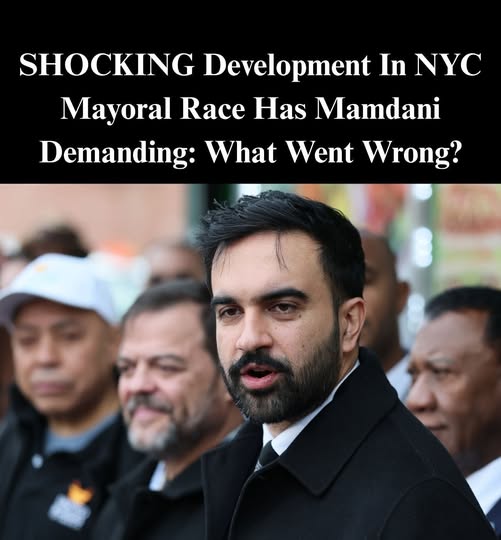
Radical socialist Zohran Mamdani’s lead over former Democratic Gov. Andrew Cuomo in the race to become the next mayor of New York City has narrowed to just 6.6 points — the tightest margin since July — according to a new AtlasIntel poll released Saturday.
The survey shows Mamdani leading with 40.6% of the vote, while Cuomo, running as an independent, has climbed to 34% just days before Tuesday’s election, The New York Post reported
.
“The gap is closing fast — we can feel it on the ground everywhere from the Bronx to Staten Island. At this rate, we win the race. Keep going strong,” Cuomo said.
“Six points in this election is nothing,” he added while campaigning in Brownsville, Brooklyn.
Cuomo credited his late-campaign momentum to what he called a voter awakening about Mamdani’s unrealistic promises, including proposals for free bus service and city-run grocery stores.
“What has happened is, in the primary, Zohran got away with his TikTok band and a smile,” Cuomo said. “He had his slogans — ‘freeze the rent,’ ‘free buses,’ ‘free food’ — and that was enough. But now people have found out what he’s about.”
“There is no free food, there are no free buses, and he can’t raise corporate taxes statewide and dedicate them to New York City. That can’t happen,” Cuomo said.
AtlasIntel CEO Andrei Roman said Cuomo’s comeback underscores deep voter anxiety about Mamdani’s far-left agenda.
“From not being inspirational to being really hated and terrifying people — that’s a major difference,” Roman said. “That’s what’s happening with Mamdani.”
Roman added that Cuomo’s path to victory depends on consolidating moderate Democrats, independents, and disaffected Republican voters.
The new poll also gave Republican candidate Curtis Sliwa his highest mark since summer, showing him at 24.1%, up from 22% in a HarrisX survey in July.
The results sharply contrast with two earlier polls that showed Mamdani holding a comfortable double-digit lead.
A Fox News poll released Thursday had Mamdani at 47%, Cuomo at 31%, and Sliwa at 15%.
An Emerson College poll the same day showed Mamdani at 50%, Cuomo at 25%, and Sliwa at 21%.
RealClearPolitics’ polling average still gives Mamdani a 14.5-point advantage, with 45% support to Cuomo’s 31% and Sliwa’s 17%.
However, the AtlasIntel numbers suggest the race may be shifting rapidly in its closing days.
In a hypothetical two-man race without Sliwa, the poll found Cuomo would lead Mamdani 50% to 42%.
Political analysts say that the result reflects growing frustration with Mamdani’s anti-police positions and statements critical of Israel — views that have alienated moderate Democrats and Jewish voters in key boroughs.
Mamdani appeared at an event in Harlem on Saturday at Rev. Al Sharpton’s National Action Network, where he brushed off suggestions of a tightening race.
“I’m not worried at all,” he told reporters. “I continue to be confident, but I never let that confidence become complacency.”
Cuomo, meanwhile, spent Saturday in Brighton Beach, Brooklyn, where he told supporters there is “no way” Sliwa can win.
“He can only make Zohran Mamdani win,” Cuomo said.
The AtlasIntel poll surveyed registered voters from Oct. 29 to Nov. 1 and has a margin of error of three percentage points.
According to the New York City Board of Elections, nearly half a million residents have already voted early, a significant increase over 2021 turnout levels.
With the election just days away, Mamdani’s once-commanding lead has now narrowed into a fight that could go down to the wire.
In an escalating political battle, President Donald Trump on Thursday formally joined the chorus of Republican lawmakers calling for the expulsion of U.S. Representative Ilhan Omar (D-MN) from Congress.His remarks followed a storm of controversy triggered by an interview Omar gave to far-left commentator Mehdi Hasan, in which she appeared to defend the assassination of conservative figure Charlie Kirk.In the interview, Omar described Kirk as a radical, suggesting that his inflammatory rhetoric may have contributed to the violent act. Omar’s comments were perceived by many as an endorsement of violence, or at the very least, a downplaying of the severity of the tragedy.The interview has sparked widespread condemnation from Republicans, who now say that Omar’s actions warrant expulsion from Congress, while Democrats are rallying to her defense, citing her right to free speech and the controversial nature of the political debate at hand.
Omar’s appearance on Hasan’s show, which aired on the far-left network MSNBC, quickly became a lightning rod for criticism. During the conversation, Omar pointed to Kirk’s history of inflammatory remarks, including comments made about school shootings and racial justice.She said, “But what I do know for sure is that Charlie Kirk was someone who once said, ‘Guns save lives’ after a school shooting.” She also referenced Kirk’s downplaying of George Floyd’s murder by Minneapolis police, as well as his dismissive stance on slavery and Juneteenth, a holiday commemorating the emancipation of enslaved people in the U.S.Omar’s comments, however, were widely criticized for taking Kirk’s words out of context. She claimed Kirk had belittled important civil rights issues, but critics argued that her characterization was misleading and unfairly distorted Kirk’s views. At one point during the interview, Omar disagreed with Hasan’s characterization of Kirk as merely someone seeking “a civil debate.” Omar dismissed this idea as “a complete rewriting of history,” adding, “Yeah, there’s nothing more effed up than to completely pretend that his words and actions have not been recorded and in existence for the last decade or so.”
For many on the right, these words were seen as an endorsement of violence. They pointed out that Omar had effectively demonized Kirk in such a way that it was easy to see why a radical might target him.Omar’s lack of clear condemnation for the assassination, combined with her incendiary comments about Kirk’s views, set off a wave of criticism from conservatives.President Trump wasted no time in weighing in on the matter. Speaking to reporters aboard Air Force One, Trump condemned Omar’s comments and called for her immediate expulsion from Congress.“I think she should be impeached. I think she’s terrible,” Trump declared. “Is she originally from Somalia? So how are they doing it? How’s their government? Do they have a president? Do they have a council? Do they have anything? Do they have police?”Trump went on to criticize Omar’s background, citing her Somali origins as evidence of her supposed unfitness to influence U.S. policy. “I love these people that come from a place with nothing, nothing, no anything, and then they tell us how to run our country,” Trump remarked, doubling down on his belief that Omar’s immigrant background made her ill-suited to offer advice on American governance.Trump’s remarks were swiftly amplified on social media, particularly through his Truth Social platform. There, he once again lashed out at Omar’s home country, Somalia, highlighting its ongoing struggles with terrorism, poverty, and political instability. In a post, Trump wrote:“Ilhan Omar’s Country of Somalia is plagued by a lack of central Government control, persistent Poverty, Hunger, Resurgent Terrorism, Piracy, decades of Civil War, Corruption, and pervasive Violence.70% of the population lives in extreme Poverty, and widespread Food Insecurity. Somalia is consistently ranked among the World’s Most Corrupt Countries, including Bribery, Embezzlement, and a Dysfunctional Government.”
Trump’s use of Omar’s background in his critique drew backlash from her supporters, who accused him of xenophobia and racism.For many Democrats, this line of attack was nothing more than a distraction from the real issues at hand—namely, Omar’s comments about Kirk and the role of inflammatory rhetoric in fueling violence.Trump, however, was undeterred in his criticism, reinforcing his claim that Omar was unqualified to serve in Congress because of her immigrant status.Trump’s calls for Omar’s removal from Congress reflect a broader Republican push to expel the Minnesota congresswoman over her controversial remarks.Republican lawmakers have expressed growing frustration with Omar’s vocal progressive views, especially her criticism of U.S. foreign policy, her stance on Israel, and her outspoken remarks on racial justice.For Republicans, the issue at hand is not just Omar’s recent interview, but a broader pattern of behavior they view as radical and un-American. Many Republican lawmakers argue that Omar’s rhetoric, especially on social media, has consistently crossed the line from political discourse into incitement, and that her actions have endangered national security and the safety of U.S. citizens.“We cannot allow a member of Congress to openly defend or justify the murder of a fellow American citizen,” said Rep. Matt Gaetz (R-FL), who has been a vocal critic of Omar for years. “This isn’t just about free speech, it’s about accountability. She should be expelled immediately.”Some Republican leaders are now pushing for a formal resolution to expel Omar from the House, following similar efforts in recent years to remove other controversial members.
While the push to expel Omar is unlikely to gain traction in a Democratic-controlled chamber, it is emblematic of the growing sense of frustration on the right over what they see as a lack of accountability for members of the progressive left.On the other side of the aisle, Democrats have rallied behind Omar, with many pointing to her comments as part of a broader political debate about the role of free speech and the dangers of political polarization.For Omar’s supporters, the attacks against her are rooted in racism and an attempt to silence marginalized voices in Congress.Omar herself has remained defiant, refusing to back down from her earlier comments.
In a series of interviews, she argued that her remarks about Kirk were valid criticisms of his extremist views and that she was merely speaking out against the normalization of hate and bigotry in American politics.“This is about holding people accountable for their words and actions,” Omar said in an interview following the controversy. “Charlie Kirk is not a victim here. He is someone who has spread dangerous rhetoric that has incited violence and division in our country.”Democrats also pointed out the hypocrisy in the GOP’s push to expel Omar, highlighting the fact that several Republican lawmakers have engaged in controversial behavior without facing similar calls for removal.They argued that the focus on Omar was a distraction from the real issues facing the country, such as healthcare, climate change, and income inequality.The ongoing clash over Omar’s remarks is not just a battle over her fate in Congress, but a larger struggle for the soul of the Democratic Party.
The controversy has exposed rifts between moderates and progressives, with some Democrats arguing that Omar’s confrontational style and rhetoric undermine the party’s ability to build a broad coalition.At the same time, Omar has become a symbol for progressive activists who see her as a champion for marginalized communities and a voice for the voiceless. Her critics, however, view her as a radical who has no place in mainstream politics.For Republicans, the effort to expel Omar is part of a broader strategy to align the party with populist and nationalist sentiments. By pushing for Omar’s removal, they seek to galvanize their base and stoke outrage among voters who feel that the progressive left has taken over American institutions.The battle over Omar’s place in Congress is likely to intensify as the 2024 election season approaches.
With both sides using her as a political pawn, the stakes could not be higher.President Donald Trump’s calls for Ilhan Omar’s expulsion from Congress have sparked a fierce political battle that cuts to the heart of America’s current ideological divide.For Trump and many Republicans, Omar’s comments about Charlie Kirk and her broader progressive agenda make her unfit to serve in Congress. For Democrats, Omar is a victim of a coordinated effort to silence her voice and discredit her politics.The push to remove Omar is unlikely to succeed in the Democratic-controlled House, but it underscores the growing polarization in American politics and the intensifying battles over free speech, representation, and accountability.