Sen. John Fetterman (D-PA) spoke with reporters this week, saying he supported Republicans using the “nuclear option” to override the Senate filibuster to pass a bill to end the government shutdown.Fetterman stated the funds for the federal Supplemental Nutrition Assistance Program, known as SNAP, are running dry and people “need to eat” as the shutdown heads into its 21st day.
“There are no winners here. It’s not getting better every day here. People are going to start to get really hungry, and I’ve been fully, fully committed to fund SNAP, open up the government,” he went on to say, before pointing out that U.S. Capitol Police officers aren’t getting paid during the shutdown.
“This is just bad political theater. Open it up,” he told reporters.
Fetterman was then asked whether he supported the GOP “nuking” the filibuster to let a House-approved funding measure pass the Senate with a simple majority. He replied with a firm yes.
“We ran on that. We ran on killing the filibuster, and now we love it. Carve it out so we can move on. I support it because it makes it more difficult to shut the government down in the future, and that’s where it’s entirely appropriate,” he explained. “I don’t want to hear any Democrat clutching their pearls about the filibuster. We all ran on it.”
Of course, not everyone agrees with Fetterman, who in recent years has proven himself to be far more moderate than most members of his party. Ed Kilgore of New York Magazine believes the Pennsylvania senator’s case for the “nuclear option” is faulty:
The filibuster isn’t an all-or-nothing proposition, and not all carve-outs are alike. Over the years, Congress has carved out a series of exceptions to the right to filibuster Senate votes, notably executive- and judicial-branch confirmations and congressional budget measures (e.g., the huge “budget reconciliation” bills like this year’s One Big Beautiful Bill Act). This year, Senate Republicans also implicitly carved out certain budget scoring rules to make it easier to disguise the deficit-swelling nature of the OBBBA. So the question is not, as Fetterman appears to suggest, whether to have filibuster carve-outs: It’s what the carve-out is for and whom it benefits.
Kilgore then says that what Democrats actually ran on was to “exempt voting-rights measures from the filibuster following a series of state voter-suppression measures sponsored by Republican-controlled states and defended by Senate Republicans.”
He concludes that it’s not hypocritical for Democrats to want to end the filibuster for one item while not wanting to do so for another.
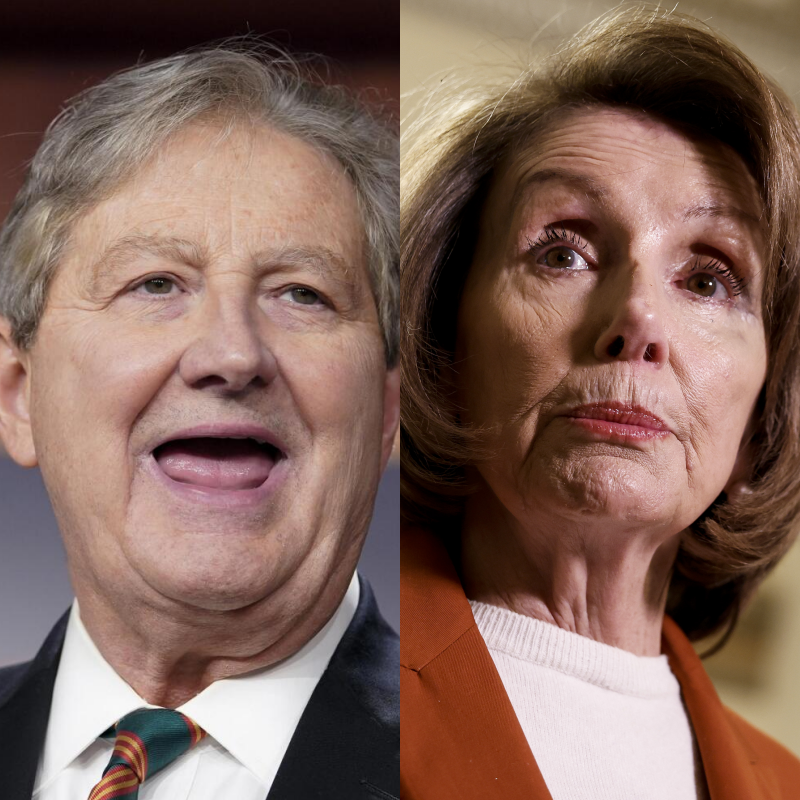
In a stunning turn of events that has gripped the nation, Senator John Kennedy has revealed explosive new information about former Speaker of the House Nancy Pelosi, leaving her and the political establishment utterly speechless. The revelation, made during a heated Senate hearing and later discussed on national television, has sent shockwaves through Washington, D.C., and beyond
The political climate in the United States has rarely been more fraught with tension. With the 2024 elections looming, every move by key players is scrutinized, dissected, and debated. Senator Kennedy, known for his sharp wit and unfiltered honesty, has often been a thorn in the side of the Democratic leadership. But his latest exposé about Nancy Pelosi has elevated the stakes to a whole new level.
.
.
.
During a live Senate committee hearing broadcast to millions, Senator Kennedy took the floor with a stack of documents and a determined look. Addressing the room, he declared, “The American people deserve the truth, and today, I intend to give it to them.”
Kennedy proceeded to outline a series of allegations concerning Pelosi’s handling of congressional funds, her involvement in controversial legislative maneuvers, and her connections to various lobbying groups. According to Kennedy, these actions not only skirted ethical boundaries but also raised serious questions about transparency and accountability in government.
“Speaker Pelosi has long positioned herself as a champion of the people,” Kennedy said, his voice echoing through the chamber. “But the evidence before us paints a very different picture—one of backroom deals, questionable alliances, and a disregard for the very principles she claims to uphold.”
As Kennedy laid out his case, all eyes turned to Nancy Pelosi. The former Speaker, renowned for her poise and ability to handle political pressure, appeared visibly shaken. For once, she was at a loss for words.
Reporters in the room described the scene as surreal. “Pelosi is rarely caught off guard,” said one veteran journalist. “But Kennedy’s presentation was so thorough, so damning, that even she seemed unsure how to respond.”
Social media erupted with clips of Pelosi’s stunned silence, with hashtags like #PelosiSpeechless and #KennedyBombshell trending nationwide. Political commentators speculated on what this might mean for Pelosi’s legacy and the broader Democratic Party.
While the full details of Kennedy’s exposé are still emerging, early reports suggest that the senator presented:
Financial Documents: Alleging misuse or questionable allocation of congressional funds during Pelosi’s tenure.
Lobbyist Connections: Highlighting meetings and communications between Pelosi’s office and high-powered lobbying firms.
Legislative Maneuvers: Accusing Pelosi of pushing through controversial bills without sufficient transparency or debate.
Kennedy called for a formal investigation into the matters raised, urging both parties to set aside political differences and prioritize the integrity of Congress.
The public response was immediate and intense. Across social media platforms, Americans expressed a mixture of shock, anger, and disappointment. Many called for Pelosi to address the allegations directly, while others demanded a broader inquiry into congressional ethics.
“I always respected Pelosi, but if these claims are true, she has a lot to answer for,” said one Twitter user. Another commented, “Kennedy’s not afraid to speak truth to power. We need more leaders like him.”
Political analysts noted that Kennedy’s move could have significant repercussions for the upcoming elections, with trust in government already at an all-time low.
Hours after the hearing, Pelosi released a brief statement to the press. While she did not address the specifics of Kennedy’s allegations, she dismissed them as “political theater” and “an attempt to distract from the real issues facing the American people.”
“I have always served with integrity and transparency,” Pelosi said. “Senator Kennedy’s claims are baseless and intended to sow division. I will continue to fight for the values that matter most to our nation.”
Despite her defiant tone, questions lingered. Would Pelosi provide a detailed rebuttal? Would Congress launch an official investigation? The answers remain uncertain.
Senator Kennedy, meanwhile, doubled down on his statements. In subsequent interviews, he reiterated his commitment to exposing corruption and holding public officials accountable.
“This isn’t about party politics,” Kennedy insisted. “It’s about ensuring that our leaders serve the people, not themselves. If Speaker Pelosi believes she has nothing to hide, she should welcome a full investigation.”
Kennedy’s supporters praised his courage, while critics accused him of grandstanding. Regardless, the senator’s actions have undeniably shifted the national conversation.
The fallout from Kennedy’s bombshell is likely to be felt for weeks, if not months, to come. Congressional leaders have called emergency meetings to discuss the implications, and ethics committees are reportedly reviewing the documents presented.
Some lawmakers have urged caution, warning against rushing to judgment without a thorough investigation. Others, however, see Kennedy’s exposé as a wake-up call for greater accountability in government.
“This is a pivotal moment for Congress,” said one senior Republican. “We need to restore public trust, and that means taking these allegations seriously.”
The United States is still reeling from the shocking events at Utah Valley University, where a single gunshot ended the life of conservative activist Charlie Kirk. The crime has not only shaken political circles but has also plunged the nation into a tense conversation about security, violence, and the cost of divisive rhetoric.
Now, as the FBI and state authorities press forward with their investigation, new details are beginning to emerge — disturbing details that shed light on the alleged shooter, his state of mind, and the motive that may have driven him to carry out one of the most brazen political killings in recent memory.
A Nation in Shock
Charlie Kirk, just 31 years old, had been a rising star in conservative politics. As the founder of Turning Point USA, he built a reputation as a fiery defender of traditional values and a close ally of former President Donald Trump. His appearances on college campuses often drew thousands of supporters and detractors alike.
When Kirk stepped onto the Utah Valley University courtyard on September 10, he likely expected another day of spirited debate, applause, and controversy. Instead, he became the target of an assassin’s bullet, fired from a rooftop overlooking the crowd.
Within hours, confirmation of his death came not from the university or local police but from the former president himself, who mourned the loss and praised Kirk as a patriot who had the “heart of America’s youth.” Across the country, students, politicians, and everyday citizens struggled to process what had just happened.
The Hunt for the Shooter
From the moment the shot rang out, investigators knew the pressure was immense. A high-profile political assassination is not just a crime — it is a test of national stability, public confidence, and law enforcement’s ability to deliver justice.
Authorities quickly scoured the area, recovering a high-powered bolt-action rifle wrapped in a towel and abandoned near a wooded section of campus. They collected footprints, palm prints, and imprints that suggested the shooter fled in haste.
By September 12, just thirty-three hours after the attack, federal agents announced that they had a suspect in custody: 22-year-old Tyler Robinson.
A Family’s Tip-Off
One of the most striking revelations came not from surveillance cameras or forensic science, but from Robinson’s own family.
At a press conference, Utah Governor Spencer Cox revealed that Robinson’s relatives had played a pivotal role in the investigation. During a family dinner, Tyler allegedly expressed disdain for Kirk, referring to him as “full of hate and spreading hate.” His remarks, combined with the knowledge that Kirk was scheduled to appear in Utah, alarmed his relatives.
That concern turned into action after the assassination. A family member came forward, alerting authorities to Robinson’s possible involvement. Governor Cox praised their courage, describing it as “doing the right thing” even in circumstances that must have torn the family apart.
Disturbing Engravings on Bullets
Perhaps the most chilling discovery was made during forensic analysis of the ammunition. According to the FBI, the bullet that killed Kirk — along with spare casings found nearby — carried engraved messages.
While officials have not publicly revealed every word, they described the markings as evidence of a political motive, the physical embodiment of an ideology carried to its most violent extreme. In the history of modern political violence, such personalized markings are rare and deeply symbolic, often used by perpetrators to leave behind a twisted manifesto.
These engravings, paired with Robinson’s earlier comments about Kirk, suggest that the assassination was not spontaneous but premeditated — a message as much as a murder.
Surveillance and Digital Footprints
Alongside the forensic evidence, investigators traced Robinson’s movements through technology. Surveillance footage showed clothing and a vehicle matching his description. Even more incriminating, digital records from Discord chats revealed Robinson discussing a bolt-action rifle — the very weapon found discarded near the crime scene.
According to investigators, one message to his roommate included a reference to the weapon shortly before the shooting. These digital trails, in combination with eyewitness accounts and physical evidence, form the backbone of the FBI’s case.
A Suspect’s Profile
Tyler Robinson’s arrest has left those who knew him divided. To his grandmother, Debbie Robinson, he was a shy, studious young man who had never shown interest in politics or firearms. She has publicly declared that “the FBI have the wrong man.”
But others point to a different picture: a young man who, in the months leading up to the shooting, had grown increasingly political, increasingly angry, and increasingly outspoken about his disdain for Charlie Kirk.
That duality — the quiet grandson versus the allegedly radicalized young adult — lies at the heart of the coming legal battle.
Governor Cox’s Warning
At Friday’s press conference, Governor Cox used the tragedy to deliver a broader message about political discourse and the dangers of violence.
“We will never be able to solve all the other problems — including the violence problems that people are worried about — if we can’t have a clash of ideas safely and securely,” Cox said.
“Your generation has an opportunity to build a culture that is very different than what we’re suffering through right now. Not by pretending differences don’t matter, but by embracing our differences and having those hard conversations.”
His words were a reminder that beyond the courtroom and beyond the forensics, the assassination of Charlie Kirk is a stark warning about what happens when debates turn into battlefields.
Political Reverberations
The killing has sparked strong reactions from political leaders. Former President Trump not only confirmed Kirk’s death but also suggested the death penalty for his killer, calling for swift and decisive justice. Supporters of Kirk view the assassination as a targeted attack on conservative values, while critics warn of escalating cycles of political violence.
For Kirk’s family — his wife, Erika, and their two young children — the rhetoric offers little comfort. They are left to grieve privately even as their tragedy becomes a national spectacle.
The Road Ahead
Robinson’s case is now moving toward formal charges, with prosecutors expected to argue political motivation, premeditation, and overwhelming forensic evidence. His defense, meanwhile, is likely to emphasize his lack of prior criminal history, claims of mistaken identity, and character witnesses who insist he was incapable of such violence.
If convicted, Robinson faces the possibility of the death penalty — a punishment that would echo Trump’s own calls for ultimate accountability.
A Nation Waiting for Answers
The story of Charlie Kirk’s assassination is still unfolding. Every new detail — from the engraved bullets to the Discord messages — deepens the mystery and heightens the tension. Was Tyler Robinson truly the lone actor investigators claim? Or is there more to the story than what has been revealed so far?
As the trial approaches, the nation will be watching closely. For some, justice will mean a conviction and closure. For others, lingering doubts about mistaken identity or prosecutorial haste will persist.
What is clear is that this tragedy has left behind more than a headline: it has left scars on families, on political discourse, and on a country still searching for a way to argue without killing.
Final Thoughts
Charlie Kirk’s assassination is a turning point in modern American politics. It is a story about a young man’s death, a suspect’s radicalization, a family’s heartbreak, and a nation’s reckoning. The engraved messages on the bullets stand as a grim reminder that words matter — and when twisted, they can become weapons.
As the FBI tightens its case and the courts prepare for what will likely be one of the most watched trials in recent history, Americans are left to ponder a sobering truth: if differences of opinion can lead to the death of a man on a university stage, what does that mean for the future of free speech and political dialogue in the United States?
For now, one thing is certain — the hunt for justice has only just begun.