House Speaker Mike Johnson revealed on Tuesday that Democrats are demanding billions in wasteful and ideological spending, including $3.9 million for LGBTQI+ democracy grants in the Western Balkans, as part of their conditions to reopen the government.
Speaking on the 14th day of what he called the Democrat government shutdown, Johnson said the American people are suffering because Democrats have chosen politics over responsibility.
“Welcome to day 14 of the Democrat government shutdown,” Johnson said during his press briefing. “It’s two weeks of Democrats in Congress inflicting untold pain on the American people for nothing other than pure politics.”
Johnson explained that House Republicans had already offered a clean continuing resolution to keep the government funded, but Democrats repeatedly rejected it.
Instead, he said, Democrats are tying unrelated left-wing priorities to essential government operations in an attempt to strong-arm Republicans into approving radical spending measures.
He accused Senate Minority Leader Chuck Schumer of catering to what he described as the party’s “Marxist base.”
The Speaker laid out details from the Democrats’ counterproposal, calling it a $1.5 trillion wish list of reckless spending that would send taxpayer money to liberal causes and foreign projects that have nothing to do with running the U.S. government.
Among the examples he cited were $24.6 million for climate resilience programs in Honduras.
Another $13.4 million would go to civic engagement programs in Zimbabwe.
An additional $2.9 million is earmarked for desert locust risk reduction in the Horn of Africa.
The Democrats’ plan also calls for $2 million to fund “organizing for feminist democratic principles” in Africa, according to Johnson.
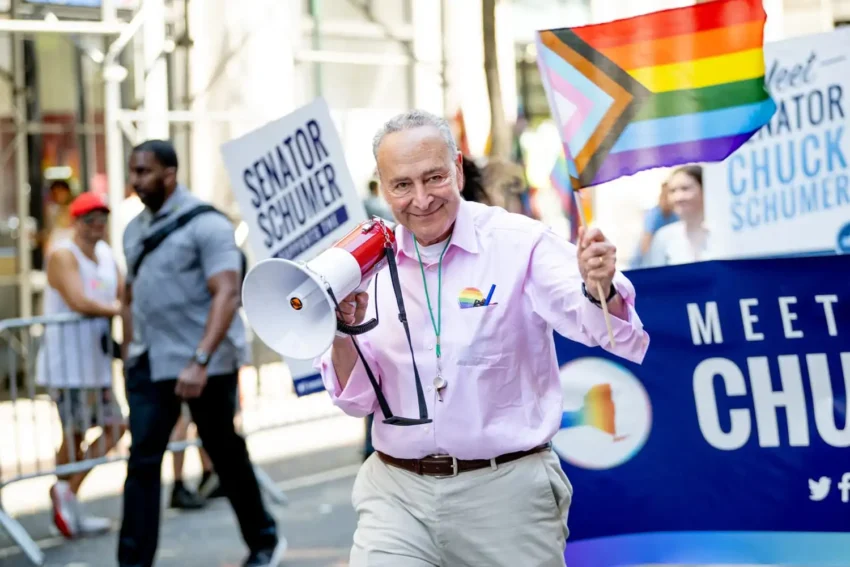
Johnson highlighted the $3.9 million in LGBTQI+ democracy grants for the Western Balkans as an example of Democrats’ misplaced priorities.
“They want to spend 3.9 million of your hard-earned dollars for LGBTQI+ democracy grants in the Western Balkans,” Johnson said. “We are not doing that.”
He argued that Democrats are also trying to undo common-sense reforms enacted by Republicans that prevent illegal immigrants from accessing taxpayer-funded healthcare.
“This is a fact,” he said. “They would add illegal aliens and non-citizens back to taxpayer-funded benefits. It would cost taxpayers nearly $200 billion.”
Johnson further warned that Democrats want to roll back modest work requirements placed on able-bodied young men without dependents.
At the same time, Democrats are pushing to make COVID-era Obamacare subsidies permanent, with no income limits or meaningful reforms.
Johnson said this approach would not only punish working Americans but also reward dependency and mismanagement.
The Speaker accused Democrats of prioritizing ideological projects over the immediate needs of the American people.
He said their proposal exposes how out of touch the party has become, highlighting spending for causes abroad while Americans face uncertainty at home.
“This is not about keeping the lights on,” Johnson said. “This is about Democrats trying to use the shutdown as leverage to fund their far-left agenda.”
Johnson reminded reporters that Republicans have already passed legislation to reopen the government responsibly, without any of the unrelated political riders Democrats insist on including.
The Republican plan, he said, would maintain government operations, protect taxpayers, and prevent wasteful spending abroad.
Johnson also pointed out that the Democrats’ proposal would restore funding to the Corporation for Public Broadcasting, sending a half-billion dollars to what he described as liberal media outlets that have long benefited from taxpayer subsidies.
He described it as another example of Democrats using government funding to reward their political allies rather than serving the public good.
“These are not the priorities of the American people,” Johnson said firmly. “They are the priorities of a radical political class that has forgotten who they work for.”
The Speaker ended his remarks by calling on Democrats to stop the political games and join Republicans in reopening the government immediately.
“We have a clean bill ready to go,” he said. “It keeps the government open, pays our troops, secures the border, and protects hardworking taxpayers. Democrats need to stop holding America hostage.”
Johnson’s comments reflect growing frustration among House Republicans who say Democrats are using the shutdown to push through spending on social experiments, foreign projects, and activist groups under the guise of government funding.
He warned that such spending will only deepen America’s fiscal crisis and fuel public anger toward Washington’s political class.
“This is a moment for leadership,” Johnson concluded. “It’s time to put the American people first and end this shutdown—not by giving in to woke demands, but by standing firm for fiscal sanity and common sense.”
A heated exchange between Representatives Marjorie Taylor Greene of Georgia and Jasmine Crockett of Texas has drawn national attention, highlighting once again the sharp partisan divides in Congress over narratives related to political identity, extremism, and media framing.The clash centered on the background of Tyler Robinson, a figure whose political affiliations have become a source of controversy following references to him in congressional discussion.The confrontation began when Crockett pointed to an online news reference suggesting that Robinson’s family leaned heavily toward MAGA politics.
Greene, known for her fiery rhetoric and uncompromising style, shot back swiftly and forcefully, rejecting any attempt to link Robinson to the MAGA movement. Instead, she painted an entirely different picture of his affiliations, one she argued was diametrically opposed to conservative values.According to the record of discussion, Crockett remarked, “Looks like Yahoo News. It says, Charlie Kirk suspects Grandma says family is all MAGA.” The statement was meant to underscore a perceived alignment between Robinson and conservative politics, echoing sentiments that have surfaced in certain media reports.
Greene immediately objected. “His family may be Republican, but all of the evidence that is being presented proves that he is a far-leftist, very much integrated in online groups that are linked to Antifa,” she declared.Greene went further, delving into Robinson’s personal life in terms likely to provoke controversy. “He was in a relationship with a biological male… so-called furry, whatever that is, that is transitioning to be a fake woman,” she said.Her words underscored her effort to distinguish Robinson from any association with MAGA and instead emphasize ties to progressive or far-left subcultures. “He was not MAGA, not one bit, that is a complete lie, and it’s an insult,” Greene concluded.
This verbal sparring between Crockett and Greene is about more than one individual. It reflects a broader battle over political branding and the desire to control narratives about extremism and responsibility.For Democrats like Crockett, tying figures accused of instability or violence to MAGA creates a narrative that the conservative movement fosters extremism.For Republicans like Greene, pushing back is essential to protect the image of their base and to shift blame onto leftist movements like Antifa.In the polarized environment of Congress, even a single person’s political background can become a flashpoint. Each side seeks to weaponize the narrative to advance broader arguments about the state of American politics.For Greene, the stakes are high because allowing any implication that Robinson was MAGA would bolster claims that conservative rhetoric fuels dangerous behavior.Greene’s comments reveal a calculated strategy. By acknowledging that Robinson’s family may have Republican ties, she inoculates herself against charges of denial.But by forcefully asserting that Robinson himself was aligned with leftist groups, she flips the narrative, suggesting that political violence is not a right-wing problem but a left-wing one.
Her invocation of Antifa reflects a longstanding Republican talking point. For years, conservative leaders have accused Antifa of infiltrating protests, inciting violence, and spreading far-left ideology through online networks.By placing Robinson within this framework, Greene seeks to reframe the conversation from MAGA extremism to leftist extremism.Her reference to Robinson’s relationship and identity issues serves a dual purpose. It underscores the cultural divides that Republicans often highlight in their critiques of progressive politics, while simultaneously distancing Robinson from conservative values.By describing him as being in a relationship with “a biological male” and a “so-called furry” transitioning to “a fake woman,” Greene employs language designed to resonate with her conservative base, which often views such cultural identifiers as alien to their worldview.For Jasmine Crockett, the decision to highlight Robinson’s family background as MAGA-linked reflects a different strategy. In political messaging, connecting figures to the MAGA label serves as shorthand for suggesting an alignment with Trump-era conservatism, a movement Democrats often portray as dangerous and destabilizing.Crockett’s reference to “Yahoo News” gave her argument the appearance of being grounded in reporting rather than speculation.
By citing an outlet and invoking Charlie Kirk’s commentary, she sought to tether Robinson to a recognizable conservative ecosystem.Yet her approach also invited backlash. Greene’s forceful response highlights the risks of making claims without airtight evidence, especially when they touch on highly contested political identities.For Democrats, the danger lies in appearing to overreach, thereby allowing Republicans to flip the narrative and claim victimization.This exchange comes at a time when both parties are increasingly eager to shape narratives about political violence and extremism. Republicans argue that left-wing movements such as Antifa pose the greatest threat to social order, while Democrats emphasize the dangers of MAGA extremism, often linking it to incidents of unrest or threats against public officials.
Robinson’s case, whatever its details, has become a proxy for this larger debate. His affiliations, whether real or perceived, matter less than the symbolic power of how they are framed.To Democrats, associating him with MAGA reinforces the idea that Trump’s movement has inspired dangerous behavior. To Republicans, painting him as a leftist infiltrator serves to defend their base and redirect scrutiny toward progressive activism.Greene’s emphasis on Robinson’s personal life highlights another layer of this dispute: the cultural divide over gender, identity, and lifestyle choices. By referencing Robinson’s relationship with a transitioning partner described as a “furry,” Greene injected culture war language into the political debate.To conservatives, such descriptions reinforce the idea that the far left is associated with lifestyles and identities they view as radical or untraditional. To progressives, Greene’s language is dismissive and derogatory, reflecting hostility toward marginalized communities.This cultural layer amplifies the political stakes. For Republicans, it provides an opportunity to mobilize their base around issues of gender and identity. For Democrats, it highlights the extent to which Republicans will stigmatize vulnerable groups in order to score political points.The Greene-Crockett exchange will likely ripple through party messaging strategies. Republicans can point to Greene’s remarks as evidence that Democrats are falsely labeling extremists as MAGA to smear their movement.Democrats, in turn, can argue that Greene’s language demonstrates insensitivity and hostility, reinforcing their narrative that Republican rhetoric fuels division.In a political environment where every moment becomes a viral clip, the confrontation will likely be replayed across partisan media platforms.
Conservative outlets will amplify Greene’s rejection of the MAGA link and highlight her claims about Antifa. Liberal outlets will focus on her inflammatory language about gender identity and accuse her of bigotry.The result is another flashpoint in America’s ongoing culture and political wars, with each side seizing on the exchange to reinforce its preexisting narratives.For the broader public, reactions will likely fall along partisan lines. Conservatives will praise Greene for defending MAGA from what they see as baseless smears, while liberals will criticize her for stigmatizing marginalized identities.Independents and moderates may see the dispute as another example of Congress descending into partisan theater rather than focusing on substantive governance.Still, the controversy underscores the importance of language and framing in politics. What one side calls a smear, the other calls accountability. What one side sees as defense of truth, the other sees as deflection.In the end, public perception will hinge less on the details of Robinson’s background and more on how effectively each side spins the narrative.The Greene-Crockett clash reflects deeper trends in American politics. As the 2024 election cycle approaches, both parties are desperate to control the narrative about extremism and responsibility. Republicans will emphasize threats from the left, while Democrats will spotlight the dangers of MAGA.Figures like Robinson become political symbols, their identities debated less for their own sake and more for what they represent in the broader struggle.
Greene’s fiery rhetoric and Crockett’s insistence on linking Robinson to MAGA highlight the stakes of this struggle, where every word is weaponized.As the political climate grows more polarized, such exchanges are likely to become more common. The language may grow sharper, the accusations more heated, and the public more divided.Yet at its core, the battle remains the same: who controls the narrative, and whose version of reality prevails in the eyes of the American people.The confrontation between Marjorie Taylor Greene and Jasmine Crockett over Tyler Robinson’s political identity illustrates the intensity of America’s partisan battles.For Crockett, citing Robinson’s family as MAGA was a way to tie him to conservative extremism. For Greene, rejecting that link and painting Robinson as a far-left activist aligned with Antifa was essential to defending her movement.Their dispute highlights not only the struggle over political branding but also the cultural divides that animate American politics. Greene’s references to Robinson’s personal life injected gender and identity into the debate, ensuring that the controversy will resonate across both political and cultural fault lines.As each side spins the narrative to its advantage, the exchange reveals the extent to which politics today is about more than policy—it is about identity, perception, and the power of framing.
The Greene-Crockett clash will not settle the debate over Robinson’s affiliations, but it has already ensured that his name will be invoked in the broader struggle over the meaning of MAGA, the nature of extremism, and the future of American politics.