In the ebb and flow of American politics, few institutions stand as tall—or as contested—as the United States Supreme Court. Over the years, it has been both a guardian of constitutional rights and a lightning rod for political controversy. Its rulings have reshaped social norms, redrawn the boundaries of federal power, and defined the limits of presidential authority. But in recent months, the Court has found itself thrust into a new storm of criticism, this time not from the usual chorus of partisan pundits, but from the highest levels of Democratic Party leadership.
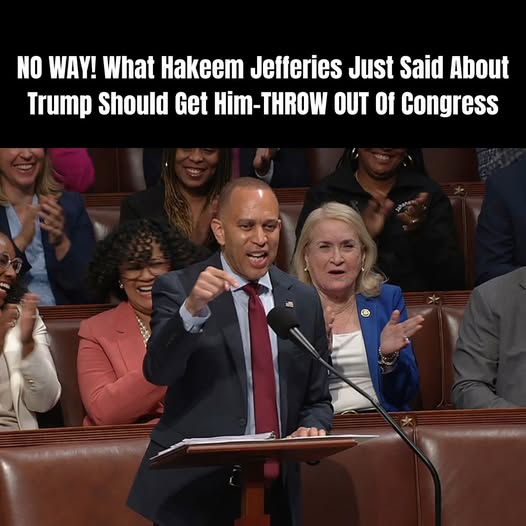
On Monday evening, during a live interview on CNN’s The Situation Room, House Minority Leader Hakeem Jeffries (D-N.Y.) delivered one of his sharpest rebukes yet of the Court’s conservative majority. His words reflected not only his personal frustration but also a growing unease within the Democratic caucus about what they see as a judiciary increasingly aligned with former President Donald Trump.
Jeffries accused the Supreme Court of having “enabled” Trump to behave like a monarch, granting him broad immunities that, in Jeffries’ view, stand in stark contradiction to the vision of the nation’s founders. His remarks sparked a flurry of reactions, highlighting once again how the nation’s political and judicial branches are locked in a tense and consequential struggle.
Jeffries’ Explosive Remarks
Speaking with CNN host Wolf Blitzer, Jeffries did not mince words. He argued that the Supreme Court’s recent decisions had effectively given Trump what the framers of the Constitution most feared: unchecked power.
“You know, one thing to understand,” Jeffries said, “is that for those who are flirting with the Trump administration, or doing its bidding, or engaging in its pay-to-play schemes, the statute of limitations is five years. Donald Trump and this toxic administration will eventually be gone. But accountability will remain. That process begins now but will not be complete until there is truly independent oversight, whether through the Department of Justice or a Democratic-controlled House of Representatives.”
The statement was not merely an attack on Trump. It was also a critique of the system that, in Jeffries’ view, has shielded him. Jeffries specifically pointed to the Supreme Court’s decision granting Trump partial presidential immunity, a ruling that has divided legal scholars and fueled political debate.
“The Department of Justice has historically stood as one of the great institutions of law enforcement in our country,” Jeffries continued. “But Donald Trump and his extremist allies have worked to erode its credibility. And let’s be clear: we must also hold the conservative justices of the Supreme Court accountable. They gave this president blanket presidential immunity in a nation where our founders explicitly rejected kingship. They’ve allowed Donald Trump to act like a king. Shame on them for what they’ve done to this country.”
The Context: Presidential Immunity and the Court’s Role
To understand the weight of Jeffries’ comments, it is important to revisit the recent history of the Supreme Court’s engagement with Trump-era legal questions.
The most controversial decision in this area came earlier this year, when the Court ruled in a landmark case that former presidents are entitled to a degree of presidential immunity for official acts taken while in office. While the ruling did not grant absolute immunity, critics—including Jeffries—argue that it created a shield broad enough to embolden Trump and discourage accountability.
The Court’s majority opinion stressed the need to preserve the independence of the executive branch, warning that subjecting presidents to endless lawsuits after leaving office could paralyze the institution. But dissenting voices, including Justice Sonia Sotomayor, warned that the decision risked turning presidents into “kings above the law.”
Jeffries seized on this dissent to underscore his point. For him and many Democrats, the Court has not simply interpreted the law—it has restructured the balance of power in Trump’s favor.
The Historical Tension Between Presidents and Kingship
Jeffries’ reference to America’s founders rejecting kingship is more than a rhetorical flourish. The framers of the Constitution were deeply concerned with the dangers of concentrated power. Having broken away from Britain’s monarchy, they sought to create a system of checks and balances that would prevent any single branch of government from dominating.
The presidency was designed to be powerful but accountable, constrained by Congress and the courts. For Jeffries, the Supreme Court’s decisions in recent years have eroded this balance, tilting power toward the executive in ways that echo the monarchy America once rejected.
A Broader Pattern of Criticism
Jeffries’ critique is not an isolated moment. It fits into a broader Democratic narrative that has taken shape since Trump’s return to the political stage. Many Democrats argue that the Court’s conservative majority—anchored by justices appointed by Trump himself—has too often sided with executive authority, voter suppression laws, or corporate interests at the expense of democratic accountability.
Consider the Court’s decisions on:
Election Law: Rulings that upheld restrictive voting measures in several states, which Democrats say disproportionately impact minority communities.
Campaign Finance: The expansion of corporate influence in politics through decisions like Citizens United v. FEC.
Abortion Rights: The overturning of Roe v. Wade, which Democrats cite as evidence of judicial activism aligned with conservative political goals.
For Jeffries, these rulings form a pattern—one in which the Court, rather than standing above politics, has become entangled in them.
Trump, the DOJ, and Allegations of Corruption
Jeffries also used the CNN interview to emphasize his belief that accountability for Trump will come, even if delayed. His comments about the “five-year statute of limitations” were a direct signal to those who may have cooperated with Trump’s administration in what Democrats describe as corrupt or self-serving schemes.
The Minority Leader suggested that once political winds shift—whether through a Democratic House majority or a change at the Department of Justice—those individuals could face consequences.
This is not an empty threat. History has shown that political accountability often lags behind the events themselves. Investigations can take years, and statutes of limitations create a ticking clock. By highlighting this timeline, Jeffries was reminding both Trump’s allies and the public that the story is far from over.
Conservative Pushback
Predictably, Jeffries’ comments drew immediate criticism from Republicans and conservative commentators. Many pointed out that even liberal justices have occasionally sided with the Trump administration on legal questions, complicating the narrative that the Court is uniformly pro-Trump.
Others argued that Jeffries’ rhetoric risks undermining public confidence in the judiciary at a time when trust in democratic institutions is already fragile. To conservatives, the accusation that the Court is enabling authoritarianism smacks of partisan sour grapes, particularly given the Court’s occasional rulings against Trump’s interests during his presidency.
Still, Jeffries’ remarks resonate with a Democratic base that views the Court as deeply compromised.
Public Reaction and the Larger Debate
The broader public reaction has mirrored the nation’s political divisions. On social media, clips of Jeffries’ interview spread rapidly, with Democrats applauding his candor and Republicans denouncing his attack on the Court. Legal scholars offered more nuanced takes, debating the long-term implications of the immunity ruling and whether it truly represented a dangerous expansion of executive power.
For many ordinary Americans, however, the issue boils down to a simpler question: Should presidents be held accountable like everyone else, or does the office require special protections? Jeffries’ forceful critique brings that question into sharp relief.
A Fight Over the Future of Democracy
At its core, Jeffries’ attack on the Supreme Court reflects a larger struggle over how democracy itself is defined in the 21st century. Is democracy simply the will of the voters expressed through elections, or does it require ongoing checks on power, even after a president leaves office?
For Jeffries and his Democratic colleagues, the latter view is essential. They argue that without robust oversight, presidents—especially one as polarizing as Trump—can exploit their office to the detriment of the republic. For Republicans, by contrast, the Court’s rulings are seen as necessary to prevent endless legal harassment of presidents, which could deter future leaders from making bold decisions.
Conclusion: A Warning and a Challenge
Hakeem Jeffries’ comments on CNN were not merely an outburst of frustration. They were a warning—that unchecked power, enabled by judicial decisions, could push the United States closer to the kind of authoritarianism its founders fought to escape.
Whether one agrees with Jeffries or not, his remarks highlight the stakes of the current political moment. The debate over Trump, presidential immunity, and the role of the Supreme Court is not just about one man or one administration. It is about the future balance of power in America and whether the nation can sustain its commitment to the principle that no one—not even a president—is above the law.
As Jeffries put it, “Shame on them for what they’ve done to this country.” His words may divide opinion, but they also ensure that the conversation about the Court, Trump, and accountability is far from over.
Earlier that day, the Prince of Wales held an investiture ceremony at Windsor Castle, where he handed out more than 50 honors. Among the recipients was Patricia Sprouse who later took to LinkedIn to share the news of her honor. In her post, she revealed some details regarding Kate and the much-needed help she gets.
“What an amazing experience, the castle was just breathtaking, everyone was so lovely to us as we were just in awe of everything,” Sprouse wrote on LinkedIn. “Prince William said that Catherine had two Filipino nurses looking after her and they were amazing and kind.”
In the early 1990s, Monica Bellucci was already a recognized face in Europe. Her modeling career was flourishing, her name graced the pages of fashion magazines, and she was gaining momentum in the film industry. But it wasn’t until her fearless performance in Giuseppe Tornatore’s
Set against the backdrop of World War II in a conservative Sicilian town, Malèna tells the story of a woman whose extraordinary beauty isolates her from the very society that obsesses over her. Monica Bellucci played the title role with astonishing restraint—speaking few words, yet conveying a universe of emotion. The role demanded subtlety and strength: sorrow, dignity, and suppressed rage, all captured through the tiniest expressions and glances. In a performance that defied the need for dialogue, Bellucci communicated everything.
She didn’t just portray Malèna—she became her. Critics and audiences alike were captivated not only by Bellucci’s physical presence but by the profound humanity she brought to the role. It was a reminder that beauty on screen could be as much a burden as a gift. And in the hands of a masterful actress, it could also be a powerful tool for storytelling.
Monica’s rise to fame was far from conventional. Born in 1964 in Città di Castello, a small town in Italy’s Umbria region, she initially studied law at the University of Perugia. To support her studies, she began modeling—and it wasn’t long before the fashion world took notice. Soon, she was walking for designers like Dolce & Gabbana and appearing on the covers of
But Bellucci never saw modeling as her endgame. In fact, she resisted being boxed in by the expectations that came with being a model-turned-actress. Unlike others who made similar transitions for the allure of fame, Bellucci’s move into acting was a deliberate act of reinvention. In her 30s—an age at which many actresses are already being pushed to the margins—she committed herself to film.
Skepticism followed. Some critics questioned whether someone as traditionally beautiful as Monica could truly be taken seriously as a performer. But she challenged those doubts head-on, taking on roles that revealed vulnerability, complexity, and courage. From romantic leads in French cinema to bold roles in Hollywood and daring independent films, she refused to let her looks define her.
Films like Irreversible (2002), The Passion of the Christ (2004), and The Apartment (1996) demonstrated Bellucci’s ability to embrace emotionally raw, physically demanding roles. She became known for her nuanced performances, for choosing scripts that asked difficult questions, and for portraying women with internal lives that stretched far beyond their appearances.
One of the most compelling aspects of Monica Bellucci’s journey is how she has navigated aging in an industry obsessed with youth. Unlike many of her contemporaries, she has never attempted to freeze time. She’s spoken openly about the pressure placed on women to look younger, yet she has remained unapologetically herself.
Her role as a Bond woman—distinctly not a “Bond girl”—in Spectre (2015) was a defining moment. At 50, she was the oldest woman ever cast opposite James Bond. But she didn’t accept the part as a novelty; she saw it as a statement. “It was a victory,” she said, “to show that a woman of my age can be sensual, can be powerful.”
Her attitude toward beauty is both radical and refreshing. “Real beauty is to be true to yourself,” she once remarked. And in every public appearance, every interview, and every role, she has modeled exactly that.
Though frequently described as a muse for directors and designers, Bellucci has always been the author of her own narrative. She is fluent in multiple languages, chooses her projects with care, and has been known to turn down roles that don’t align with her values. Whether in Italian, French, or English, she brings an intelligence and introspection to her performances that defy the clichés attached to her physical image.
She’s also managed to keep much of her personal life private—a rare feat in the age of constant exposure. Her dignity, grace, and quiet strength have made her not just an actress or a model, but a symbol of self-determined womanhood.
Even into her late 50s and beyond, Monica Bellucci continues to act, to captivate, and to evolve. She has portrayed opera singers, queens, witches, and lovers—always with a blend of elegance and intensity that makes each performance memorable. Her legacy is still unfolding, but one thing is clear: she has never settled for being seen only as an icon of beauty.
Monica Bellucci’s life and career defy the idea that women must choose between being admired and being respected. Her story is a testament to reinvention, resilience, and authenticity. In every era of her career—from modeling’s spotlight to cinema’s shadows—she has shown that true allure comes not from perfection, but from presence.
And as the industry slowly begins to catch up with the ideals she’s embodied for decades, Monica Bellucci remains ahead of her time—mysterious, magnetic, and magnificently her own.
In an unexpected turn, Texas Congresswoman Jasmine Crockett has captured national attention — not for politics, but for compassion. Reports confirm that Crockett spent $55,000 of her personal funds
The store, a humble corner shop in her childhood neighborhood, was more than just a business. For Crockett, it was where she bought after-school snacks, where her family stretched every dollar, and where she dreamed of a brighter future.
While many saw the grocery store as just another small shop, for Crockett it symbolized community, survival, and opportunity. Neighbors recalled how the owner often gave credit to families in need, sometimes handing out essentials without charge.
“Without this place, many of us wouldn’t have made it through hard times,” one longtime customer said. “It wasn’t just food — it was dignity, hope, and kindness.”
When Crockett learned the store faced imminent closure due to rising rents and mounting debt, she quietly stepped in. Instead of issuing a statement or staging a photo op, she personally wrote the check for
Local media revealed she had initially planned to keep the gesture private, but the story spread after the store owner placed a
The handwritten sign read:
“Thank you, Jasmine, for saving the dream we built for this community. We will never forget how you stood by us when no one else would.”
Witnesses say when the store owner saw Crockett standing outside reading the sign, he broke down in tears. Soon, neighbors gathered, clapping, cheering, and many crying as the moment unfolded.
For residents, the act was more than financial aid — it was validation. In an era where many politicians are seen as disconnected from ordinary struggles, Crockett’s gesture reminded people of the power of empathy.
“Politicians give speeches. Jasmine gave us hope,” one resident said.
Another added: “She didn’t just save a store; she saved a piece of our history.”
Crockett herself has said little about the gesture, other than acknowledging the store was part of her childhood and that she “couldn’t stand by and watch it vanish.”
Her action has since gone viral, sparking thousands of shares, comments, and emotional reactions online. Many praised her for putting community before politics, calling it a rare act of humanity in Washington’s cutthroat climate.
In spending $55,000 of her own money, Jasmine Crockett didn’t just save a small grocery store. She saved a symbol of community, resilience, and shared history. The thank-you sign may have made the store owner cry, but it also brought an entire neighborhood together — a reminder that sometimes, the most powerful political statement is a simple act of kindness.
In a packed courtroom filled with a hushed crowd of spectators, legal professionals, family members, and advocates, a former soldier stood quietly before the judge. Wearing his formal military dress uniform, the weight of years of service, sacrifice, and personal struggle was etched across his face. His request was simple yet profound: he wished to say one final goodbye to his service dog—the loyal companion who had walked beside him through some of the darkest and most challenging moments of his life.
The relationship between a soldier and a service dog is unlike any other. These highly trained animals are not mere pets; they are essential partners who provide emotional support, protection, and a calming presence in the face of fear, anxiety, and trauma. For this soldier, the dog had been a steady lifeline through long deployments, sleepless nights haunted by memories of war, and the difficult transition back into civilian life. As he recounted the countless moments when his service dog had offered comfort—resting its head on his lap during times of distress or nudging him gently awake from nightmares—those in the courtroom began to feel the profound depth of their connection.
His voice trembled as he spoke about the invisible wounds that often go unnoticed in returning veterans, and how his service dog had been there every step of the way, offering unconditional love and companionship. This animal had been more than a helper; it was a source of hope, a symbol of resilience, and a reminder that he was never truly alone.
The judge listened attentively, moved by the soldier’s heartfelt words and the undeniable strength of the bond he described. Then came the moment the entire courtroom had been waiting for. The soldier slowly knelt down on the polished floor, arms open wide. His service dog, sensing the significance of the moment, approached with gentle steps and rested its head softly against his chest. A hush fell over the room—an almost sacred silence that conveyed the power of their shared history and deep mutual trust.
Recognizing the extraordinary nature of this relationship, the judge made an unusual and compassionate ruling, allowing the service dog to remain with the soldier throughout the remainder of the proceedings. This gesture was met with quiet applause and visible relief from those present. Many reached for tissues, overcome by the display of raw emotion and loyalty unfolding before their eyes.
For those witnessing this intimate reunion, it was a poignant reminder of the vital role service animals play in supporting veterans and others living with invisible injuries. The moment transcended the courtroom’s walls—it spoke to the universal human need for connection, love, and understanding, especially in the face of hardship.
Beyond the touching embrace and the judge’s compassionate decision, this story also serves as a powerful call to society to recognize and honor the unique challenges faced by service members. It highlights the importance of providing resources and support not only to veterans but also to the animals who dedicate their lives to helping them heal and thrive.
In that courtroom, the soldier’s final goodbye with his service dog was more than just a farewell—it was a celebration of courage, loyalty, and the unbreakable bonds forged in the toughest of circumstances. It demonstrated how love and compassion can provide solace and strength, even when the burdens of life seem overwhelming.
As the soldier stood side by side with his faithful companion, the entire courtroom was reminded of a profound truth: that in the darkest times, the presence of a loyal friend can be the beacon that guides us back to hope and healing.
This moment will remain etched in the memories of everyone who witnessed it—a testament to the enduring power of devotion and the extraordinary impact a service animal can have on the life of a veteran.