Almost a quarter of the way through the 2025-26 season, it’s becoming clearer that the Philadelphia Flyers are still a far cry from the Stanley Cup-contending team they aspire to be.
Yes, the Flyers are in a playoff spot at the time of this writing, but they’re also two points away from being the second-worst team in the Eastern Conference.
Teams like the Toronto Maple Leafs, Columbus Blue Jackets, Tampa Bay Lightning, and Florida Panthers have too much talent to lay dormant forever, though injuries are certainly taking their tolls on those teams.
And, when it comes to tiebreakers, the Flyers are tied with Buffalo for the fewest regulation wins (4) and have the second-fewest regulation and overtime wins (5).
If the team isn’t currently thinking about the postseason, they’d be in the right frame of mind.
The Flyers aren’t a bad team, necessarily, but they are painstakingly boring and still haven’t found a way to consistently generate offense.
In the Rick Tocchet era thus far, the Flyers are dead last in the NHL in shots per game (24.6), tied for the third-fewest goals per game (2.56), and more generally have seen very little improvement from many of their core players.
Franchise player Matvei Michkov is at the heart of those issues, and it’s not all his fault.
At 5-on-5, Michkov, 20, leads the Flyers in on-ice goals for per 60 minutes (3.15) and on-ice shooting percentage (12.05%) and ranks second in on-ice goals percentage (58.82%) and expected on-ice goals for per 60 (2.63), according to Natural Stat Trick.
The problem, however, is that Michkov is averaging just 11:55 a night at 5-on-5, which ranks ninth on the Flyers behind Travis Konecny, Sean Couturier, Owen Tippett, Noah Cates, Tyson Foerster, Christian Dvorak, Trevor Zegras, and Bobby Brink.
To put all of that information into layman’s terms, the Flyers are generating and scoring the most with their Russian talisman on the ice, but he’s barely playing third-line minutes.
And to wrap it up, Michkov is sixth in scoring amongst his 2023 draft classmates, while players like Leo Carlsson, Connor Bedard, and Will Smith have all taken off this season with 17 or more points. Michkov, on the other hand, is stuck at nine points and pacing for 47 on the year.
After hot starts, Foerster and Tippett have all but faded into obscurity, too.
The former, returning from an 11-day layoff due to injury, has managed just one goal and one point in his last five contests.
Foerster is on pace for 46 points, narrowly besting his career-high of 43 from last year, despite playing nearly two minutes more on average going from 16:52 a night to 18:24.
If the 23-year-old continues to feature exclusively as a checking-line forward, then he’ll only ever be a checking-line forward who doesn’t reach his full potential offensively. It’s a self-fulfilling prophecy.
As for Tippett, his game has completely stalled out after scoring five times in the first six games of the season. Since then, he has one assist in his last 10 games.
Tocchet admitted recently that Tippett needs to “stay a little bit more focused in the game,” but Tippett immediately went offside on what would’ve been a game-winning Konecny goal with 26 seconds left in a 1-1 game against the Edmonton Oilers on Wednesday night.
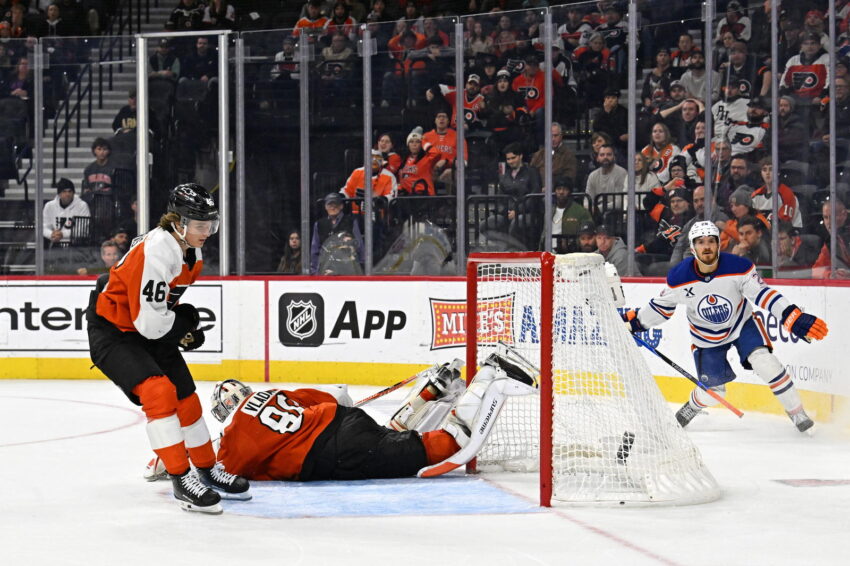
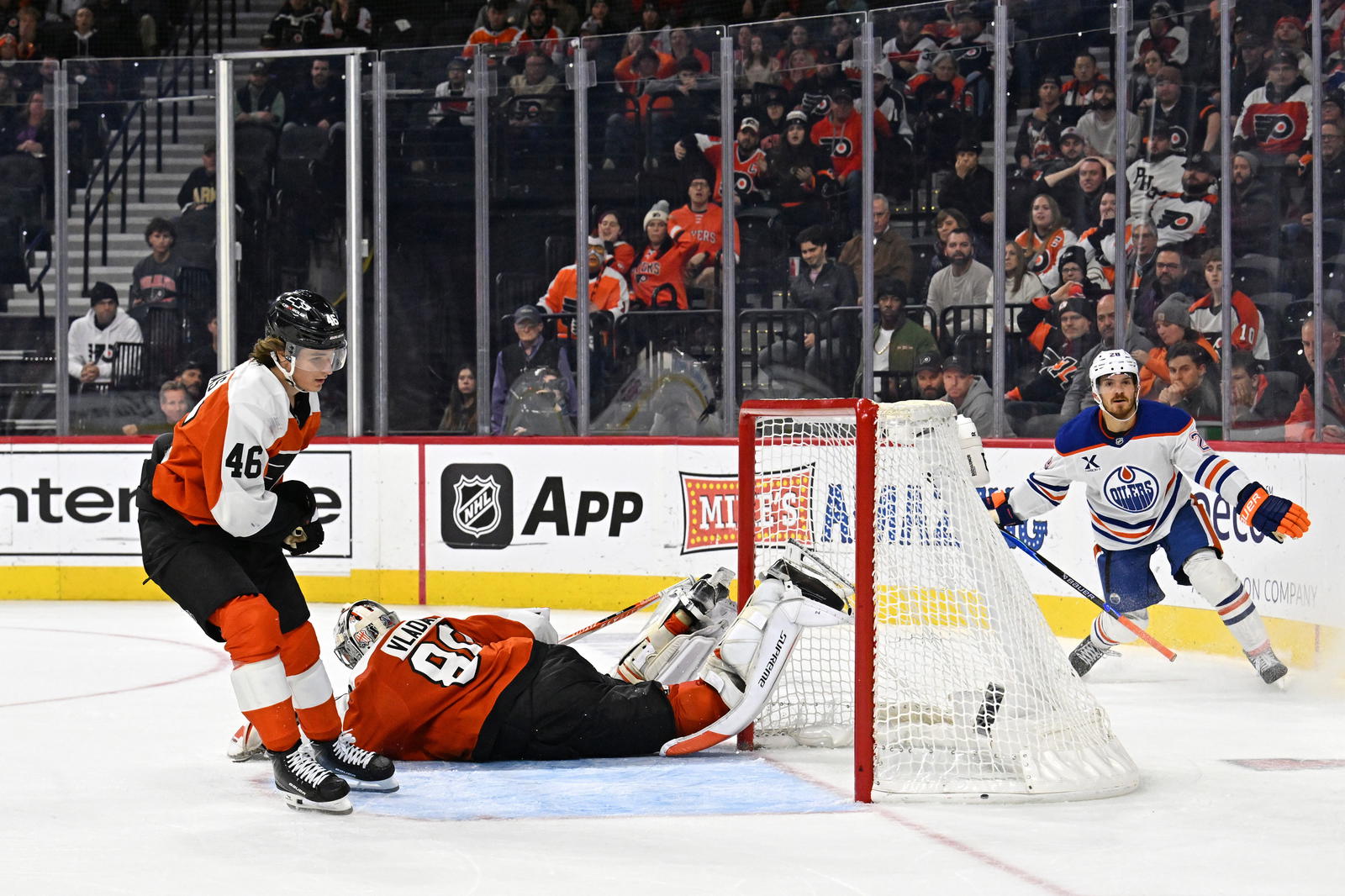
That goal, of course, didn’t stand, and the Flyers lost 2-1 in overtime on an unfortunate and uncharacteristic error from Cam York.
Zegras’s point-per-game pace and Konecny’s resurgence are things to be happy with, as is Dan Vladar’s .919 save percentage.
As for the young players, and the ones who didn’t just arrive in Philadelphia this summer? It hasn’t been perfect.
York and Jamie Drysdale look improved, but, as mentioned above, York did just lose them a game with a turnover, and Drysdale’s game still lacks end product with seven points in 16 games.
Rookie forward Nikita Grebenkin, who has flashed promise and his playmaking chops at various times throughout the nascent season, didn’t even play against the Oilers on Wednesday night.
That came at the cost of 6:59 of ice time for Nick Deslauriers, 7:50 of ice time for Garnet Hathaway, and 6:21 of ice time for Rodrigo Abols, who also went 0-for-5 on faceoffs.
Overall, the way the Flyers are developing their current players and the direction of the rebuild overall has clearly taken a downward turn.
Whether that is temporary or not remains to be seen, and the sky isn’t falling.
As far as reinvigorating interest and excitement in the Flyers? The progress amongst the fans, at least those with voices on social media, has been inscrutable.
Since before the summer, the NHL has been waiting for the next big name to shake loose. The Minnesota Wild are, finally, no exception. But just as they regained their flexibility to make moves, the trade market dried up. There were no Matthew Tkachuks or Mikko Rantanens ripe for the plucking. There weren’t even any medium-sized names who might move the needle.
A month into the season, though, a bunch of teams that hoped to contend are finding themselves also-rans. The St. Louis Blues might be one of the first squads to give up, and they’ve got a name to throw into a stagnant trade market: Jordan Kyrou.
The Blues are off to a sub-Wild start, with a 6-8-3 record, seventh in the Central Division. Kyrou’s apparently been chosen as a scapegoat for this start, getting healthy scratched for a game last week. It’s perhaps not undeserved, with just five goals and nine points through 16 games.
Those things won’t cool the market for Kyrou, if he’s available. Michael Russo and Joe Smith reported in The Athletic on Sunday that “it’s abundantly clear Guerin has been working the phones pretty furiously lately, and you can bet that even includes… Kyrou.”
Kyrou is a lot of great things. He’s an excellent goal-scorer, shooting 13.6% on over three shots per game since the start of the 2022-23 season. Kyrou is one of the fastest wingers in the NHL and would bring a high-caliber right-shot option for the power play, something that the Wild have been missing for over a decade.
Despite all that, there’s one drawback: He’s not Mitch Marner. He’s no Rantanen. He’s not even Brady Tkachuk, let alone the more talented Matthew.
That’s important from the Wild’s perspective, because they might get just one shot at making a big splash. Their prospect pool is good, but not so elite that they can spare huge assets on multiple trades. They have cap room going forward, but they’ll presumably need cash to pay players like Zeev Buium down the road.
The Wild can push in their chips for Kyrou, and they’d be a better team for it. But how much better? Would it be enough?
Let’s turn to The Athletic’s
Player Tiers, compiled with both data and feedback from NHL coaches and executives, to get a sense of where Kyrou is at stacked against his peers. The panel put Kyrou in Tier 4C, the bottom of their “Star” tier.
OK, but what does that mean? His forward peers include Sam Bennett, Bo Horvat, J.T. Miller, Martin Necas, John Tavares, Carter Verhaeghe, and rising stars Logan Cooley and Matvei Michkov.
Trading for Cooley and Michkov, both in the early stage of what should be brilliant careers, would be a no-brainer, of course. But what about the rest of the list? Bennett and Tavares were free agents this offseason. Was anyone thinking that was the answer to the Wild’s problems? Miller and Necas were both traded last season, and it’s hard to think the Wild would be Stanley Cup contenders if they’d traded for either. Would any Wild fan plan a parade if the Wild got Verhaeghe tomorrow?
Any of those names would have made Minnesota better, absolutely, but would it change the fortunes of the franchise?
In the Wild’s pecking order, specifically, Kyrou wouldn’t be close to the Wild’s best player (Kirill Kaprizov, Tier 1C, “MVP”). He wouldn’t displace Matt Boldy (Tier 3A, “All-Star”) as Minnesota’s second-best player. He’d be below Joel Eriksson Ek and Brock Faber (4B). Presumably, at some point Buium would overtake him, leaving Kyrou potentially outside the top five as soon as next year.
In that case, the math for the Wild is simple: Can they win if their second-best player is Boldy?
Ten teams have multiple players in Tiers 1 or 2 (“Franchise”): the Edmonton Oilers, Colorado Avalanche, Florida Panthers, Tampa Bay Lightning, Toronto Maple Leafs, Vegas Golden Knights, Dallas Stars, Winnipeg Jets, New Jersey Devils, and Carolina Hurricanes. That’s a pretty comprehensive list of Cup contenders. You have to go back to 2021 to find a postseason where those teams didn’t take all four Conference Finals spots.
For the Wild to step into that next level with Kyrou, one of two things needs to be true. The first path is that Boldy keeps taking the next step into the “Franchise” territory. Boldy’s on a 41-goal, point-per-game pace, which could well get into the conversation of being on par with William Nylander or Sam Reinhart. Combined with Kaprizov, that could be enough.
The other route to contention with Kyrou would be that his fit with the team outweighs his talent. This could also easily be true. Believe it or not, the Wild actually have spent the ninth-highest percentage of their even-strength time in the offensive zone, per NHL EDGE.
But in terms of actually generating offense with the puck, they’re underperforming. Minnesota is 14th in expected goals per hour at 5-on-5, and 21st in shots on goal per hour.
In other words, they can grind out offensive zone time on the cycle, but they’re not shooting, and they’re not getting quick-strike opportunities on the rush.
As tracked by Natural Stat Trick, Marcus Foligno, Marcus Johansson, and Marco Rossi are tied with the most shot attempts on the rush at 5-on-5… with two apiece. That’s not as bad as it looks — Nathan MacKinnon leads the NHL with five, and just 116 players have multiple attempts — but it does speak to a lack of team speed.
Kyrou brings that threat on the rush, and it’s an element the Wild often lack outside of Kaprizov. Dating back to the 2023-24 season, Kyrou is 16th in the NHL in 5-on-5 Rush Attempts with 27. That sails past Kaprizov and Ryan Hartman, who co-lead the Wild, (21, tied for 63th over that time). Kyrou can enter the offensive zone with ease and make dangerous plays happen, as All Three Zones shows us from their data from last season:
This is where the Wild would get a force multiplier in Kyrou that surpasses his own talent. His ability as a puck-carrier allows the team to give Boldy a true running mate away from Kaprizov. Generally speaking, Boldy is at his best when he has a linemate that can handle the majority of the puck-carrying responsibilities. It’s why Boldy works well with Kaprizov, and to a lesser extent, Marcus Johansson. Being a line’s primary puck carrier simply takes Boldy away from the other things he can do in the offensive zone.
That wouldn’t be an issue with Kyrou, who is more than happy to race the puck up the ice. Even better, he’s a willing and frequent shooter, which is a giant improvement over Johansson, and would help create rebounds for Eriksson Ek and Boldy to put away. Meanwhile, Johansson would be free to move down a line, suddenly giving Minnesota three units who can enter the zone at a high level.
Is that enough to move the needle for the Wild? Maybe, maybe not. But they might not be in a position to turn down a potential Kyrou trade and wait for the Next Big Thing. Who’s to say that the next Marner or Tkachuk or Rantanen even want to go to Minnesota? How confident are Wild fans in the ability to land Artemi Panarin in free agency, let alone his ability to keep playing at a high level in his mid-30s?
There might be risk in landing Kyrou (if, of course, he’s willing to waive his full No-Trade Clause for Minnesota), but there is also risk in inaction. The Wild might only get one shot to make a big splash on the trade market… or they might get zero. Kyrou might be that one shot, and that alone might be a good reason to push Minnesota’s chips in on him now, instead of waiting for a better opportunity that may never actually arrive.