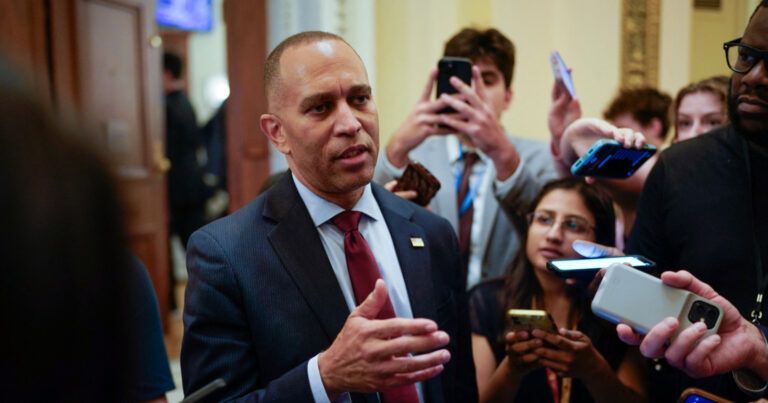
Dozens of Democratic candidates running for U.S. House seats nationwide told Axios they either would not support House Minority Leader Hakeem Jeffries (D-N.Y.) for party leader or were not prepared to commit to voting for him.
The responses suggest growing unease within some parts of the Democratic Party about its current leadership as the 2026 election cycle approaches, the outlet reported this week.
Since assuming the role of Democratic leader in 2022, Hakeem Jeffries has maintained unanimous support within his caucus. That unity, however, may be tested in the next Congress amid rising frustration from grassroots activists, particularly on the party’s left flank.
While Senate Minority Leader Chuck Schumer (D-N.Y.) has drawn much of the criticism from progressive circles this year, Jeffries is increasingly becoming a focal point of dissatisfaction as well, Axios noted.
Axios contacted nearly every Democrat running for a U.S. House seat considered potentially winnable for the party in 2026, receiving responses from 113 candidates through phone interviews or written statements.
Of those surveyed, 20 said they would not vote for Hakeem Jeffries as speaker or minority leader, while another five indicated they were likely to oppose him. Fifty-seven candidates declined to commit to supporting Jeffries, describing it as too early to decide or citing concerns over ideology, strategy, messaging, or leadership style.
Only 24 respondents said they would definitely back Jeffries, and seven more said they were likely to do so, the outlet said.
However, his office pushed back on the narrative that he’s lost support.
“Leader Jeffries is focused on battling Donald Trump, ending the Republican shutdown of the federal government and addressing the crushing GOP health care crisis,” Jeffries spokesperson Justin Chermol told Axios.
Many of the Democrats expressing skepticism toward Hakeem Jeffries are political outsiders or long-shot candidates, while several front-runners in key battleground races declined to respond to Axios’ inquiries. Still, a number of Jeffries’ critics and noncommittal candidates have credible paths to winning seats in Congress.
Among them are Daniel Biss and Kat Abughazaleh, two leading contenders in the Democratic primary to replace retiring Rep. Jan Schakowsky (D-Ill.), both of whom stopped short of pledging to support Jeffries.
Other prominent challengers — including Luke Bronin, Donavan McKinney, Mai Vang, Saikat Chakrabarti, and Patrick Roath — have also withheld their support. Each is running well-funded campaigns aimed at unseating long-serving Democratic incumbents.
Heath Howard, a New Hampshire state representative running for an open U.S. House seat, told Axios regarding the Democratic leader: “I think we need to have a new type of leadership that’s … going to fight back significantly harder against the Trump administration.”
Abughazaleh, meanwhile, told Axios she will support a leader who is “taking actual action against this administration” and that the left should use “our leverage to demand progressive change.”
“We’ve got to see improvement, without question,” Amanda Edwards, who was a member of the Houston city council and is now running in a Texas special election, told the outlet.
Harry Jarin, a firefighter mounting a primary challenge to former House Majority Leader Steny Hoyer (D-Md.), told Axios: “The anger of the base right now is not being matched by Democratic leadership … and that is going to have to change one way or another.”
A recurring theme among candidates who declined to back Jeffries was his refusal to endorse socialist New York City mayoral candidate Zohran Mamdani — a decision that has also become a source of frustration among left-wing members of Congress.
“His refusal to endorse Zohran makes me nervous that, if I were to become the nominee in my race, he and the party would not support me,” noted Jacob Lawrence, who is set to challenged Rep. Chuck Edwards (R-N.C.).
Chakrabarti, when asked whether he would support for Jeffries, quipped: “What is it that Hakeem said about endorsing Zohran? ‘I’ll have conversations with him and see where it goes.’”
Bruce Willis, one of the most recognizable faces in Hollywood history, remains a figure of strength and resilience despite the health struggles that have slowly pushed him away from the spotlight. For decades, he captivated audiences with his commanding screen presence, most famously as John McClane in the
In recent years, however, Willis’s life has taken a very different turn. His family confirmed that he has been battling frontotemporal dementia (FTD), a devastating neurodegenerative disease that impacts speech, memory, and behavior. This condition has understandably limited his public appearances and ultimately brought his acting career to a close. While the diagnosis was heartbreaking news for millions of fans, it also revealed the remarkable unity of his family, who have surrounded him with love and support as he navigates this difficult chapter.
Amid the challenges, Willis’s family continues to share glimpses of their private life, offering comfort to those who admire him. Recently, his daughter Scout Willis shared a heartfelt post on Instagram that resonated deeply with fans around the world. Scout, 33, posted a mirror selfie wearing a frayed suede jacket and a baseball cap with the word “actor” boldly stitched across the front. Though simple, the post carried profound meaning. It wasn’t just a snapshot of herself—it was a quiet message of resilience, love, and hope for her father. For many followers, seeing even a symbolic nod to Bruce Willis’s enduring presence was a gift, a reminder that his spirit still shines through, even as his health declines.
The Willis family’s bond has been central in helping Bruce through these difficult times. He is the proud father of five daughters—Rumer, 35, Scout, 33, and Tallulah, 30, whom he shares with his former wife Demi Moore, and his younger daughters, Mabel Ray, 12, and Evelyn Penn, 10, with his wife Emma Heming Willis, whom he married in 2009. The family has been remarkably open about his condition, not only to update his fans but also to raise awareness about dementia and the emotional toll it takes on loved ones. Through their transparency, they’ve created a community of compassion and support, reminding the world that even iconic figures face deeply human struggles.
Scout’s Instagram post may seem modest, but for many, it was a powerful reassurance. It reflected the family’s ongoing commitment to honoring Bruce’s dignity while also celebrating the love that surrounds him. Fans who grew up watching him on screen found comfort in knowing that the man they admired is still embraced by the people who matter most to him. His family’s willingness to share these moments underscores the importance of resilience and connection during times of adversity.
Frontotemporal dementia is an unforgiving condition, one that gradually strips away speech and personality. Yet, what remains is the love, the memories, and the profound human bonds that cannot be erased by illness. That is what Scout’s post highlighted: a reminder that beyond Hollywood stardom, Bruce Willis is a father, a husband, and a man who is deeply loved. Her message reminded the world that even in hardship, hope and love remain unshakable.
What we are witnessing is more than an update about a celebrity’s health—it is a testament to the power of family and the resilience of the human spirit. Bruce Willis’s legacy extends far beyond the silver screen. While his roles as action heroes and unforgettable characters will forever live on in film, his true legacy lies in the love he fostered and the way his family now carries him through these challenges with grace and compassion.
For fans across the globe, Bruce Willis’s story is both heartbreaking and inspiring. It reminds us that no matter how larger-than-life someone may seem, we are all bound by the same fragility and strength of the human experience. The quiet moments—photos shared on social media, notes of encouragement from his children, and the love of a devoted family—become the most meaningful markers of his life’s journey.
As the world continues to follow Bruce Willis’s path, his story offers a profound lesson: true strength is not just about facing explosions on screen, but about confronting life’s most painful battles with courage, dignity, and love. His family’s devotion reminds us all to cherish the people we love, to be patient in hardship, and to find hope in even the smallest expressions of care.
Bruce Willis may no longer be the unstoppable hero leaping across movie screens, but in the eyes of his family and millions of fans, he remains just as heroic—perhaps even more so now. His enduring spirit, and the unwavering love of his family, are proof that while illness can change many things, it cannot erase the power of love, memory, and human resilience.