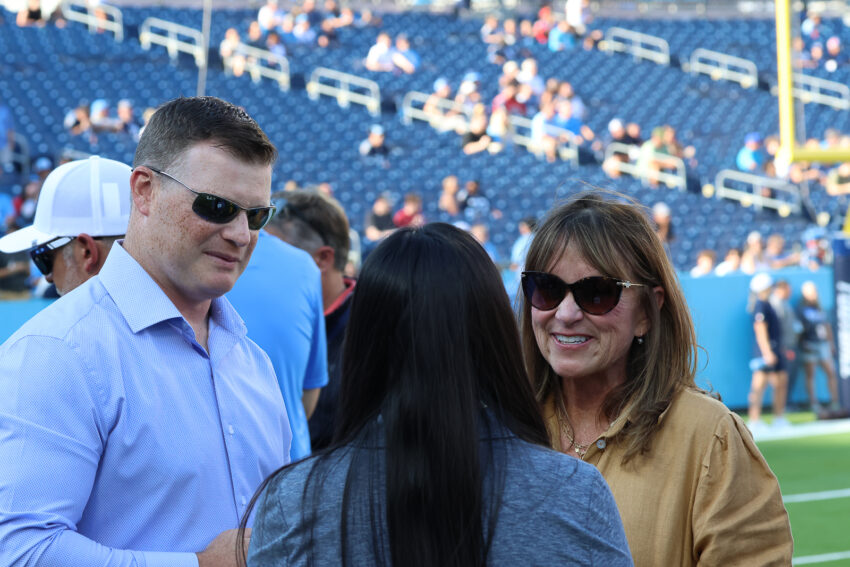
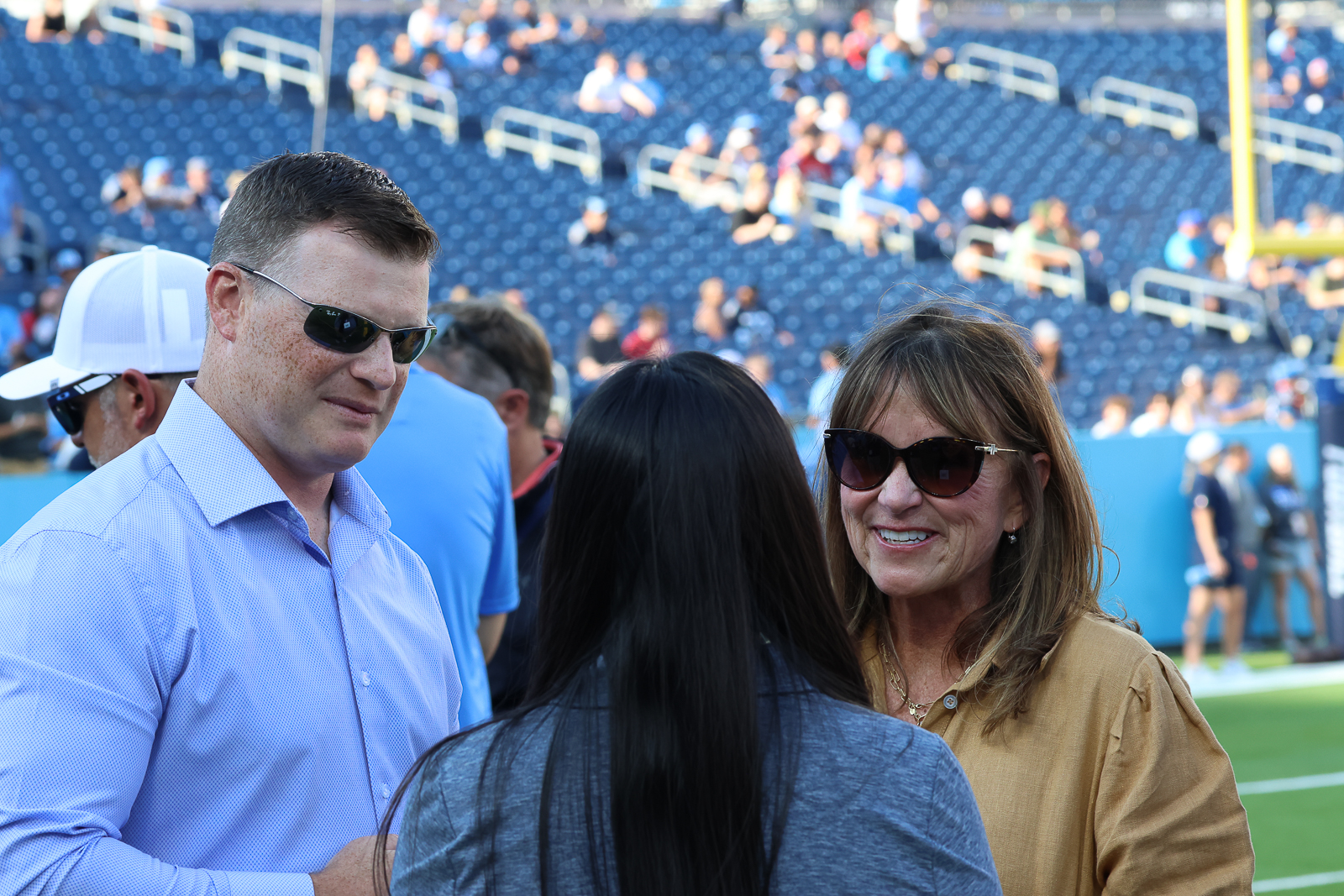
The Tennessee Titans are in flux. They’ve been that way for some time now, with a rotating cast of leaders, and players, and identities (or lack thereof), but you can really feel the winds of change right now.
Titans owner Amy Adams Strunk is atop both the organizational power structure as well as the person all of this change ultimately leads back to. But the man under her, above everybody else in the football operation, is Chad Brinker. This is his third season in Tennessee. And through most all of this tumult he’s not only survived, but has somehow risen up the ranks.
I want to talk about why his public perception is the way that it is, what he actually does around here, and how he should be judged going forward.
The Titans are a team that has a different GM and head coach today than they had 11 months ago. And the GM and head coach they had 11 months ago were different from the GM and head coach they had almost exactly two years before that. Throw in the fact that all four of these people were hired and fired individually, all on different timelines, and you begin to see the mess this franchise has made of itself.
Jump back to the present, and we’ve just seen two talented young players at a premium position traded for Day 3 pick swaps: CB Jarvis Brownlee Jr. and CB Roger McCreary, who each have their own story. We’ve heard whispers about other players on the roster who might have less of a future with the team than previously thought. We heard from national sources that the Titans were one of the biggest sellers heading into the deadline, yet they weren’t a fire-sale team at all.
Now, those of us who are local and actually have our finger on the pulse of the team can explain some of these things away. I was reporting why this team would not be a fire-sale for weeks before the deadline. I also wrote here about how regime change always victimizes some good players, and that’s why the carousel must stop.
Nonetheless, confusion persists. Or maybe it isn’t confusion, maybe it’s discontent in the face of uncertainty. Either way, fans are understandably frustrated and questioning of this team’s leadership over… well, everything. “I can’t believe Chad Brinker is doing these things to the roster” is the sentiment I see frequently. And then when I (or others who cover the team) respond by pointing out that GM Mike Borgonzi handles the roster, wondering why Borgonzi gets a pass that Brinker doesn’t, this is the response:
First of all, extending the coaching staff isn’t something unique to the Titans; it’s standard practice in the industry. It’s fair to be mad they didn’t fire the staff after Year 1, but not that they extended their contracts once the decision was made to keep them. With that detail out of the way, let’s now talk about what Chad Brinker actually does around here.
Here’s how I would describe Chad Brinker right now: I think he’s the most misunderstood man in the Titans organization. I also think it’s possible he’s just not any good at this. Only time can tell at this point. His stated processes and fundamental beliefs are sound, at least in my estimation. But his team also hasn’t produced any meaningful success yet, even though he’s taken over a complete mess. So I just don’t know for sure yet. How could I?
Here’s what I do know, or at least feel pretty good about: if he is no good at this, I don’t think that it’s in the ways that the general public seems to already hate him for.
First of all, a lot of the “stink” on Brinker’s reputation amongst fans seems to do with the fact that he’s been in the building through a lot of this chaos. How does somebody ascend to become the boss of the man who hired him, and then be a part of the leadership that dismisses him and the head coach they hired together? How does somebody like that get to survive while nobody else does? How does his station only improve through it all? He must be a power-hungry, cold-blooded snake!
I don’t find that to be the case at all. Of course Brinker is ambitious, nobody gets to the top of a billion dollar operation without ambition. But I don’t think his ambition drives him in the way many seem to think. I don’t think he’s some disloyal fraud. So what is he?
I think Chad Brinker’s ascent is a result of his usefulness. When Ran Carthon hired him to be an Assistant GM in 2023, he was brought in primarily to be the cap management and analytics guy. he’s good at those things. But cutting his teeth in Green Bay’s front office for so long, he’d diversified his skillset to the point that he’s really a front office jack of all trades. Quibble with how good he actually is at all of these things, that’s fine. That’s not the point; the point is that he knows how to actually do them.
He has functional experience with the logistics of this job. He has experience grinding tape and evaluating talent. He has experience managing the cap. He has experience making trades, and in analytics, and in operational management. Ran Carthon’s skillset was different, and wasn’t nearly this broad. Amy Adams Strunk identified this, and for whatever reason that I think only Amy herself could tell you, she latched onto Brinker as her trusted ownership liaison. She finds him useful as a jack of all trades, and she trusts him to be her messenger; a position that is too often deeply unenviable.
When Brinker was here as AGM in 2023, there was no question he was under Ran Carthon. He did the GM’s bidding. In 2024 when the power structure was adjusted in a way that made Brinker technically in charge of the full football operation, there was plenty of confusion and suspicion publicly over who exactly was calling the shots. My understanding based on talking to many people inside the building is that Ran Carthon’s vision was still driving the construction of the roster. Brinker was doing what he felt was right: continuing to do the roster bidding of the GM.
Make of that what you will. A heavy dose of skepticism makes plenty of sense to me. But based on the way that the current regime has both talked about and acted on the actions and philosophy of the Carthon years makes it pretty easy for me to believe. Their consistent emphasis on drafting and developing—being patient through the process and insisting that a free agency sugar rush never works—runs counter to how things went when Carthon was here.
When Carthon was fired at the end of the 2024 season, Brinker remained as “in-charge” on paper as he already was. What changed was that the process leading to the hiring of Mike Borgonzi was his design. This was, in my estimation, the first of three puzzle pieces put in place by Brinker himself, building the Tennessee Titans football operation according to his own vision.
Chad Brinker is fully responsible for the GM position today. Not because he makes the roster decisions, which I feel comfortable saying he does not. He’s responsible because Mike Borgonzi is his guy, who he hired, and who he empowers to control the roster.
Chad Brinker is responsible for the football operations of this team. Not just because it’s literally in his title, but because he has molded (and is still working on molding) a lot of it in his image. The video team, security team, and PR team are just a couple of places he’s left his fingerprints lately.
And now Chad Brinker will be responsible for the next coaching staff, because that will be his pick too. It’s been reported and is my understanding that this next hire will be led by Brinker and Borgonzi. Meaning once the hiring of the next coach happens in the new year, the Tennessee Titans will officially be the Chad Brinker Show. The football operations—front office staff, coaching staff, and ops staff—will more or less be finally built in his vision.
That doesn’t mean he should be crushed the moment something doesn’t work perfectly in 2026; this entire franchise still has a long ways to go if they’re going to be a high-level ball club. But it does mean that his remodel of this team will be complete—or at least fully set in motion—in each sector he oversees.
So yes, judge Brinker on this upcoming coaching hire. Judge him for the way that this team carries themselves, both internally and in the public eye. And judge him for the decisions his front office makes; not because he’s the iron first actually making all the moves in the shadows, but because they’re his people. And for crying out loud, pray Amy Adams Strunk has the courage of her convictions to give his vision for her franchise a chance to steady itself and mature. We’re too far down this road to pull another ripcord.
The Cleveland Browns admitted making a mistake with Dillon Gabriel during a 27-20 loss to the New York Jets that put their rookie quarterback in a bad position.
Down just one score, the Browns faced a critical fourth-and-one in the second half. But instead of running the ball with Quinshon Judkins, new offensive coordinator Tommy Rees called a pass. Gabriel had some options but was ultimately sacked for a seven-yard loss that ended the important possession.
2 guys are open in the flat and Dillon Gabriel takes a sack on 4th down.
The Dillon Gabriel era is over. #Browns
“Look as a play caller, there’s always things you want back,” Rees said on Thursday. “Felt like we put our guys in position to have success throughout the game and then, when you do that and you don’t have success, you always look to why and what you can do during the week to help your players have that success. There’s going to be a handful of calls that you make that the defense won the rep, and that happens in football throughout a game.”
A reporter pointed out that Gabriel had an open option on the play, and Rees conceded again that they shouldn’t have put their rookie quarterback in that situation.
“Yeah, I should have run the ball,” Rees said. “I don’t want to get into the specifics of the play itself. You can freeze almost any play and say, ‘Hey, this guy’s open, this guy’s open.’ I want to make sure I’m putting our players in the right spot. I made a call, an aggressive one, it didn’t work and we got to move on to the next.”
The Browns’ offense showed some brief flashes of competency against the Jets. But overall, it was still a sloppy, inconsistent showing from the unit that is averaging just 16.2 points per game this season.
The results haven’t been there with Gabriel, who had a few costly misses against the Jets. Still, Rees said the issues haven’t stemmed from his decision-making or where his eyes are supposed to be.
“We always grade that part of them and he grades out pretty high,” Rees said. “Look, nobody’s going to bat a thousand. I don’t bat a thousand calling it. Nobody’s going to bat a thousand in really anything they do. But I would say he grades out where we want him. Dillon’s prep and where he is mentally for a rookie is really well beyond. He’s mature in that way and we want to make sure that those things that are happening during the week, we go ahead and execute them on Sundays.”
One of the Browns’ objectives has been to get the ball to Jerry Jeudy more often. Jeudy was a Pro Bowler last season but entered Sunday’s matchup with just 22 catches in eight games.
While the Browns lost, they were able to get Jeudy more involved. He snagged a season-high six catches for 78 yards and his first touchdowns of the year.
“Jerry does a lot of things well, and I’ll just say we’re trying to put him in a position to do those things in the right spots, in the right moments,” Rees said. “And, you know, we talked last week, when you get your good players going early, usually helps them throughout the game. So, Jerry’s a very talented guy who’s worked extremely hard, and, you know, he put himself in that position to have success.”
Jeudy and the Browns face the Baltimore Ravens on Sunday. Cleveland is a 9.5-point underdog for the matchup.