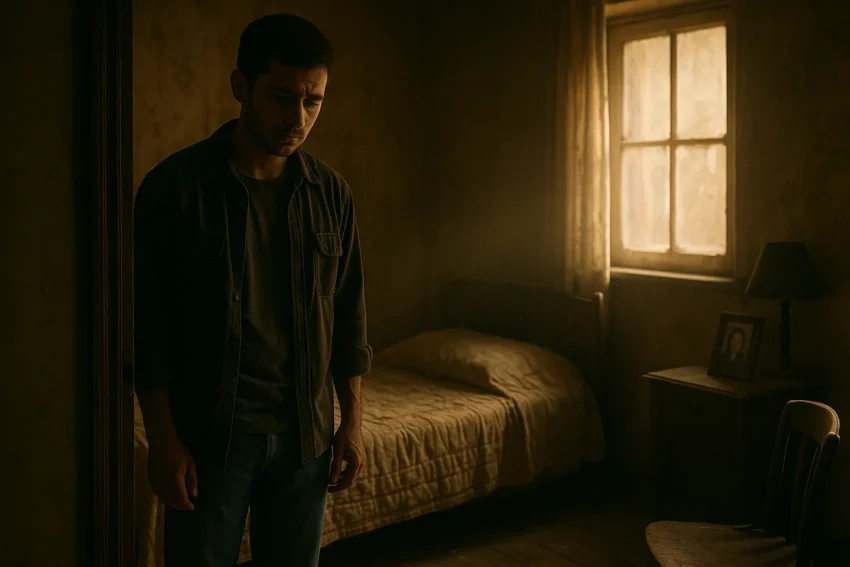
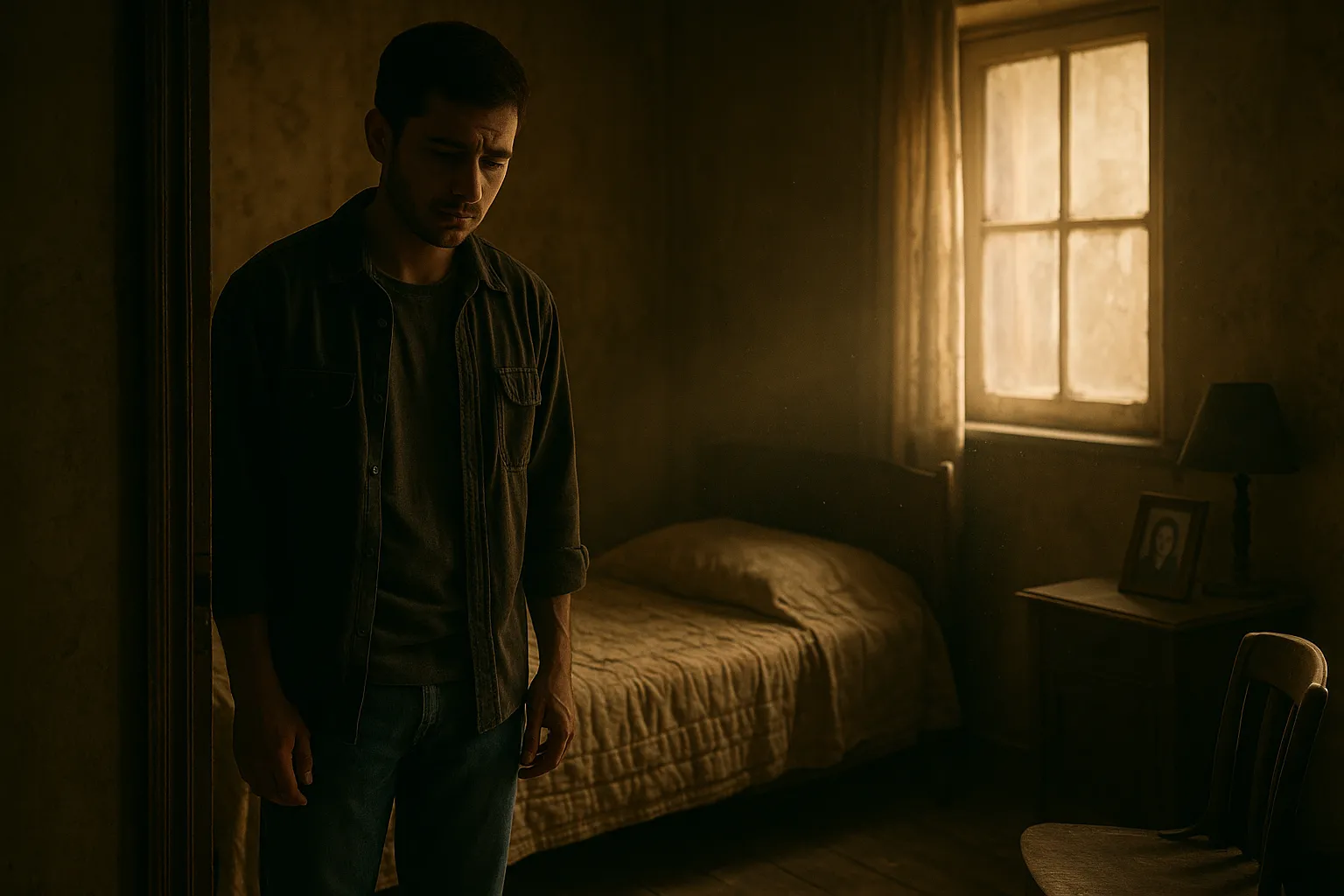
I stood there in silence, the key still trembling in the lock. The air inside felt thick, heavy, as if time itself had stopped the day she left. The curtains were drawn, and only a thin beam of sunlight filtered through a small tear in the fabric. It illuminated floating particles of dust — a soft storm suspended in the stillness.
Her apartment was small: a narrow hallway leading to a living room with two worn-out chairs, a crucifix on the wall, and a shelf full of old books whose spines had long since faded. A faint scent of lavender lingered in the air — the kind of scent that stays clinging to the memories of someone who never wanted to bother anyone.
“Qué tristeza,” murmured Don Ramiro, the landlord, as he opened a window to let the air in. “She never asked for anything. Paid on time, always alone.”
I walked around slowly, afraid to disturb the silence. There was a teacup still resting on the counter, a spoon beside it. A rosary hung on the wall near her bed. Everything was tidy — too tidy, as if she had prepared herself to leave quietly.
Then, I saw the bed. The sheets were perfectly folded, the pillow plumped as if waiting for her return. On top of it lay a small box wrapped in a faded white handkerchief. My heart began to race.
I hesitated before touching it. Something inside me whispered that it wasn’t just a box — it was a part of her story, maybe the last thing she wanted someone to find.
I sat on the edge of the bed and carefully untied the knot. Inside, there was a stack of neatly folded papers, a few black-and-white photographs, and a small tin heart-shaped pendant.
The first photograph caught my attention — a young woman in her twenties standing next to a man in a soldier’s uniform. Her smile was bright, her eyes full of dreams. It took me a moment to realize that the woman was Doña Teresa, decades younger.
The papers were letters — old, yellowed, their edges frayed. I took one and began to read.
“My dear Teresa,
The war keeps me far from you, but every night I dream of our small house by the lake. I promised you I’d come back, and I will. Don’t stop praying for me. Tell our little girl I’ll bring her the blue ribbon she wanted. With all my love,
—J.”
I blinked, stunned. She had a husband. A daughter.
The next letters revealed more. One after another, written in elegant handwriting, full of tenderness and hope. But the last one, dated 1956, was different.
“Señora,
We regret to inform you that soldier José Ramírez died in service. He was brave until the end. His remains could not be recovered. Please accept our condolences.”
I stopped reading. The words blurred behind my tears.
So that was it. That’s why she’d been alone all these years.
She had lost everything — her husband, her child, her hope — and yet she still smiled, still thanked me for bringing her soup.
I turned to the last envelope. It wasn’t sealed. The handwriting was shaky, almost unreadable.
“To the kind neighbor downstairs,
If you’re reading this, it means my time has come. I wanted to thank you for every meal, for every visit, for treating me as if I mattered.
I never had anyone after my daughter passed away. She was seven when the fever took her. Since then, I’ve lived remembering them both — my José and my little Ana.
I didn’t tell you because I didn’t want your pity. I wanted your kindness to stay pure.
Under the floorboard near the window, there’s something I saved my whole life. Please, don’t keep it. Give it to someone who truly needs it. That’s all I ask.
—Teresa”
I felt the air leave my lungs. She had written to me.
I searched the corner near the window. The wooden plank was loose, as she’d said. I knelt down and lifted it carefully. Underneath, wrapped in an old cloth, was a tin box. Inside were stacks of bills — old and new, neatly arranged, probably years of savings.
I counted in disbelief. There had to be more than a hundred thousand pesos.
Don Ramiro’s eyes widened. “¡Dios mío! She never spent anything. Lived like a saint.”
I sat there, stunned. All this time, she had quietly gathered her savings — not for herself, but for someone else.
For a long time, I just stared at the money, unsure what to do. Then I looked at her note again: “Give it to someone who truly needs it.”
That night, I couldn’t sleep. Every time I closed my eyes, I saw her smile, heard her soft voice thanking me for the food. I remembered her tiny hands trembling as she held the bowl of soup, and the way she always said, “Dios te lo pague, m’ijo.”
Now I understood. She wasn’t poor — not in the way the world thinks. She had lived in silence not out of misery, but out of humility.
The next morning, I went back to her apartment. The landlord had already cleaned most of it, but I asked him for one favor.
“Let me take care of her funeral,” I said.
He looked at me, surprised. “Are you sure?”
“Yes. It’s the least I can do.”
The funeral was small. No relatives showed up — only two neighbors, Don Ramiro, and me. The priest spoke of kindness and quiet faith, but his words couldn’t capture what she had truly been.
Afterward, as we lowered her casket into the earth, I placed the tin heart-shaped pendant on top. Inside it, I had tucked a copy of her last letter — so she would know her secret wouldn’t die forgotten.
In the following weeks, I couldn’t stop thinking about her last wish. “Give it to someone who truly needs it.”
At first, I thought of keeping a small part — after all, my rent was due, and my salary barely covered groceries. But every time I considered it, I remembered her eyes: calm, grateful, untouched by greed.
Then, one rainy afternoon, I found my answer.
Down the block lived a young woman named Laura, a single mother with two children. I’d often seen her leaving for work at dawn, holding their little hands, her clothes soaked from the rain. One of the kids, Mateo, always smiled and said, “Buenos días, señor.”
That day, I saw her sitting on the steps, crying quietly. The factory where she worked had closed, and she didn’t know how to pay the rent.
I didn’t think twice. I told her I had a small donation — from a friend who had passed away. I didn’t tell her how much. I just handed her the envelope.
When she opened it, her eyes filled with tears. She tried to speak, but no words came.
“Use it to start over,” I said. “It’s what she would have wanted.”
She hugged me tightly, sobbing, and whispered, “Tell your friend thank you. She saved us.”
I smiled faintly. “She already knows.”
Months passed. I visited the cemetery often, bringing fresh flowers to Doña Teresa’s grave. One morning, when I arrived, I found a small note placed under the bouquet I’d left before.
It said:
“Dear Doña Teresa,
Because of your gift, I opened a small bakery. My children are happy. Every day, we share bread with our neighbors, just as you shared your kindness with us.
With love,
Laura and the kids.”
I pressed the note to my chest, tears spilling down my face.
Her kindness had multiplied, just as she must have hoped.
Over the years, I kept her memory alive. I spoke about her to my friends, to my children — how a quiet old woman, forgotten by the world, had changed lives with nothing but grace and generosity.
Her apartment was eventually rented out again, but I asked Don Ramiro to leave the window just as it was — slightly open, the way she liked it.
Sometimes, late at night, when the wind passed through the stairwell, I could almost hear her soft voice again:
“Eres muy amable, m’ijo.”
Ten years later, Laura’s bakery had grown into a community center. Every Sunday, they gave free meals to the elderly and the homeless. The sign above the door read:
“Comedor Teresa – Because kindness never dies.”
Every time I visited, I saw the same light in Laura’s eyes that once lived in Doña Teresa’s — that quiet, steadfast compassion.
The last time I visited her grave, I brought one of the bakery’s warm loaves wrapped in a napkin. I sat beside the headstone, watching the sun set over the cemetery.
“You see, Doña Teresa,” I whispered, “your love didn’t end here. It kept growing — through people you never met. You’re still feeding the hungry, still reminding us what matters.”
The wind stirred the flowers, and for a brief moment, I swore I heard her laugh — soft, gentle, like a whisper carried from heaven.
I smiled, feeling the warmth of the bread in my hands, and thought of her final words: Give it to someone who truly needs it.
So I stood, walked down the street, and handed that loaf to a man sitting on the corner, shivering in the cold.
He looked up, surprised. “For me?”
I nodded. “From a friend.”
And as I walked away, I felt light — as if Doña Teresa herself were walking beside me, her footsteps soft and steady, the echo of her kindness still alive in every act of love that followed.
The story of the modern British monarchy is often told through its crowns, its palaces, and its ceremonies. But behind the gilded doors, the tale is just as much about human pride, family wounds, and the quiet wars of dignity. Few episodes illustrate this more vividly than the strained relationship between Queen Camilla and Catherine, Princess of Wales — and the moment when Kate, pushed too far, finally delivered a lesson that no one in the royal household will soon forget.
For the Middletons — Kate’s solidly middle-class parents who built their own business from scratch — watching their daughter marry into the most famous family in the world should have been the pinnacle of pride. Yet, at King Charles’s coronation, whispers emerged of a cruel humiliation.
According to insiders, Camilla ensured that Michael and Carole Middleton did not enter Westminster Abbey through the main royal gate. Instead, they were instructed to use the servants’ entrance — as if they were unworthy of standing shoulder to shoulder with Britain’s aristocracy. It was a cutting reminder of how the old establishment has always eyed “commoners” with suspicion.
For parents who had supported their daughter with nothing but love and sacrifice, the slight was more than just protocol. It was an insult. One that would be remembered.
If that sting weren’t enough, another wound followed. After the birth of Prince George, Camilla reportedly tried to limit the Middletons’ access to their grandchildren. The reasoning? That they might be a “bad influence” on royal heirs who, in Camilla’s view, should be molded by palace tradition, not by suburban warmth and Sunday roasts in Berkshire.
Imagine the heartbreak of grandparents treated as outsiders, denied the simple joy of reading bedtime stories or holding their grandson’s tiny hand. For Kate, a fiercely protective daughter and mother, the message was clear: her family would never be welcomed without resistance.
Time passed. The public saw smiles on balconies and carefully staged appearances, but beneath the glittering crowns, tensions simmered. And then came the opportunity for reckoning.
When the Crown Prince of Jordan announced his wedding, it was set to be a gathering of royals from across the world. Camilla, eager to flaunt her newfound status as Queen, intended to attend. A royal spectacle abroad was exactly the stage she craved — one where she could shine without sharing the spotlight with Elizabeth’s memory or Diana’s shadow.
But Kate saw through it. With quiet precision, she delivered a rebuke so sharp it cut to the bone: it would be “inappropriate for someone divorced” to attend a celebration of a new marriage. The words carried the weight of unspoken history. Everyone in the room knew who had been the “other woman” in Charles’s story.
And just like that, Camilla’s moment evaporated. The invitation passed instead to William and Kate.
At the Jordanian wedding, Kate walked into the ballroom not only as the future Queen of England, but also as the bearer of a legacy Camilla could never touch. Perched on her head was the dazzling tiara once worn by Princess Diana.
To the world, it was a nod of continuity — mother-in-law to daughter-in-law, a passing of grace and resilience. To Camilla, it was a silent reminder of the shame that crowns cannot erase: she may hold the title of Queen, but she will always carry the shadow of being the “other woman.”
Guests noticed. Cameras captured. And millions watching from afar understood the unspoken message: respect cannot be commanded by a crown; it is earned through character.
Kate’s victory wasn’t loud. It wasn’t public revenge in the tabloid sense. Instead, it was the kind of subtle, graceful strike that defines true strength. She didn’t raise her voice or hurl accusations. She simply used the weight of dignity, tradition, and quiet wit — and Camilla’s own history — to undo her.
For many in Britain and beyond, the moment confirmed what they already felt: Kate represents the monarchy’s future not because she was born into it, but because she embodies something more enduring — compassion, integrity, and a loyalty to both family and duty.
Among royal watchers in the US and UK — especially those who lived through Diana’s era — the story resonates deeply. It is a reminder of how the institution has wounded, healed, and reinvented itself through generations. It recalls the pain of the People’s Princess, sidelined and betrayed, and how her spirit still hovers, influencing the choices of her son’s wife.
And for those who have ever felt dismissed because of their background, who have seen loved ones excluded from tables they deserved to sit at — the story of the Middletons is personal. In Kate’s quiet defense of her family, many see their own longing for justice, their own wish that dignity triumphs over cruelty.
Camilla may wear the crown, but no jewel can rewrite the past. No ceremony can erase the whispers of betrayal or the pain of those humiliated in her rise to power.
Kate, however, has found a way to turn pain into strength. Every time she steps into the public eye with poise and grace, every time she honors Diana’s memory while carving her own path, she reminds the world that history remembers not titles, but character.
And in that truth lies the lesson Camilla can never escape: power without respect is hollow, but respect born from love is eternal.