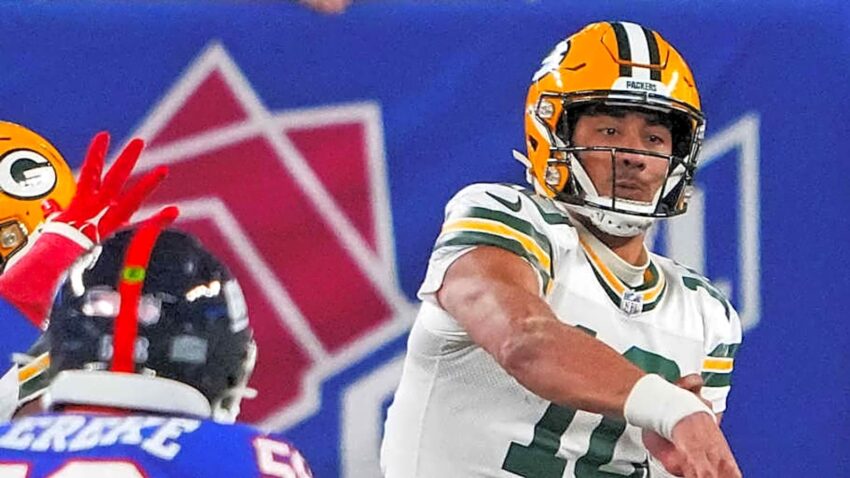
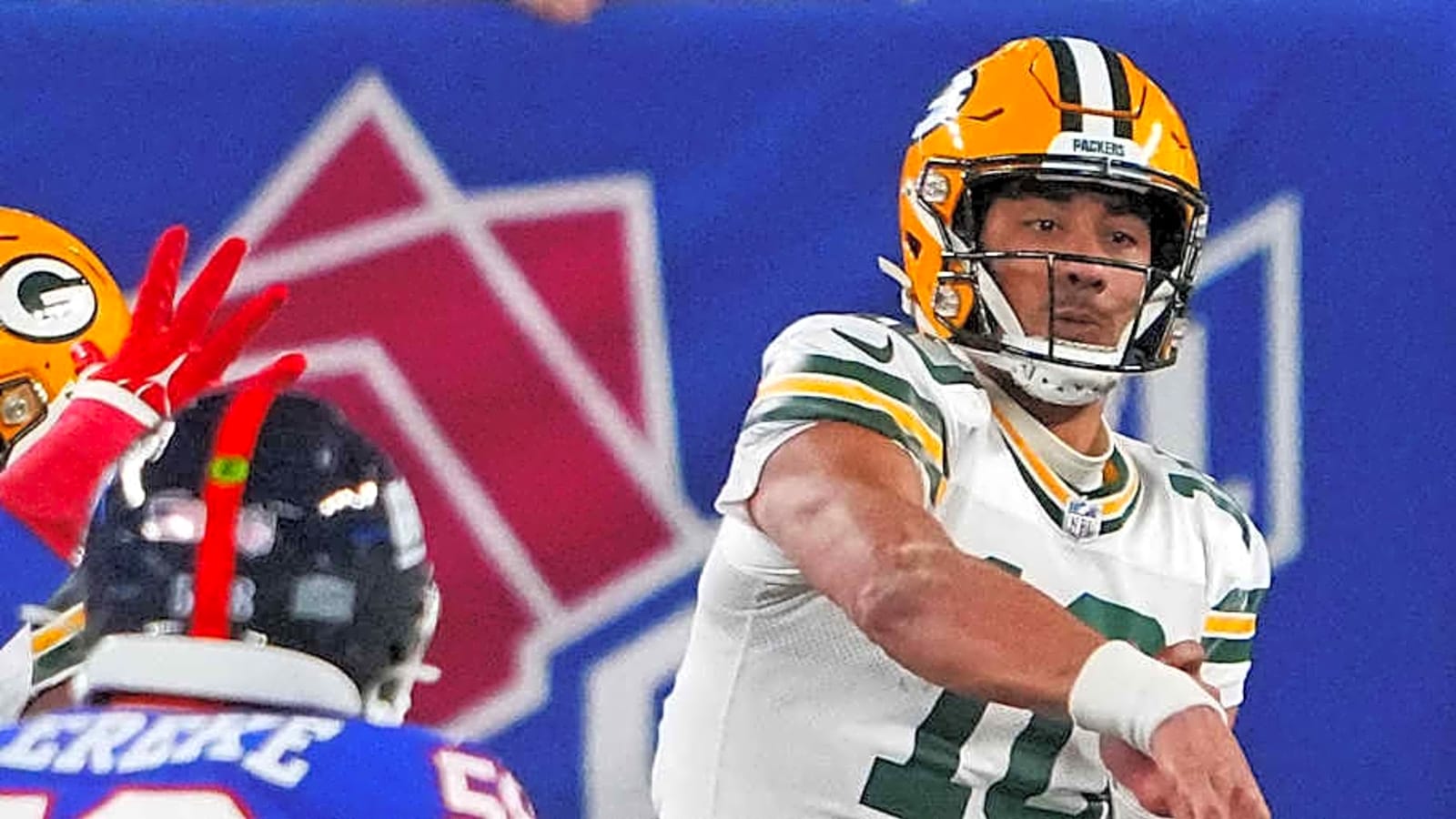
The Green Bay Packers took another loss in a low-scoring game against the Eagles on Monday. It was their third loss of the season, with all three being by three points with a field goal missed or blocked during the game.
They will look to bounce back on Sunday against the struggling New York Giants, who will be without rookie starting quarterback Jaxson Dart, among other key players who are questionable to play.
Here are three keys to the Packers getting back in the win column this week, as well as a look at the Giants’ offense, defense and special teams.
The Giants are going through two dramatic changes with a new coach and a new starting quarterback.
The Giants will be without their first-round quarterback, Jaxson Dart, who started the last seven games but suffered a concussion last week against the Bears. It is not the first time this season he has found himself in concussion protocol.
In a Week 6 victory over their division-rival Eagles, Dart was evaluated for a concussion and eventually cleared to play, though the Giants’ handling of the situation became a point of contention and
Dart has been praised for being a mobile quarterback, running the ball 57 times for 317 yards and seven touchdowns. While his mobility has been one of his strongest assets, he is fighting through the growing points that a lot of rookie quarterbacks go through, and that is taking hits to pick up extra yards instead of sliding.
With Dart out, it will be veteran Jameis Winston taking over at quarterback for the Giants. An 11-year pro, Winston has not played this season but was chosen over Russell Wilson by interim coach Mike Kafka.
Winston has been known to be an all-or-nothing quarterback, and that is something that the Packers’ defense can take advantage of after having a great game against the Eagles.
“He’s played a lot of ball, he’s had a lot of success,” coach Matt LaFleur said. “He’s going to let it rip, so we’re going to have to do a great job in coverage, we’re going to have to do a great job with our pre-snap disguises and, ultimately, I think it always comes down to the ability to put pressure on the quarterback.”
Josh Jacobs had a good game against the Eagles, running for 74 yards on 21 carries and a touchdown. Jacobs has scored a rushing touchdown in a league-high eight of the Packers’ nine games this season.
While the Eagles’ run defense ranks a mediocre 19th in the NFL, the Giants are even worse at 31st, the second-worst in the NFL while allowing 152.1 rushing yards per game. With Jacobs posting decent production the last few games and the Packers’ tendency to run the ball early and often, Jacobs could be in for a big game.
The Giants do have a force in the middle of their defensive line in Dexter Lawrence II, but he is more suited as a pass rusher than a run stopper. The strength of the New York defense is its pass rush. The Packers will look to avoid Brian Burns and Co. on Sunday and build some momentum on the ground for the stretch run.
“I think that’s the main thing I’ve been trying to preach to the guys,” Jacobs said, “that we’re going to go as far as we want to go. So, it’s really about us.”
Last week against the Eagles, Jordan Love didn’t have a great game, throwing for just 176 yards on 20 completions.
However, 24 of his 36 passing attempts and 113 of his 176 yards came in the fourth quarter, when the Packers were down 10-0. Notably, he threw the ball nine times out of 11 plays on the Packers’ only touchdown drive, completing seven passes for 37 yards to set up Josh Jacobs’ touchdown run.
The Packers have a tendency to play conservative early in games and try to chip away at defenses in the run game, trying to use as much time as possible and wearing defenses down with long drives. While it has worked in the past, the last two weeks have shown that the offense can stagnate if the run is stopped, especially closer to the goal line.
After giving Love a hefty contract extension last summer and following two close losses over the last two weeks, it is time to put the ball in his hands and see what he can do with the keys to the offense.
The Giants finished last season ranked 30th in yards per game (294.8) and 31st in points per game (16.1) and finished with a 3-14 record. They have been much better this season at 14th in yards per game (332.9) and 24th in points per game (21.7) but still find themselves at 2-8.
The Giants have been led by two quarterbacks this season, and a third will start on Sunday. Rookie Jaxson Dart has seen the most action, starting the last seven games before entering concussion protocol. Dart has put up decent numbers, throwing for 1,417 yards and 10 touchdowns with three interceptions, good for a 93.5 passer rating, while picking up the Giants’ only two wins of the season.
On Sunday, it will be veteran Jameis Winston starting for the Giants rather than Russell Wilson, who replaced Dart last week.
Before a gruesome ankle injury ended his season, rookie Cam Skattebo was leading the Giants’ rushing attack, which is 17th in the NFL. In an upset win over the Eagles, he rushed for 98 yards and three touchdowns.
In his absence, it is Tyrone Tracy Jr. starting at running back. In eight games, Tracy has run the ball 64 times for 248 yards (3.9-yard average) and a touchdown. In last week’s loss to the Bears, he ran the ball 14 times for 71 yards. He had three 100-yard games last season.
Another key season-ending injury sidelined the Giants’ top receiver, second-year phenom Malik Nabers. After his Week 4 ACL tear, the receiving corps is led by Wan’Dale Robinson, who has brought in 53 catches for 602 yards and two touchdowns. The receiving room could be even more depleted this week with big-play receiver Darius Slayton not practicing to start the week due to a hamstring injury.
The Giants’ offensive line is near the bottom of the NFL, giving up 31 sacks, which is the seventh-most in the league.
The Giants rank 29th with 383.0 yards allowed per game and 27th with 27.3 points allowed per game. They have allowed 30-plus points in half of their games.
The Giants have the 23rd-ranked pass defense, allowing 230.9 yards per game. They are tied for 27th in interceptions with four, two of which are from cornerback Dru Phillips, and one has come from an unexpected source, nose tackle Dexter Lawrence II. The secondary is led by Phillips, who has 44 tackles and nine passes defensed, and fellow cornerback Paulson Adebo, who has 48 tackles and four passes defensed. Adebo’s health status is up in the air.
The strength of the Giants is their pass rush, with their defensive front filled by first-round picks Brian Burns, Kayvon Thibodeaux, Dexter Lawrence and rookie No. 3 overall pick Abdul Carter. Most of their production comes from one player, Brian Burns, who is tied for the league lead in sacks with 11.
Thibodeaux, who had six pressures in last week’s loss to Chicago, has 2.5 sacks and Lawrence and Carter have a half-sack apiece. Carter has been a disappointment at this early stage of his career. While he has eight quarterback hits, they all came during the first four games of the season.
The run defense is the second-worst in the league, allowing 152.1 yards per game, including four consecutive games of more than 140. Linebacker Bobby Okereke, who didn’t practice to start the week, leads the way with 88 tackles.
After placing kicker Graham Gano on injured reserve, the Giants are expected to go with veteran Younghoe Koo. One of the best kickers in the NFL for a four-season stretch with Atlanta, he made both field-goal attempts last week against Chicago.
Punter Jamie Gillan has been called on to punt the fourth-most times in the league with 40 attempts and is 28th in the NFL in yards per attempt at 44.3. Of his 40 punts, 14 have ended up inside the 20-yard line with four touchbacks and 14 fair catches. He’s a lefty, and his kicks are hard to handle. The Giants give up an average of 8.2 yards per punt return.
The returner is Gunner Olszewski, who has returned 17 kickoffs for an average of 28.0 yards per return and 16 punts for an average of 9.3 yards per return.
“No. 80’s a real good player,” special teams coordinator Rich Bisaccia said of Olszewski. “He’s a north-south guy, he’s aggressive going to catch the football, he makes really good decisions in the red zone. He’s doing a good job north-south in the kickoff return game. I think they have a really good unit.”
“We’ve got to be better, plain and simple. There’s no excuse for where we are right now. We need to hold ourselves accountable and make the necessary changes, because this isn’t acceptable.” — Alex Tuch, Buffalo Sabres Forward
Buffalo Sabres fans, brace yourselves: change is coming. After yet another brutal defeat — a 5-2 loss to Utah followed by a 6-2 drubbing by the Colorado Avalanche — it’s clear that this team is nowhere near the contender they were supposed to be this season. And for fans who’ve waited 14 years for a playoff spot, the latest string of losses is a hard pill to swallow. With Buffalo’s record now at a dismal 5-8-4, and eight losses in the past nine games, it’s evident: major changes are coming to Buffalo.
Sabres in Crisis Mode: A Season on the Brink
The loss to the Avalanche capped off a disastrous five-game losing streak, with four of those losses coming in regulation. The Sabres’ defense is porous, their goaltending unreliable, and their offense is sputtering with little consistency. While Tage Thompson and Rasmus Dahlin continue to show flashes of brilliance, the rest of the roster simply isn’t pulling its weight. As Alex Tuch himself said, “We’ve got to be better, plain and simple.”
The truth is, the Sabres have been in this situation for far too long. The fans are fed up, and even the players are starting to admit what’s been painfully obvious: the current roster and management just aren’t cutting it.
The End of the Line for Adams and Ruff?
At this point, there is no denying that accountability must fall on both GM Kevyn Adams and head coach Lindy Ruff. The Sabres have shown no meaningful improvement under their leadership, and this latest collapse only reinforces the fact that change is overdue. Adams and Ruff have had more than enough time to get the job done, but after so many failed seasons, it’s clear that the status quo is no longer an option for Buffalo.
As Tuch stated, “There’s no excuse for where we are right now.” The Sabres have been left behind in a rapidly advancing NHL, and with another playoff-less season on the horizon, it’s time for ownership to act.
The Roster Shake-Up: Who’s Safe and Who’s Not?
But it’s not just the front office and coaching staff that needs to change. With this current Sabres team showing no signs of getting it together, nearly every player on the roster is at risk. Tage Thompson and Rasmus Dahlin are the clear exceptions, both standing out as cornerstones of the franchise. But for everyone else, it’s now or never. No one’s job is safe, especially after this latest stretch of embarrassment.
The Sabres need to shed their past — and that means moving out players who aren’t contributing to the rebuild. It’s a painful reality, but every player needs to be held accountable for this team’s continued failure. It’s no longer about potential or promises — it’s about delivering results, and if you’re not part of the solution, you’ll be part of the problem.
Buffalo’s Road to Redemption: How to Fix the Sabres?
So, what now for Buffalo? The road to redemption starts with tough decisions. Kevyn Adams will need to make bold moves to reshape the roster, bringing in fresh talent to bolster the lineup. The Sabres’ defense needs a complete overhaul, and the goaltending situation is looking more desperate by the day. The team can no longer afford to let mediocrity slip by — it’s time to build a playoff-caliber team, and the clock is ticking.
This won’t be an easy fix, but with the right moves, Buffalo could finally start to dig itself out of this hole. The fans deserve a competitive team, and the Sabres owe it to themselves to deliver.
Can the Sabres Turn It Around?
There’s no sugar-coating it — the Sabres’ current path is not sustainable. Another year of misery for Buffalo fans will simply not do. As the Sabres face the harsh reality of their worst season in recent memory, one thing is clear: the status quo cannot continue. The front office and coaching staff need to make bold, immediate changes. The future of the Buffalo Sabres depends on it.
The time for change is now — and for the first time in years, it feels like the Sabres have no choice but to start fresh.