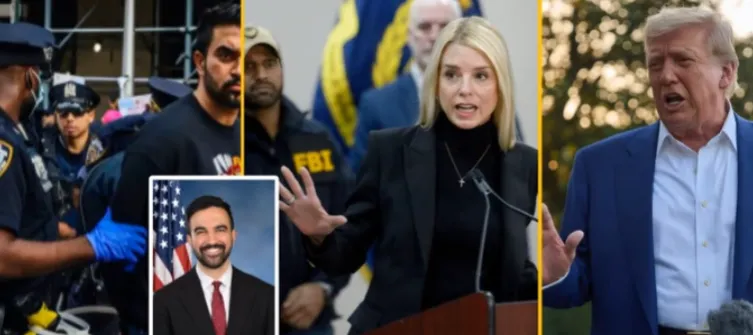
Sen. John Fetterman (D-Pa.) voiced support for U.S. Immigration and Customs Enforcement’s efforts to apprehend illegal immigrants accused of child sex offenses, while Rep. Anna Paulina Luna (R-Fla.) called for those individuals to face the death penalty.In a Monday press release, ICE noted that it “arrested 214 illegal aliens for immigration offenses in the Houston area in the past six months who have been charged or convicted of a sex offense involving a minor.”Fetterman noted in an X post: “I don’t support or agree with all of ICE’s tactics or actions. I do fully support moves like these. This makes our nation more secure and all our children safer.
In response to the news about the ICE arrests, Luna said in a post on X, “Skip deportation. Go directly to the death penalty. Do not pass go. Do not collect $200.”
According to the ICE media statement, one of the individuals arrested was “Jose Guadalupe Meza, a 40-year-old, four-time deported criminal alien from Mexico who was arrested June 24 and has been convicted of theft and sexual assault of a child. ICE removed Guadalupe Meza to Mexico June 25.
The news comes as the Trump administration intensifies its crackdown on border security and immigration enforcement.
Fetterman has previously voiced support for ICE’s efforts, calling proposals to abolish the agency both “inappropriate” and “outrageous.”
But that said, Fetterman joined the rest of his Democratic Party in opposing the “Big, Beautiful Bill” that provides tens of billions more in funding for ICE and its operations. Included in the legislation was additional money to finally finish the border wall that President Donald Trump started during his first term.
“Bringing together the resources and expertise of the entire federal law enforcement community to confront the overwhelming surge of illegal immigration that we saw over the past four years has resulted in the arrest and removal of historic numbers of violent criminal aliens, transnational gang members and child sex offenders,” said ICE Enforcement and Removal Operations Houston acting field office director Paul McBride, as noted in the release.
Meanwhile, Department of Homeland Security Secretary Kristi Noem, who also oversees ICE, came under fire from local Texas officials following the deadly floods in the state over the July 4 holiday.
Kerrville officials were mostly unprepared for the disastrous floods that hit the Hill Country, according to recently made public city correspondence, including emails and text messages that KSAT obtained through public records requests.
Among the records is a text discussion in which Dalton Rice, the city manager of Kerrville, seems to make fun of Noem.
Hours before a July 5 press conference, held alongside federal, state, and local officials to update the public on rescue efforts, a city employee texted Rice, “Just saw you met Homeland Barbie. How is she?”
Rice replied, “Basically Homeland Barbie,” followed by a string of laughter.
Since Noem was appointed DHS Secretary earlier this year, the nickname and other similar titles, such as “ICE Barbie,” have been used online to mock her.
Given the seriousness of the catastrophe response and mounting criticism of its handling, the exchange has drawn attention.
Democrats, especially, have been critical of the response, which isn’t surprising. Connecticut Sen. Chris Murphy, one of the most partisan left-wing Democrats in the chamber, claimed the Trump administration undermined FEMA’s preparedness by firing FEMA employees while flood victims were actively phoning the agency for assistance, but he did not explicitly blame Noem for the flooding itself.
Earlier this month, Noem refuted claims of delay by defending the federal reaction in an interview on Fox News Sunday.
After speaking with Texas officials, she said, within hours, more than 700 FEMA employees were on the ground. She added that the Coast Guard was sent out right away after that discussion.
NEW YORK – Following a recent electoral victory in New York City, progressive candidate Zohran Mamdani delivered a high-energy acceptance speech that immediately drew sharp criticism, even from within the Democratic sphere. The speech, marked by a confrontational tone and explicit socialist messaging, prompted political opponents and commentators to question the nature of his political ambitions and the future direction of New York City politics.
The central point of contention focused on a perceived “character switch” in Mamdani’s demeanor compared to his campaign trail appearances, along with specific policy pronouncements that quickly became targets for conservative critique.
Mamdani’s speech was noted for its aggressive delivery and direct challenges to prominent national figures, particularly President Donald Trump.
In one highly publicized segment, Mamdani addressed Mr. Trump directly, stating:
“So, Donald Trump, since I know you’re watching, I have four words for you… to get to any of us, you will have to get through all of us.”
Beyond the confrontational rhetoric, Mamdani offered a clear ideological vision for the city, framed in terms of class and power dynamics:
“We will hold bad landlords to account because the Donald Trumps of our city have grown far too comfortable taking advantage of their tenants.”
He further emphasized the city’s identity as a home for non-natives:
“New York will remain a city of immigrants. A city built by immigrants, powered by immigrants, and as of tonight, led by an immigrant.”
Mamdani also explicitly voiced his commitment to a political philosophy that views governmental intervention as paramount:
“No problem too large for government to solve or too small [to be] important.”
Finally, he issued a direct challenge to federal immigration authority, promising to “completely block ICE [Immigration and Customs Enforcement] for operating the city,” and vowing not to allow ICE to arrest criminal aliens in New York City.
Mamdani’s speech triggered immediate and strong reactions, with analysts focusing on the potential real-world impact of his stated agenda.
Commentators argued that Mamdani’s rhetoric, which included quoting historical socialist figure Eugene Debs, confirmed an allegiance to democratic socialism rather than mainstream Democratic principles. Critics quickly translated his core philosophy—that government should be involved in solving all problems—into significant economic warnings.
Conservative analysts contended that this ideology would necessitate sweeping tax increases, arguing that this would cause businesses and job creators to “flee as quickly as they possibly can,” ultimately making the city less economically viable for residents.
Mamdani also proposed the extreme idea of the city government taking over grocery stores and controlling food access, a measure critics labeled as an “asinine, lunatic, insane idea” that centralizes control over essential services.
The candidate’s promise to defy ICE and block the arrest of criminal aliens was swiftly addressed by President Donald Trump, who suggested such defiance would invite federal scrutiny and potentially lead to the withholding of federal funds.
Trump stated that Mamdani “has to be a little bit respectful of Washington, because if he’s not, he doesn’t have a chance of succeeding. And I want to make the city succeed.” He implied that federal funding to New York City is already disproportionately high compared to states like Florida, and cooperation is necessary for success. Trump openly suggested that Mamdani should “reach out” to the federal government rather than taking a confrontational stance.
CNN analyst Van Jones summarized the discomfort among many Democrats, stating that the “warm, open, embracing guy” seen during the campaign was “not present in that speech.” Jones warned that Mamdani missed an opportunity to “open up and bring more people into the tent,” fearing that the sharp tone would cost him future political capital.
Jones’s reaction underscores a common political dynamic where a candidate’s shift from inclusive campaigner to ideological warrior once power is secured can alienate potential allies and consolidate opposition.
Commentary surrounding Mamdani’s win also invoked recent political precedents in other major US cities that have elected progressive leaders, only to face subsequent political and social turmoil.
The video compared Mamdani’s victory to the elections of progressive leaders in Chicago, citing former Mayor Lori Lightfoot and current Mayor Brandon Johnson. Critics argued that in both cases, the election of progressive candidates ultimately led to disappointment, with the city experiencing increased crime, high costs of living, and an atmosphere that prompted many long-time residents to leave.
This historical reference serves as a caution that radical socialist agendas, despite promising utopia, often result in higher taxes, economic flight, and increasing urban challenges. Conservative voices explicitly warned that the same fate awaits New York City under a similar political direction, suggesting that voters may only learn that “socialism is not the way to go” after experiencing the negative consequences firsthand.
The prevailing message from Mamdani’s opponents is that his electoral victory, while securing a progressive seat, is a critical test of whether the explicitly socialist platform he advocates can govern a major global city without accelerating economic and social decline